Key Elements for the Design and Construction of Impermeable Geomembrane Liners
Blog · 2026-09-15 · 0 views
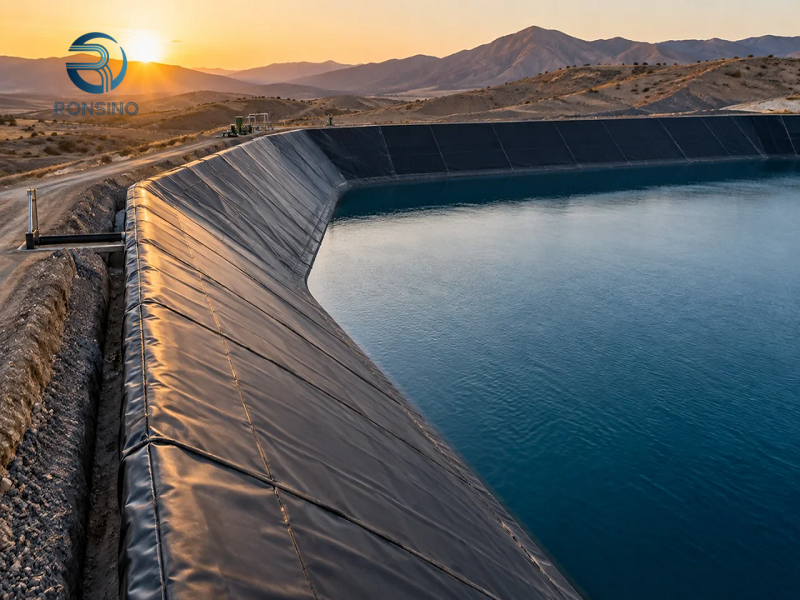
What is Key Factors in Geomembrane Liner System Design
The conceptual framework behind effective geosynthetic barrier infrastructure hinges profoundly upon assessing vital structural metrics foundational physicochemical traits alongside mandated operational benchmarks Meticulously analyzing then refining these dimensions is indispensable for securing enduring physical robustness superior fluid-holding efficiency plus strict adherence statutory guidelines governing various sequestration applications examples being municipal dumps extractive enterprises public storage basins heavy-industry complexes
It is an indispensable prerequisite for engineers, procurement managers and EPC contractors to have a deep understanding of the key elements of geomembrane anti-seepage system design. This is because every decisive decision in the design directly affects the operating performance, actual service life of the system and the economic benefits of the overall project. Therefore, this guide has constructed a comprehensive and detailed evaluation framework to help professionals deeply analyze and consider various core indicators in the field of geomembrane anti-seepage system design.
Technical Specifications: Key Design Factors
The following table defines the key technical factors in geomembrane liner system design.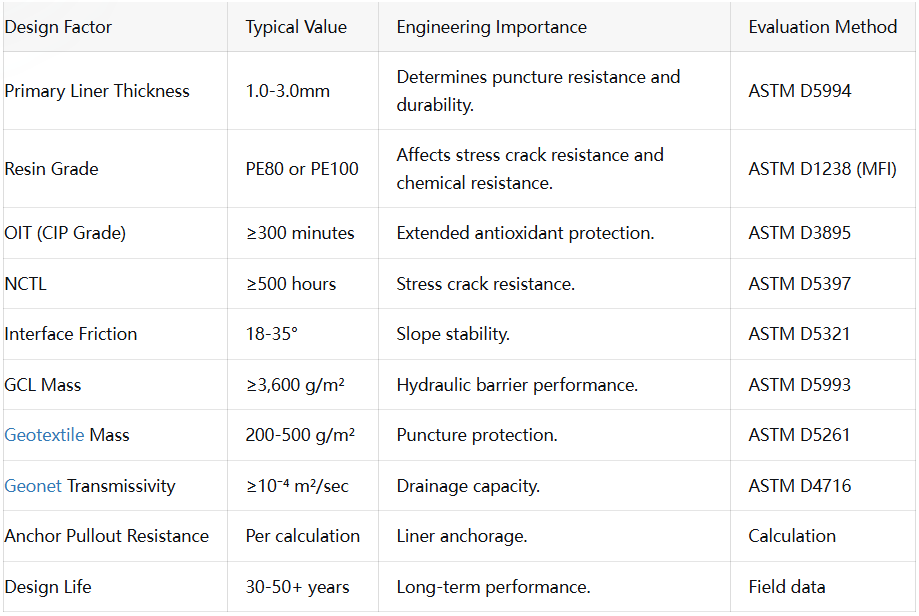
Key Design Factors by Category
Material Selection Factors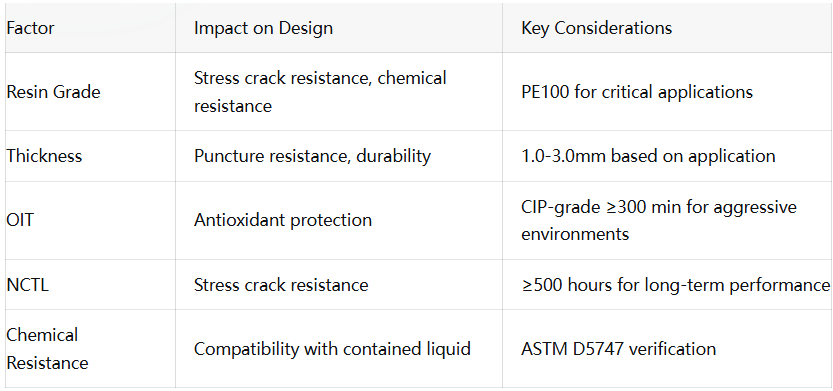
Geotechnical Factors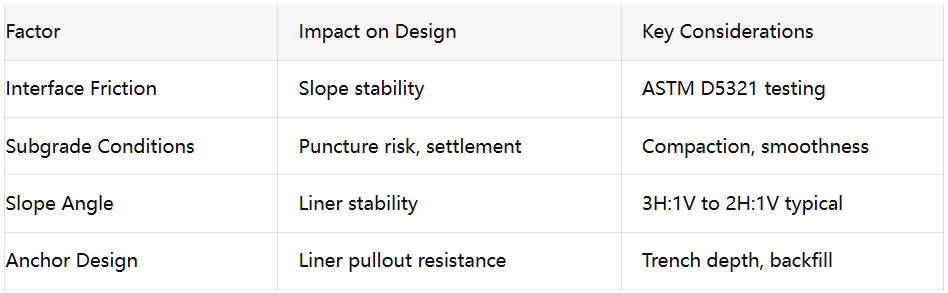
Hydraulic Factors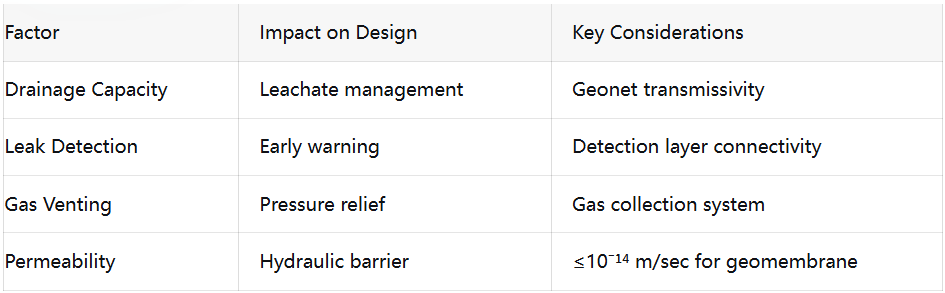
Material Selection Factors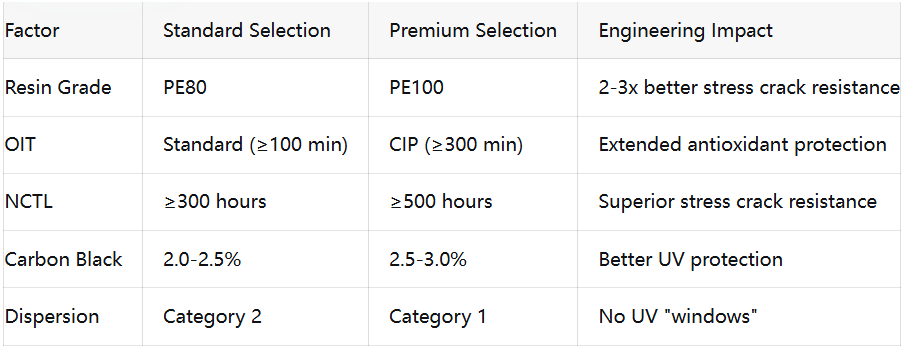
Common Design Factor Failures and Solutions
Problem 1: Inadequate Stress Crack Resistance
Root cause: PE80 resin or low NCTL. Design solution: PE100 resin, NCTL ≥500 hours.
Problem 2: Insufficient Interface Friction
Root cause: Interface friction not analyzed. Design solution: ASTM D5321 testing, textured geomembrane if needed.
Problem 3: Inadequate Anchor Design
Root cause: Trench too shallow or backfill inadequate. Design solution: Calculate pullout resistance.
Problem 4: Missing Design Components
Root cause: Incomplete system design. Design solution: Include all functional layers.
Risk Factors and Design Strategies
Material Selection Risk
Risk: Material not suitable for application. Prevention: Verify chemical compatibility. PE100 CIP-grade for critical applications.
Geotechnical Risk
Risk: Slope instability or anchor failure. Prevention: Interface friction testing. Proper anchor design.
Hydraulic Risk
Risk: Drainage failure or leak detection issues. Prevention: Verify transmissivity. Design detection system.
Regulatory Risk
Risk: Non-compliance with regulations. Prevention: GRI GM13 compliance. Regulatory verification.
Procurement Guide: How to Address Key Factors in Geomembrane Liner System Design
Step 1: Define Project Requirements
Define: application, chemistry, design life, regulatory requirements.
Step 2: Evaluate Material Factors
Evaluate: resin grade, thickness, OIT, NCTL, chemical resistance.
Step 3: Evaluate Geotechnical Factors
Evaluate: interface friction, subgrade conditions, slope angle, anchor design.
Step 4: Evaluate Hydraulic Factors
Evaluate: drainage capacity, leak detection, gas venting.
Step 5: Specify Complete System
Specify: all components with appropriate design factors.
Step 6: Verify Design Factors
Verify: test data, calculations, and compliance.
Step 7: Review and Approve
Review design with stakeholders. Obtain approvals.
Engineering Case Study: Design Factor Failure
Project type: Heap leach pad, 150,000m².
Location: South America.
Design factor failure: Inadequate interface friction analysis.
Failure: Liner system slid downslope.
Corrective action: Redesigned with proper interface friction analysis.
Cost impact: $2.5M remediation.
FAQ Section
Q1: What are key factors in geomembrane liner system design?
A: In order to guarantee the structural soundness and optimal operational efficiency of any infrastructure network, it is fundamentally necessary to thoroughly evaluate a suite of pivotal design criteria. These essential metrics encompass the intrinsic
Q2: What are the most important material factors?
A: Resin grade (PE100 preferred), thickness, OIT (CIP-grade ≥300 min), and NCTL (≥500 hours).
Q3: What are the most important geotechnical factors?
A: Interface friction, subgrade conditions, slope angle, and anchor design.
Q4: What are the most important hydraulic factors?
A: Drainage capacity, leak detection, and gas venting.
Q5: Why is interface friction important?
A: Low interface friction can cause the liner system to slide on slopes.
Q6: What is the factor of safety for slope stability?
A: 1.5 minimum based on interface friction angle analysis.
Q7: What is the design life of geomembrane liner systems?
A: 30-50+ years with proper design and material selection.
Q8: What is the most common design factor failure?
A: Inadequate interface friction analysis leading to slope instability.
Q9: What documentation is required for design factors?
A: Test data, calculations, specifications, drawings, and CQA plan.
Q10: What is the most important factor in liner system design?
A: Material selection and interface friction analysis. Both are critical for long-term performance.
Request Technical Support or Quotation
For engineering consultation on key factors in geomembrane liner system design for your specific project:
Request quotation: Submit project requirements for a complete design factor analysis.
Request samples: Obtain design templates and calculation tools.
Download technical specifications: Comprehensive package including key design factors guide.
Contact technical team: Our design specialists provide independent review.