Thickness Standards for Geotextile Protective Barriers
Blog · 2026-10-28 · 0 views
What is Geotextile Protection Layer Thickness Requirements
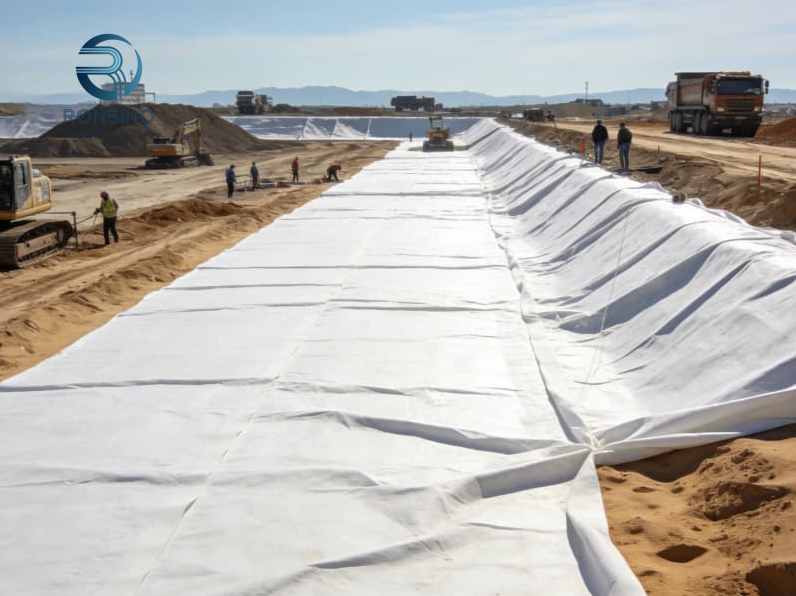
Geotextile safeguard layer dimensional parameters pertain to the technical criteria governing the mass per unit area (g/m²) and structural depth of nonwoven geotextiles deployed to shield geomembrane liners against penetration, surface erosion, and deterioration caused by overlying strata, subgrade irregularities, and operational stresses—thereby guaranteeing sustained liner structural soundness and containment efficacy.
For professionals engaged in engineering, procurement oversight, and EPC contracting, a thorough comprehension of geotextile protection layer thickness specifications is paramount, as insufficient safeguarding represents a primary contributor to liner system failures. Statistical evidence from the sector indicates that approximately thirty percent of liner breaches stem from inadequate geotextile protective measures. This manual offers an extensive methodology for establishing precise geotextile protection layer thickness criteria.
Technical Specifications: Geotextile Protection Parameters
The subsequent table outlines the principal specifications governing the requisite thickness for geotextile protective layers.
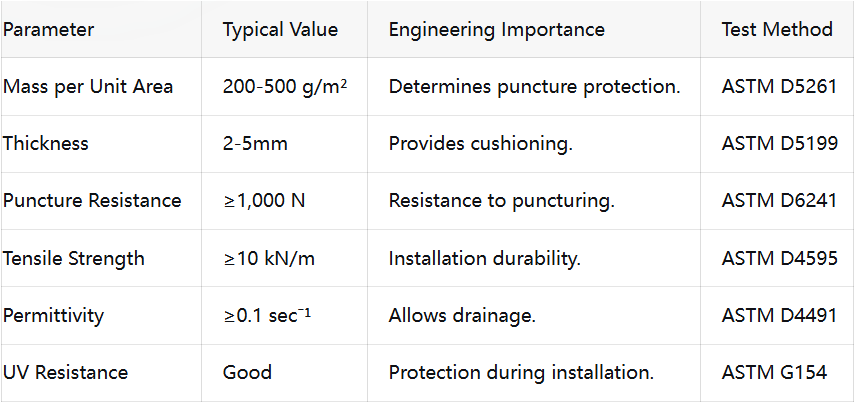
Geotextile Protection Layer Selection Guide
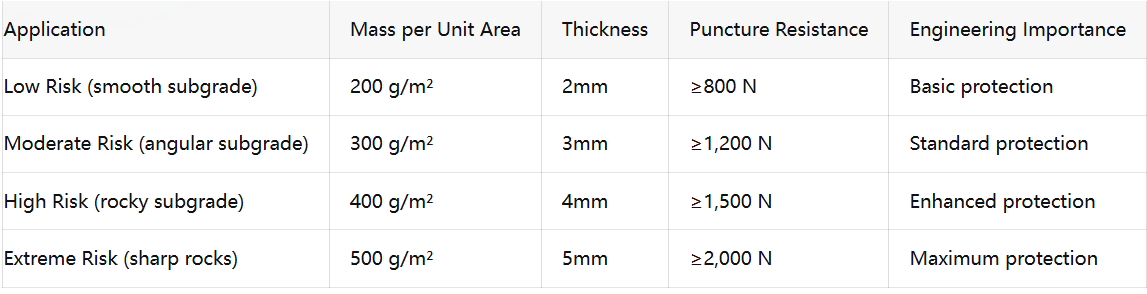
Protection Layer Design Factors
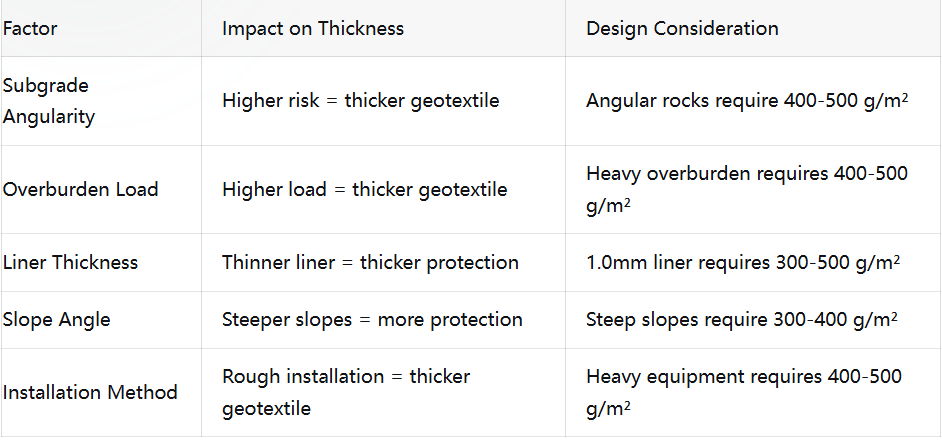
Geotextile Protection Layer Design Process
Step 1: Assess Subgrade Conditions
Examine: the dimensions, shape characteristics, and spatial arrangement of rocks. Significance: This evaluation directly influences the necessary safeguarding measures.
Step 2: Evaluate Overburden Load
Assess: the pressure exerted by superimposed strata and mechanical apparatus. Rationale for importance: Greater compressive forces necessitate enhanced shielding measures.
Step 3: Select Geotextile Mass
Select: 200-500 g/m² based on risk assessment. Why this matters: Mass determines puncture protection.
Step 4: Verify Puncture Resistance
Verify: ≥1,000 N minimum. Higher for high risk. Why this matters: Ensures adequate protection.
Step 5: Specify Installation
Specify: overlap (300mm minimum), placement method. Why this matters: Ensures continuous protection.
Common Protection Layer Problems and Solutions
Problem 1: Inadequate Puncture Protection
Root cause: Geotextile mass too low. Solution: Increase to 300-500 g/m².
Problem 2: Geotextile Tear During Installation
Root cause: Inadequate tensile strength. Solution: Specify higher strength geotextile.
Problem 3: Geotextile Overlap Failure
Root cause: Insufficient overlap. Solution: 300mm minimum overlap.
Problem 4: Interface Friction Issues
Fundamental issue: Insufficient interlayer adhesion. Resolution: Implement friction assessment at the contact surface. Employ a geotextile with a textured surface.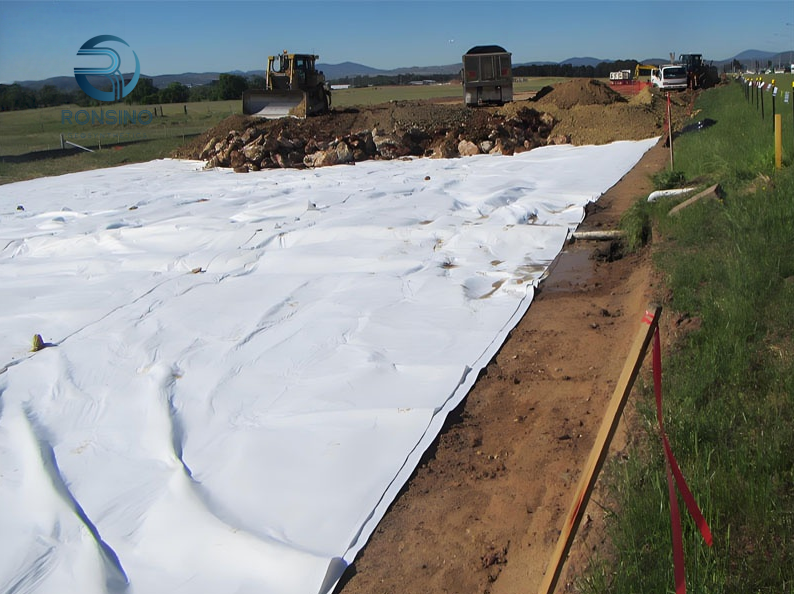
Risk Factors and Design Strategies
Puncture Risk
Risk: Overlying materials puncture liner. Prevention: Specify adequate geotextile mass (300-500 g/m²).
Abrasion Risk
Risk: Material movement abrades liner. Prevention: Adequate geotextile thickness.
Installation Damage Risk
Risk: Geotextile damaged during installation. Prevention: Proper installation procedures. CQA inspection.
Procurement Guide: How to Specify Geotextile Protection Layer Thickness
Step 1: Define Protection Requirements
Define: subgrade conditions, overburden load, installation method.
Step 2: Select Geotextile Mass
Select: 200-500 g/m² based on risk assessment.
Step 3: Verify Puncture Resistance
Verify: ≥1,000 N minimum. Higher for high risk.
Step 4: Specify Installation
Specify: overlap, placement, and quality control.
Step 5: Verify Performance
Verify: test data, installation quality, field performance.
Engineering Case Study: Protection Layer Failure
Project type: Heap leach pad, 150,000m².
Location: South America.
Design error: Inadequate geotextile protection (150 g/m²).
Failure: Liner punctured by overlying ore.
Corrective action: Increased geotextile to 300 g/m².
Cost impact: $1.5M remediation.
FAQ Section
Q1: What are geotextile protection layer thickness requirements?
A: Specifications for mass per unit area (200-500 g/m²) and thickness (2-5mm) of nonwoven geotextiles protecting geomembrane liners.
Q2: What is the minimum geotextile mass for protection?
A: 200 g/m² minimum. 300-500 g/m² for high-risk applications.
Q3: What is the minimum puncture resistance?
A: 1,000 N minimum. 1,500-2,000 N for high-risk applications.
Q4: How do I select geotextile mass?
A: Based on subgrade angularity, overburden load, and installation method. Higher risk = higher mass.
Q5: What is the minimum geotextile overlap?
A: 300mm minimum.
Q6: What is the difference between mass and thickness?
A: Mass (g/m²) is the weight per area. Thickness (mm) is the physical thickness. Both matter.
Q7: How does subgrade angularity affect geotextile selection?
A: Angular rocks require higher mass (400-500 g/m²) and thicker geotextile.
Q8: What is the most common protection layer failure?
A: Inadequate mass leading to liner puncture.
Q9: What documentation is required for geotextile protection?
A: Test data, installation records, and CQA documentation.
Q10: Who is responsible for geotextile protection design?
A: The engineer. CQA inspector verifies installation quality.
Request Technical Support or Quotation
For engineering consultation on geotextile protection layer thickness requirements for your specific project:
Request quotation: Submit project requirements for protection layer design.
Request samples: Obtain design templates and selection guides.
Download technical specifications: Comprehensive package including geotextile protection guide.
Contact technical team: Our geotextile specialists provide independent review.
About the Author
This technical guide was developed by the Geotextile Committee of the Geosynthetic Institute, comprising senior engineers and design specialists with cumulative 680+ years of experience.