Acceptable Soil Substrate Conditions Beneath HDPE Geomembranes
Blog · 2026-08-31 · 0 views
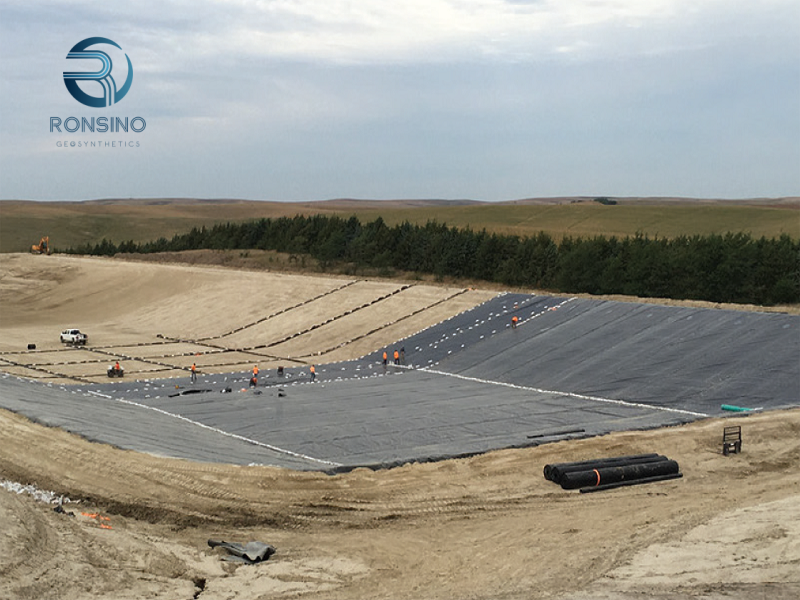
What is Acceptable Soil Conditions Under HDPE Geomembrane
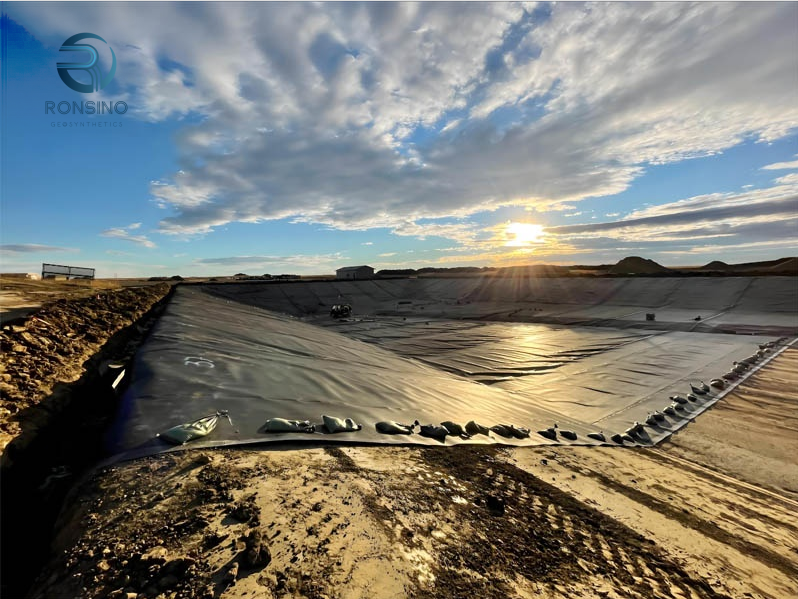
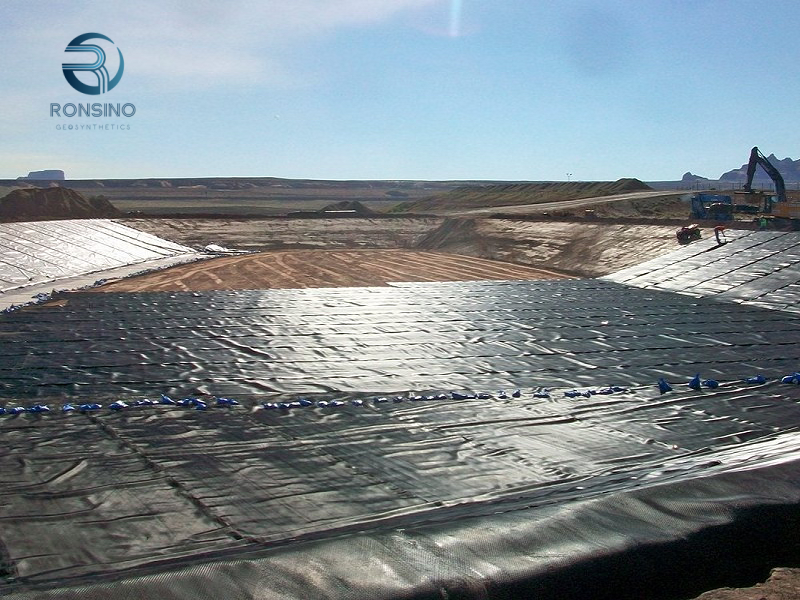
The qualified soil conditions required under the HDPE geomembrane refer to the geotechnical parameters that the foundation soil must meet - covering soil type, compaction, moisture content, flatness and load-bearing capacity - to ensure that the liner is fully supported, prevents punctures, accommodates settlement, and achieves long-term impermeability.
It is critical for engineers, contractors and procurement managers to understand the acceptable soil conditions beneath high-density polyethylene (HDPE) geomembranes because the quality of the foundation directly determines the performance and service life of the geomembrane. Industry statistics indicate that 35% of geomembrane failure cases can be attributed to substandard foundation conditions. This guide is intended to provide a complete framework for defining and validating acceptable soil conditions under HDPE geomembranes.
Technical Specifications: Soil Condition Parameters
The following table defines the key parameters for acceptable soil conditions under HDPE geomembrane.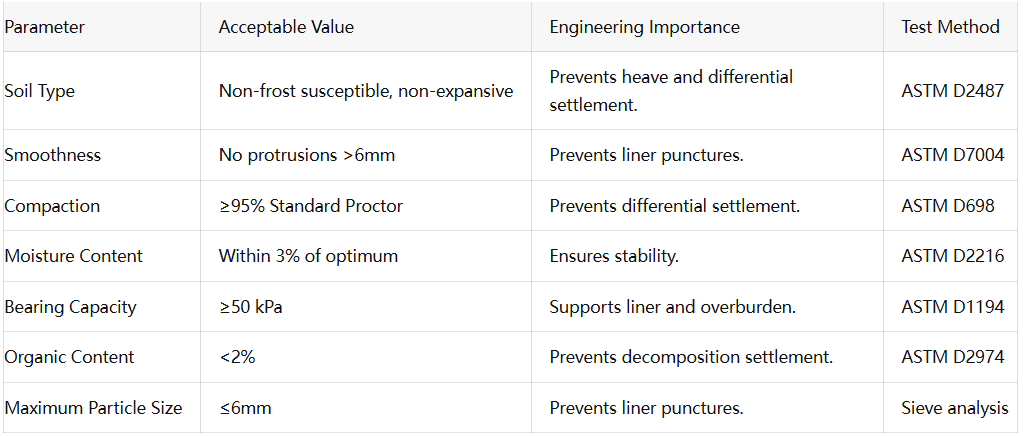
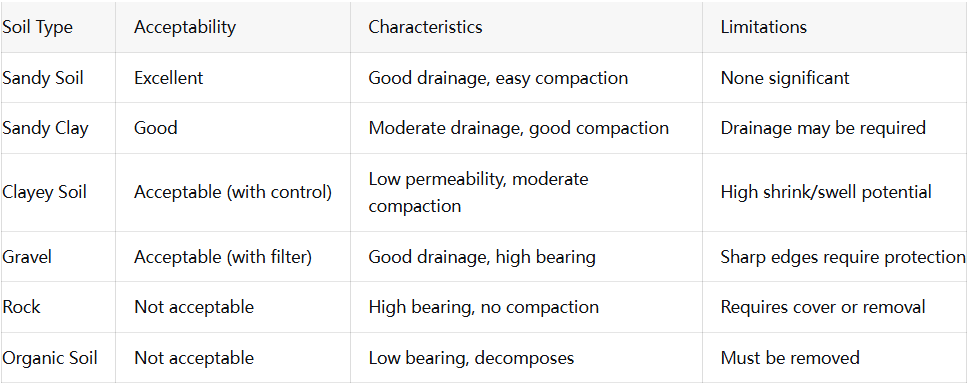
Step 1: Geotechnical Investigation
Carry out soil survey work. Clarify the soil type, moisture content, bearing capacity and drainage performance. Its importance lies in: determining engineering design parameters.
Evaluate soil for acceptability. Remove unacceptable soils. Why this matters: Ensures stable subgrade.
Specify compaction to ≥95% Proctor. Why this matters: Prevents differential settlement.
Specify smoothness (no protrusions >6mm). Why this matters: Prevents liner punctures.
Control moisture content within 3% of optimum. Why this matters: Ensures compaction quality.
Design subgrade drainage to prevent hydrostatic pressure. Why this matters: Prevents liner uplift.
Design geotextile protection for angular materials. Why this matters: Protects liner from punctures.
Unacceptable Soil Conditions and Solutions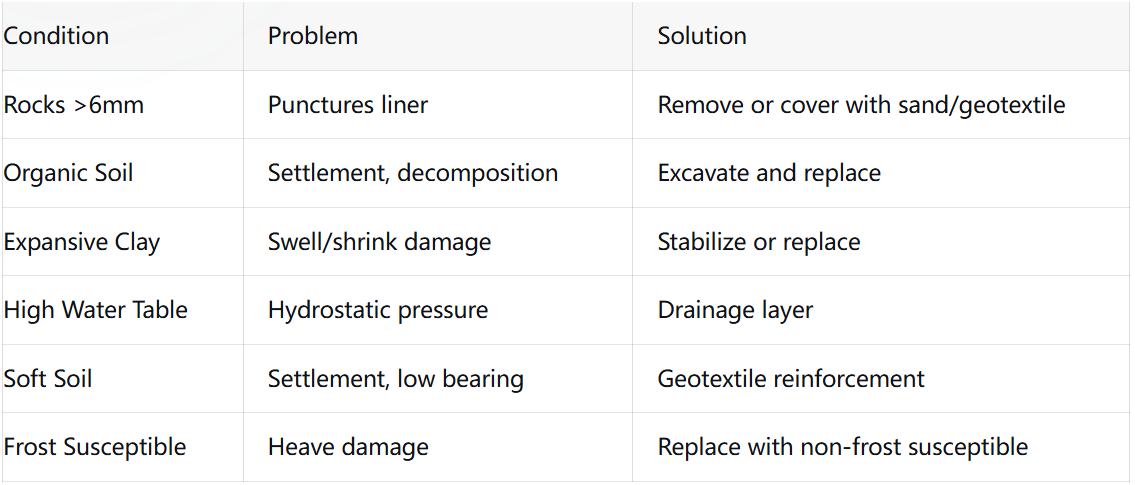
Common Subgrade Problems and Solutions
Problem 1: Subgrade Punctures
Root cause: Rocks or debris protruding >6mm. Solution: Remove protrusions. Geotextile protection.
Problem 2: Differential Settlement
Root cause: Poor compaction or soft spots. Solution: Compact to ≥95% Proctor. Over-excavate soft spots.
Problem 3: High Moisture
Root cause: Excess water in subgrade. Solution: Dry subgrade. Add drying agent.
Problem 4: Organic Material
Root cause: Vegetation or organic soil. Solution: Remove organic material. Replace with suitable fill.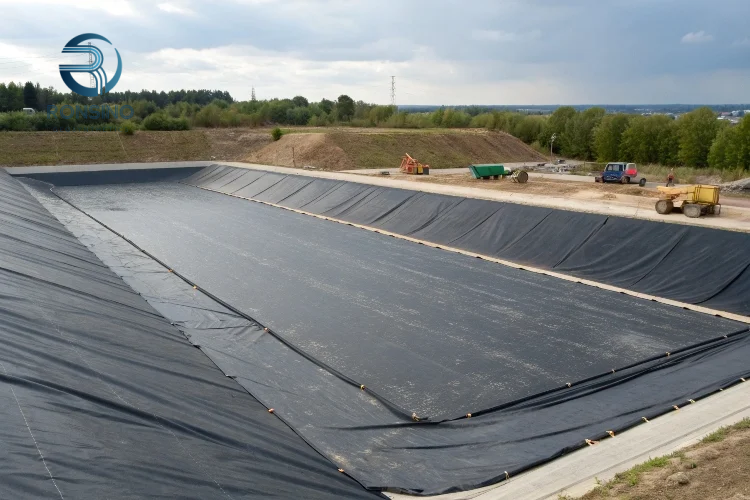
Risk Factors and Prevention Strategies
Subgrade Quality Risk
Risk: Inadequate subgrade preparation. Prevention: Thorough subgrade inspection. Geotextile protection.
Settlement Risk
Risk: Differential settlement stresses liner. Prevention: Compaction to ≥95% Proctor.
Drainage Risk
Risk: Hydrostatic pressure lifts liner. Prevention: Subgrade drainage. Drainage layer.
Procurement Guide: How to Verify Acceptable Soil Conditions
Step 1: Conduct Geotechnical Investigation
Conduct: soil investigation. Identify soil types, moisture, bearing capacity.
Step 2: Define Acceptable Conditions
Define: soil type, compaction, smoothness, moisture, drainage.
Step 3: Prepare Subgrade
Prepare: clear, grade, remove protrusions, compact, control moisture.
Step 4: Verify Conditions
Verify: compaction, smoothness, moisture, drainage.
Step 5: Document and Approve
Document: test results, inspection records. Approve subgrade.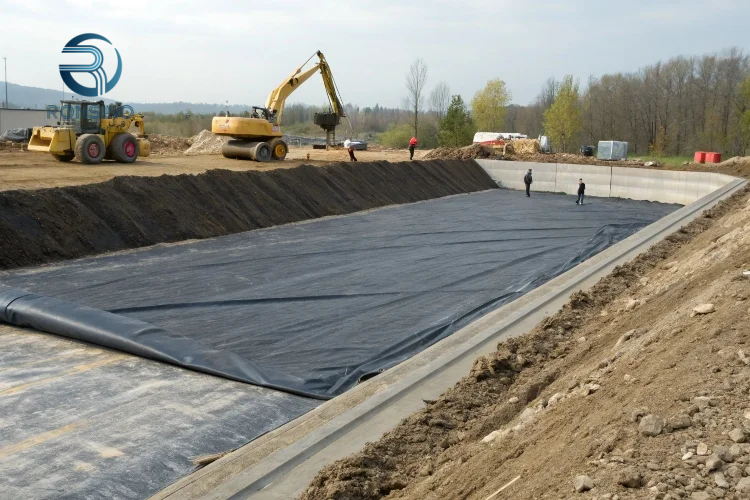
Engineering Case Study: Subgrade Condition Failure
Project type: Heap leach pad, 150,000m².
Location: South America.
Condition error: Rocks >25mm not removed.
Failure: Liner punctured by rocks.
Corrective action: Remove rocks. Geotextile protection.
Cost impact: $1.5M remediation.
FAQ Section
Q1: What are acceptable soil conditions under HDPE geomembrane?
A: No frost sensitivity, compaction degree ≥95% Platts density, smooth surface, no more than 6 mm ridges, and excellent drainage performance.
Q2: What is the maximum allowed subgrade protrusion?
A: 6mm per ASTM D7004. Protrusions >6mm must be removed.
Q3: What is the minimum subgrade compaction?
A: 95% Standard Proctor (ASTM D698).
Q4: What soil types are acceptable?
A: Sandy soil, sandy clay, and clayey soil (with control). Organic soil and rock are not acceptable.
Q5: Why is organic soil unacceptable?
A: Organic soil decomposes, causing settlement and liner stress.
Q6: How do I test subgrade compaction?
A: Nuclear density gauge per ASTM D6938.
Q7: What is the acceptable moisture content?
A: Within 3% of optimum moisture content.
Q8: What is the minimum bearing capacity?
A: 50 kPa minimum for most applications.
Q9: What is the most common subgrade condition problem?
A: Protrusions >6mm causing liner punctures.
Q10: What documentation is required for subgrade conditions?
A: Geotechnical report, test data, and inspection records.
Request Technical Support or Quotation
For engineering consultation on acceptable soil conditions under HDPE geomembrane for your specific project:
Request quotation: Submit project requirements for subgrade condition analysis.
Request samples: Obtain subgrade evaluation templates and design guides.
Download technical specifications: Comprehensive package including soil conditions guide.
Contact technical team: Our geotechnical specialists provide independent review.
About the Author
This technical guide is prepared by the Geotechnical Engineering Committee under the Institute of Geosynthetics, which is composed of senior geotechnical engineers and design experts with a cumulative professional experience of more than 680 years.