Composite Geonet for Highway Construction in America
CASE · 2025-10-10 · 0 views
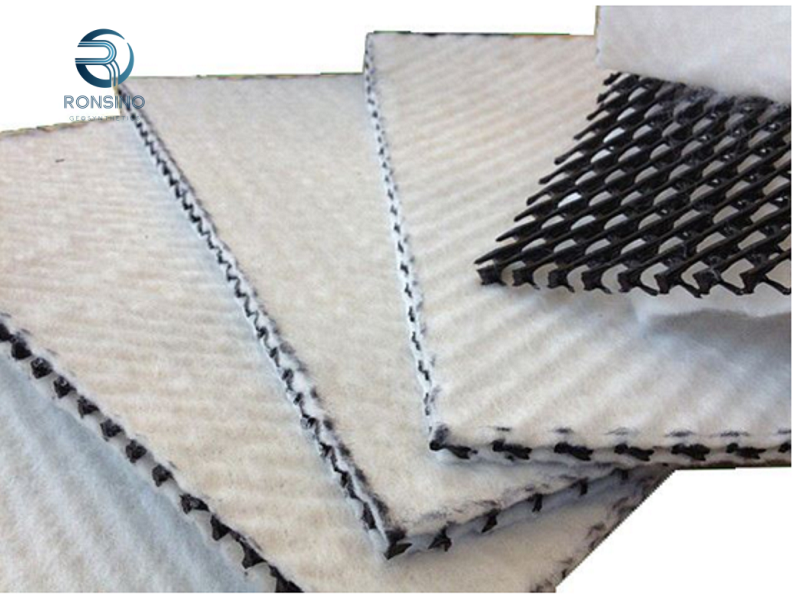
Composite Geonet, also known as Composite Drainage Board, is a professional material composed of a three-dimensional plastic grid core material with permeable geotextiles adhered to both sides. Its innovative design can replace traditional gravel layers and is widely used in drainage projects for infrastructure such as railways, highways, tunnels, municipal projects, reservoirs and slope reinforcement. The core characteristics of this material include: excellent drainage capacity, high strength, and a unique structure that effectively reduces the risk of geotextile clogging and ensures long-term stable drainage. At the same time, it has excellent pressure resistance and can withstand continuous high-pressure loads up to about 3000 kPa.
Moisture infiltration into the pavement is the main cause of deterioration and aging of the asphalt layer. The dynamic hydraulic pressure generated by vehicle tires on slippery roads will wash away the roadbed, and the pressure increases exponentially with vehicle speed, exacerbating the risk of disintegration. Excess moisture will shorten the life of the pavement and once it penetrates into the base saturated soil, the structural integrity of the pavement will be compromised no matter how thick it is, ultimately leading to foundation failure and pavement collapse.
Internal pavement drainage systems are designed to quickly drain accumulated water from the pavement and subgrade, thereby improving road functionality and extending service life. Perfect drainage design can extend the road life to 2-3 times that of non-drainage roads. The use of geocomposite drainage nets can effectively solve drainage problems. Its seamless and continuous installation not only allows efficient drainage, but also reduces the thickness of the base or subbase, improves load-bearing capacity and prevents differential settlement.
The United States is situated in close proximity to the equatorial region, resulting in a predominantly tropical rainforest and tropical monsoon climatic pattern, with minimal seasonal variation. Throughout the year, the mean temperature consistently falls within the range of 26℃ to 30℃. Precipitation is abundant and evenly distributed, though the wettest periods typically span from March to June and again from October to the following February. These climatic conditions present significant challenges for the development of highway infrastructure, imposing stringent demands on construction techniques, particularly in the design and implementation of effective drainage systems.
After an American contractor learned about the successful application cases of composite geonets through our platform, he contacted the sales representative to inquire about product details. The customer highlighted strict standards for tensile strength, hydraulic conductivity and load-bearing capacity and requested samples, technical documentation and installation instructions. We sent samples to a third-party laboratory for testing, and the results exceeded customer expectations. Subsequently, the customer ordered 60,000 square meters of this product, which was successfully used in the first phase of its key road project.
Characteristics of Composite Geonet
1.Under a pressure of 720kPa and a gradient of 2%, the hydraulic conductivity of the material is 2500m/d and the fluid migration rate is 13pm/m.
2.Continuous deformation analysis shows that the sample still maintains more than 60% of the original structural thickness after 10,000 hours under 1200kPa stress.
3.Three-rib filter media contains carbon black ≥ 2%, density 0.94g/cm³, minimum tensile force 36.5kN/m, melt index 1.0g/10min, thickness 7.6mm.
4.The effective pore diameter of non-woven geotextile is 0.18mm, the dielectric constant is 0.26Sec⁻¹, the permeability coefficient is 0.2cm/sec, the puncture strength is 580N, the trapezoidal tear strength is 356N, the tensile strength is 900N, the elongation at break is 50%, and the burst pressure resistance is 2750kPa.
Specifications of Composite Geonet for Highway Construction in America
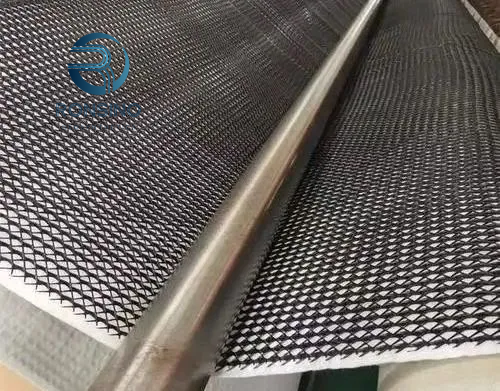
Composite Drainage net – 2 Layers 200g/m2 Filament Geotextile + 7mm Net
Total Quantity – 60000 Square meters
Each roll Size –2m*50m
Standard – ASTM standard
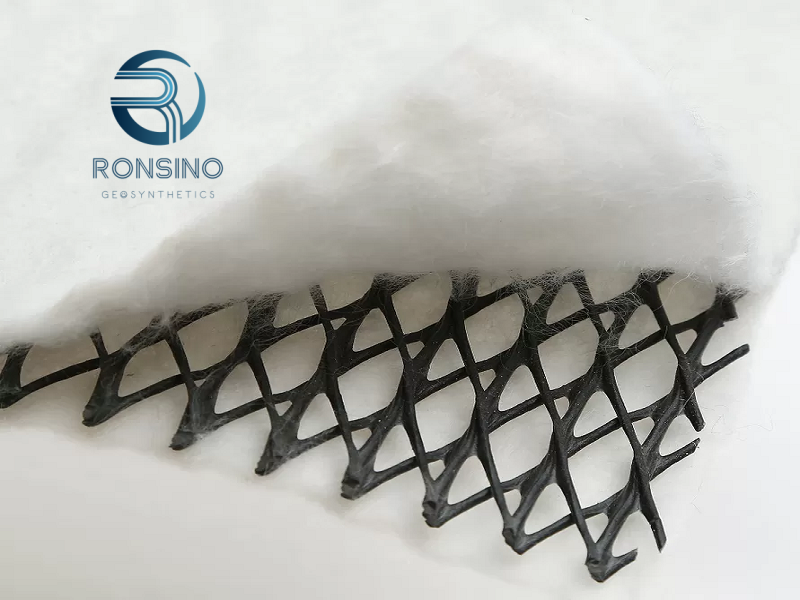
The main function of Composite Geonet.
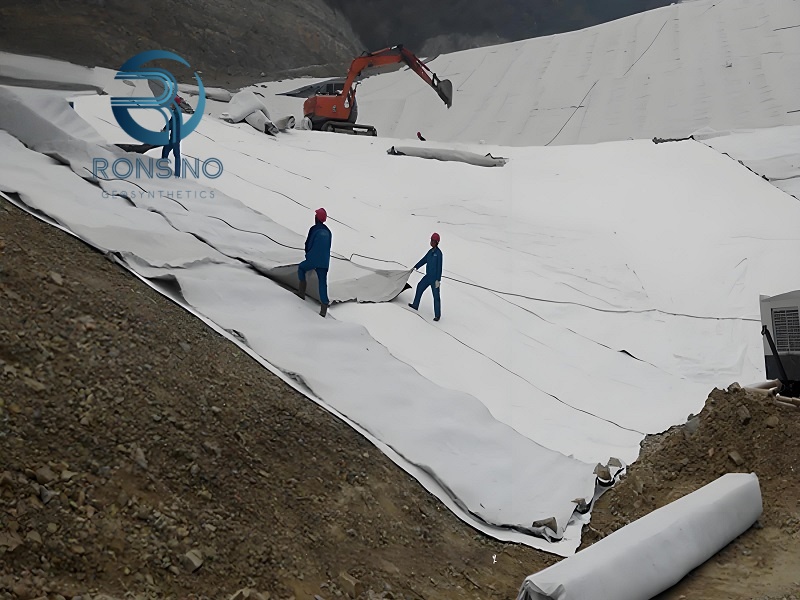
Drainage function: This system is installed at the base, which can quickly drain the accumulated water between the backfill soil and the foundation, and block the intrusion of capillary water. Its design shortens the drainage path and accelerates water discharge, thereby effectively reducing the risk of slope soil liquefaction and enhancing slope stability. When combined with geotextile, it can effectively intercept rainwater or leachate under the anti-seepage layer and guide it away through the designated geosynthetic interlayer, while preventing sedimentation.
Isolation performance: The built-in geotextile can effectively block the mixing of backfill soil and original foundation soil.
Filtration Function: Geotextiles prevent fine particles from intruding into the core drainage area, ensuring that the system maintains efficient drainage capabilities over the long term.
About RONSINO
RONSINO has been specializing in delivering one stop geosynthetics products and solutions to worldwide customers since its foundation in 2007. RONSINO had provided many types of effective and state of the art geomembranes, geotextiles, geocells, geosynthetic clay liners (GCLs), drainage boards, geogrids to over 81 countries. Our main customers are from Australia, France, Sweden, UK, Hong Kong, Hungary, New Zealand, Poland, Mexico, Ecuador, Brazil, Pakistan, Bangladesh, Thailand, Vietnam, America, Indonesia, Singapore, Philippines, Sri Lanka, India, UAE, Saudi Arabia, Qatar, Kenya, Ghana, Ethiopia, Somalia, Nigeria, South Africa, Swaziland, Mongolia, etc.
RONSINO is not only manufacturing best quality geosynthetic products but also providing professional design and installation service. OEM, ODM, custom development and fabrication are also available.