
HDPE Cheap Pond Liner for Heap Leaching Project in Canada
CASE · 2025-11-21 · 0 views
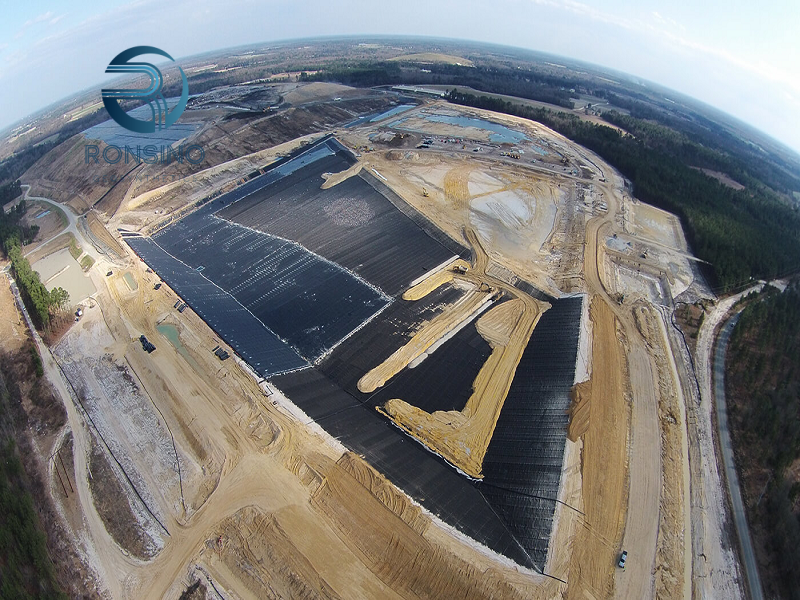
The mining sector is widely acknowledged as the global’s foremost generator of solid waste, with waste rock and tailings being its two predominant waste categories. Membrane liners perform a dual function: they contain the chemical solvents utilized for dissolving minerals from ore, while also enabling the efficient collection of leachate.
A prime example of such a liner is the 2mm plastic geotechnical membrane—a widely applied HDPE product crafted from high-density polyethylene through three-layer co-extrusion and blown film techniques. This membrane is formulated with carbon black, antioxidants, anti-aging additives and UV inhibitors, endowing it with exceptional chemical stability, UV resistance, impermeability, high tensile yield strength and robust weld integrity. Owing to these superior attributes, HDPE liners have become a staple selection for lining systems in diverse civil engineering undertakings.
The Advantagesof Plastic Geotechnical Membrane are Numerous and Include
1.Chemical Stability: HDPE geotechnical membrane boasts exceptional chemical inertness, delivering strong resistance to corrosion from a broad spectrum of chemical substances. This makes it ideal for deployment in sewage treatment facilities, chemical reaction tanks, and sanitary landfills.
2.Aging Resistance: Featuring outstanding anti-aging, UV-resistant, and anti-degradation properties, HDPE geotechnical membrane performs reliably in exposed outdoor settings, with a designed service life spanning 50 to 70 years.
3.Root Penetration Resistance: With superior puncture-proof performance, this geomembrane can block intrusion from most plant root systems, suiting it perfectly for landscaping and related greening projects.
4.High Mechanical Strength: HDPE geotechnical membrane features favorable mechanical properties, with a tensile strength at break of 28MPa and an elongation at break of 700%.
5.Cost-Efficiency: This geomembrane offers remarkable cost advantages, supported by an optimized and efficient production process. Its manufacturing cost is lower than that of conventional waterproofing materials, cutting overall project expenses by roughly 50%.
6.Rapid Construction: Boasting high flexibility and diverse specifications with multiple laying modes, HDPE geotechnical membrane meets the anti-seepage demands of various engineering scenarios, enabling simple and efficient on-site installation.
7.Eco-Friendly & Non-Toxic: Non-toxic and environmentally safe, HDPE geotechnical membrane achieves impermeability through ordinary physical changes without releasing any hazardous substances. It is a premium option for environmental protection projects, aquaculture sites, and drinking water reservoirs.
8.Superior Weldability: Compatible with specialized geomembrane welding equipment, HDPE geotechnical membrane achieves high-quality welded joints. The weld strength exceeds that of the base material, streamlining construction operations.
9. High Tensile Strength & Elasticity: HDPE anti-seepage lining offers excellent tensile strength and exceptional ductility, enabling it to adapt to uneven foundation settlement and accommodate structural expansion or contraction.
Case Study
Destination: Canada
Product: 2mm plastic geotechnical membrane
Purpose: Heap Leaching Project
Issue
A Canadian client discovered our enterprise via Google Search. Subsequent communications revealed that the client is overseeing a copper mining project situated in central Canada. This initiative employs a hydrometallurgical approach, integrating heap leaching and electrowinning techniques to manufacture cathode copper.
As the designated area for ore stacking, heap leaching pads require adequate load-bearing capacity. Simultaneously, their foundational layers must be equipped with superior anti-seepage performance. This dual requirement serves to avoid the infiltration of leachate into the subsurface—thereby preventing contamination of soil and groundwater resources—and to enable effective collection of the leaching solution.
Within the hydrometallurgical heap leaching process for copper extraction, the anti-seepage system acts as a critical component. It fulfills two vital functions: not only does it block acidic, heavy metal-laden solutions from seeping underground and contaminating groundwater supplies, but it also facilitates the efficient recovery of leachate for subsequent processing.
Solution
Once we had a clear grasp of the client’s project requirements, we proposed a 2mm plastic geomembrane for their copper ore heap leaching pad project.
Among all polyethylene-based materials, HDPE plastic geomembranes feature the highest density, with a range of 0.940 to 0.965 g/cm³, and they differ substantially in performance from standard polyethylene products. These geomembranes are endowed with outstanding mechanical strength, heat resistance, and desirable elasticity. As their thickness goes up, their breaking strength, yield strength, tear resistance, and puncture resistance all show a gradual increase.
In terms of key technical specifications, HDPE plastic geomembranes can attain a tensile strength of 22–45 MPa, an elongation at break of 200%–900%, and a melting temperature spanning 126°C to 136°C. What is more, the permeability coefficient K of HDPE geomembranes is below 10⁻¹³ cm/s, making their impermeability far superior to that of other anti-seepage materials available.
We furnished the client with samples of the 2mm plastic geomembrane that meets the GRI GM13 standard. After thorough testing, the client was highly satisfied with all performance indicators, and we promptly entered into an order agreement with them.
Specification of HDPE Cheap Pond Liner for Heap Leaching Project in Canada
Geotechnical membrane thickness: 2mm
Total Quantity: 530,000 square meters
Each roll Size: 7m*100m
Standard: ASTM GM13 standard
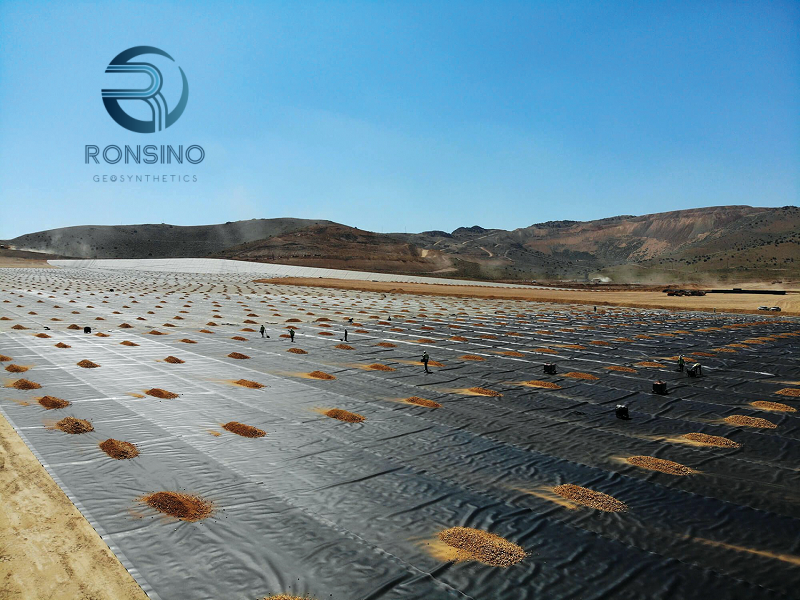
Installation of HDPE Plastic Geotechnical Membrane
1. Base Surface Requirements for Geomembrane Installation
The installation base for geomembrane construction must be fully compacted and leveled to meet construction standards. All sharp debris, including tree roots, stones, glass fragments, and iron nails, shall be completely removed from the base surface. All internal and external corners of the base shall be trimmed into rounded arcs with a fillet radius of no less than 50cm, and the surfaces intended for welding seams must be thoroughly cleaned. Geomembrane construction may only commence after the civil engineering team and supervision party conduct acceptance inspection and sign off on the qualified base surface.
2. Climate Conditions for Geomembrane Construction
Generally, geomembrane construction shall be carried out at temperatures above 5℃. In low-temperature environments, the geomembrane should be laid with proper tension; in high-temperature conditions, the geomembrane shall be laid in a relaxed state. During installation, the geomembrane should be pre-released with an extension rate of 2% to 5%, adjusted based on actual site conditions and real-time weather parameters. Construction is prohibited when the wind force exceeds Level 4, or under extreme weather such as heavy rain, snowfall, and extremely low temperatures. In windy conditions that disrupt normal construction, the geomembrane sections to be welded must be firmly pressed in place with large stones or sandbags to prevent displacement.
3. Geomembrane Laying Standards
For the overall anti-seepage system, geomembrane laying shall follow the principle that welding seams are arranged parallel to the slope toe line, meaning along the slope direction. During laying, the number of welding seams should be minimized as much as possible. On the premise of ensuring construction quality, raw materials shall be conserved rationally, which also facilitates quality control. For corners and deformed sections of the structure, the length of joints should be shortened to the greatest extent. Additionally, for slopes steeper than 1:6, welding seams are not recommended within 1.5m of the slope crest or in stress concentration areas, unless otherwise specified.
Artificial wrinkles must be avoided during geomembrane laying. In low-temperature scenarios, the membrane should be stretched and leveled thoroughly. Once the geomembrane is positioned, pedestrian traffic and tool movement on the membrane surface shall be minimized. No objects that may cause physical damage to the geomembrane shall be placed on the membrane or transported across it, to prevent accidental rupture or impairment of the membrane.
4. Key Pre-Construction and Laying Processes
As a critical construction procedure, visual quality inspection of geomembrane rolls must be performed prior to unpacking and laying. Any defects found, such as mechanical damage, manufacturing flaws, pinholes, and tears, shall be recorded and repaired promptly. Before cutting the geomembrane, accurate on-site measurements shall be taken, and cutting shall be executed in accordance with actual measured dimensions. The lap width between adjacent geomembrane sheets for welding seams shall be controlled within 10cm to 15cm, with the seam direction kept parallel to the slope toe line (i.e., along the slope direction).
5. Supplementary Construction Precautions
To further ensure the construction effect of the geomembrane anti-seepage system, avoid over-tensioning the membrane during laying and reserve a certain margin for thermal expansion and contraction. Meanwhile, the protective layer covering the geomembrane must be constructed properly to prevent heavy objects or sharp materials from causing irreversible damage to the membrane.
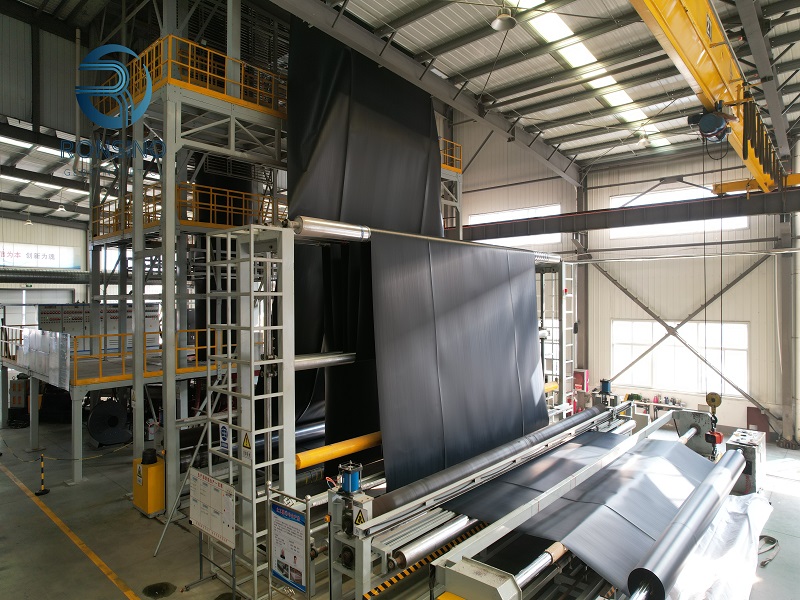
About RONISNO
RONISNO has been specializing in delivering complete line of geosynthetics products and solutions to worldwide customers since its foundation in 2007. RONISNO had provided many types of effective and state of the art geomembranes, geotextiles, geocells, geosynthetic clay liners (GCLs), drainage boards, geogrids to over 81 countries. Our main customers are from Australia, France, Sweden, UK, Hong Kong, Hungary, New Zealand, Poland, Mexico, Ecuador, Brazil, Pakistan, Bangladesh, Thailand, Vietnam, Malaysia, Indonesia, Singapore, Philippines, Sri Lanka, India, UAE, Saudi Arabia, Qatar, Kenya, Ghana, Ethiopia, Somalia, Nigeria, South Africa, Swaziland, Mongolia, etc.
RONISNO is not only manufacturing best quality geosynthetic products but also providing professional design and installation service. OEM, ODM, custom development and fabrication are also available. If you have any questions or inquiries, please fill and submit the following form, we will reply as soon as possible.


