
HDPE Geocell for Roadbed of the Racecourse in the Australia
CASE · 2025-10-13 · 0 views
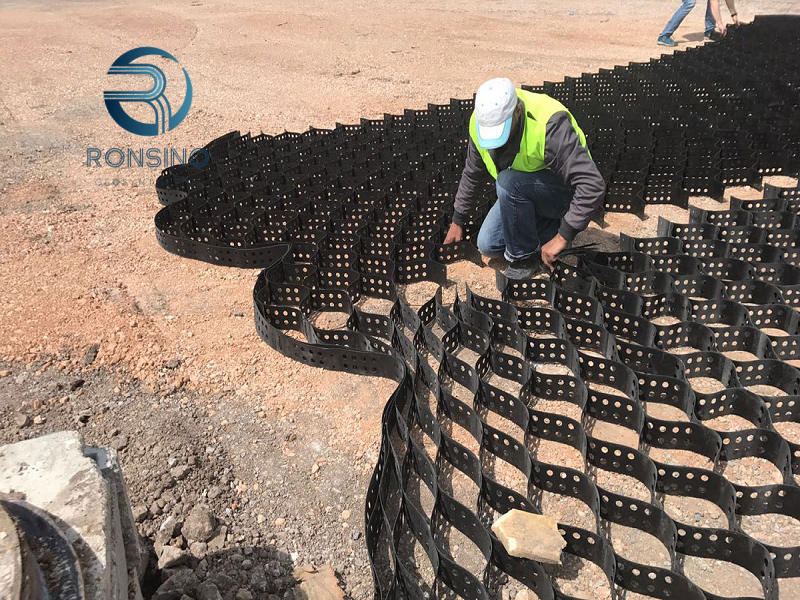
Geocell HDPE Material is a three-dimensional honeycomb structure made of high-density polyethylene sheets that are thermally bonded (often including ultrasonic welding). Its internal partitions can be perforated to meet specific engineering needs.
Its three-dimensional structure can effectively restrain lateral displacement, greatly increase the overall bearing capacity, and is suitable for soil and water conservation and structural reinforcement. The open-hole design allows water to penetrate and promote plant root growth.
Geocell filled with concrete can be used as an integrated mold to replace traditional wooden formwork and steel bars, significantly reducing costs. Concrete is poured directly after unfolding on site to form a structure with high strength, durability, and excellent resistance to erosion and environmental stress. It is an efficient and multi-functional engineering solution.
Case Study
Location – Australia
Product(s) – Geocell HDPE Material
Application – Roadbed of the racecourse
1.Engineering Applications
1.Process the half-filled and half-excavated roadbed. When constructing an embankment on a natural slope with a slope exceeding 1:5, steps should be excavated at the bottom of the embankment, and the width of the steps should not be less than 1 meter. When roads are constructed in phases or rebuilt and widened, the connection between the old and new roadbed fill slopes needs to be excavated. For highways, the step width is usually set to 2 meters. Laying HDPE geocell material on each step can make full use of its lateral reinforcement effect, thereby effectively solving the problem of uneven settlement.
2.Roadbed in sandy areas. The roadbed in sandy areas should be given priority in the form of low embankments, and the filling height is generally not less than 0.3 meters. Since the construction of low roadbed in sandy areas has high professional requirements and bears heavy loads, the use of HDPE geocell materials can provide lateral restraints for loose fill, ensuring that the roadbed has high stiffness and strength to withstand the load stress of large vehicles.
3.Reinforce the roadbed behind the bridge abutment. The application of HDPE geocell materials can better achieve the purpose of reinforcement behind the bridge abutment. Sufficient friction can be generated between it and the filler, which can significantly reduce the uneven settlement between the roadbed and the structure, thereby effectively mitigating the early impact damage to the bridge deck caused by the "jumping" phenomenon.
4.Roadbed in permafrost areas. When filling roadbed in permafrost areas, the minimum filling height must be ensured to prevent the upper limit of permafrost from melting or moving downward, causing excessive settlement of the embankment. The unique facade reinforcement effect and overall restraint effect of HDPE geocell material can ensure the minimum filling height to the maximum extent in special road sections, so that the filler can obtain high-quality strength and stiffness.
5.Treatment of collapsible loess. For highways and first-class highways that pass through collapsible loess or highly compressible loess sections, when the allowable bearing capacity of the high roadbed foundation is lower than the combined pressure of vehicle load and embankment self-weight, the roadbed should be adjusted according to the bearing capacity requirements. At this time, the advantages of HDPE geocell materials are particularly prominent.
6.Saline soil and expansive soil. The shoulders and slopes of highways and first-class highways constructed with saline soil and expansive soil need to be reinforced. The facade reinforcement effect of HDPE geocell material is the best among all reinforcement materials, and it has excellent corrosion resistance, which can fully meet the requirements for the construction of high-grade highways in saline soil and expanded soil areas.
2.Issue
An Australian customer inquired about the use of HDPE geocells to rehabilitate arid zones at a horse farm facility. The goal is to stabilize paths that may contain gravel or fill substrate, and to stabilize pastures containing soil and vegetation. Given the enormous weight of tractors used in operations such as earthmoving, waste management or stone removal, the materials chosen must have excellent load-bearing capabilities. The client desired to integrate turf growth into the geocell structure to enhance the ecological quality of the surrounding area.
3.Solution
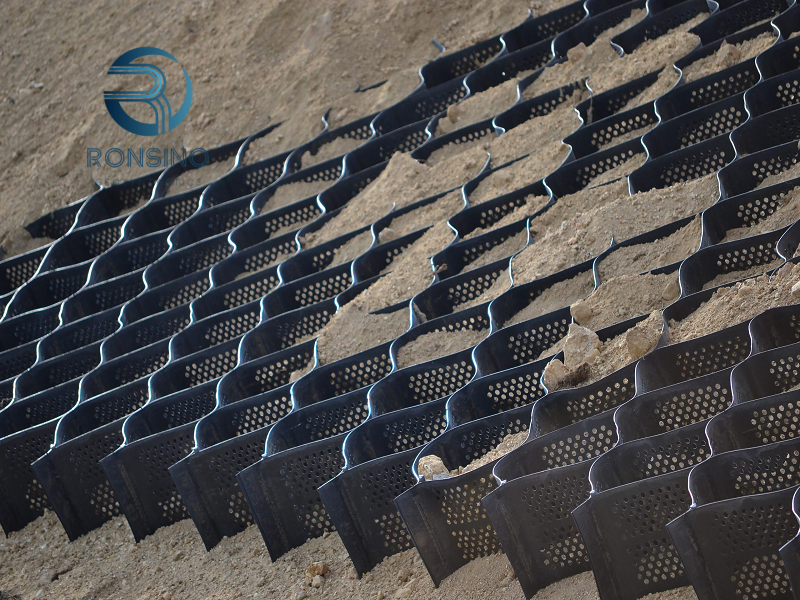
After assessing the customer's needs, we recommended a high-density polyethylene geocell with a height of 200mm and a weld spacing of 500mm that complies with ASTM standards and is equipped with drainage holes to optimize vegetation growth.
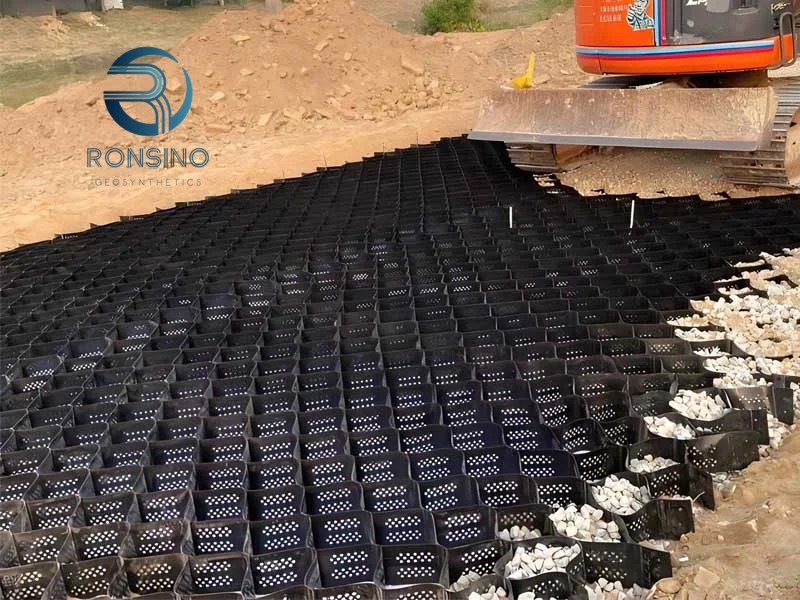
We recommend laying 3-4cm of graded gravel as the foundation, then filling the cell with nutrient-rich soil, leaving 3-5cm of covering soil on top. In anticipation of heavy traffic, we recommend the use of geotextiles and geogrids for reinforcement at the base level.
When the customer raised questions about the cost, we explained in detail the high-quality aspects such as materials, processes, and packaging as well as our pricing strategy, which ultimately led to the customer placing an order.
Our RONSINO geocells are made of 100% imported virgin polymers and pass strict quality inspection in the in-house laboratory. The product has excellent durability (anti-UV, anti-oxidation, corrosion resistance) and flexibility, can be folded and unfolded freely, and is easy to install.
After filling, it can form a high-strength side structure, which can significantly improve the bearing capacity and foundation stability, and the size can be customized as needed. This is a high-performance, cost-effective infrastructure solution.
4.About RONSINO
Since its establishment in 2007, RONSINO has been committed to providing one-stop geosynthetic materials products and solutions to global customers. With its rich industry experience, the company has supplied a variety of high-performance geomembranes, geotextiles, geocells, bentonite waterproof blankets (GCL), drainage boards, geogrids and other products to more than 81 countries and regions. Our main customers are located in Australia, France, Sweden, the United Kingdom, Hong Kong, Hungary, New Zealand, Poland, Mexico, Ecuador, Brazil, Pakistan, Bangladesh, Thailand, Vietnam, Malaysia, Indonesia, Singapore, Philippines, Sri Lanka, India, United Arab Emirates, Saudi Arabia, Qatar, Kenya, Ghana, Ethiopia, Somalia, Nigeria, South Africa, Swaziland, Mongolia and other countries.
RONSINO is not only manufacturing best quality geosynthetic products but also providing professional design and installation service. OEM, ODM, custom development and fabrication are also available. If you have any questions or inquiries, please fill and submit the following form, we will reply as soon as possible.


