
HDPE Pond Liner Sheet Manufacturer | Engineering Guide
Blog · 2026-06-24 · 0 views
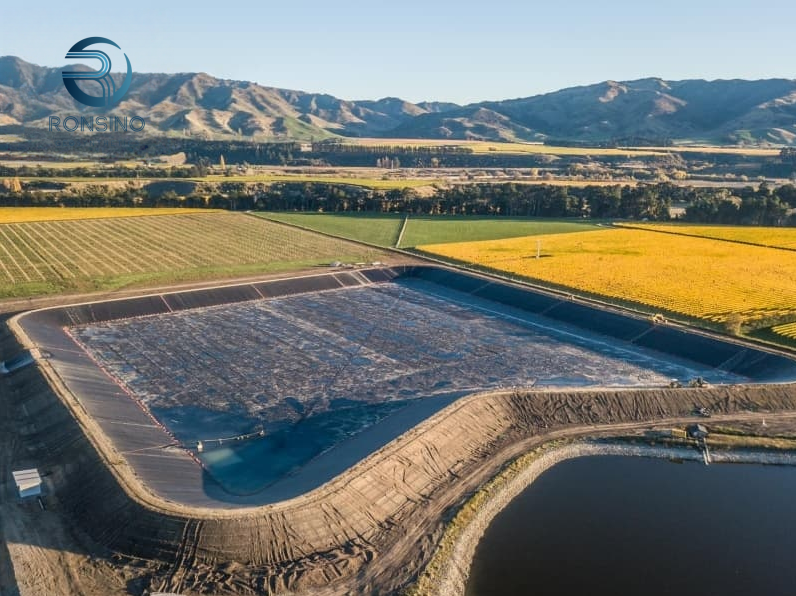
The selection of an environmentally friendly liner manufacturer is a critical decision affecting environmental compliance, barrier integrity and project sustainability. This technical guide provides a complete evaluation framework, covering manufacturer qualification review, material technology analysis and key points of anti-seepage system reliability. It has important reference value for environmental engineers, procurement and general engineering contractors.
What is Environmental Protection Liner Manufacturer
Our company is a professional environmentally friendly anti-seepage liner manufacturer, mainly engaged in HDPE and reinforced geomembranes, which can block the penetration of hazardous liquids, leachates, and polluted water. It is suitable for landfills, hazardous waste storage areas, mining areas, and industrial wastewater treatment facilities. We provide technical information, chemical resistance certification, and construction support.Project selection gives priority to 8-meter width, thickness uniformity, stress cracking resistance (NCTL ≥ 500 hours), and extreme chemical environment resistance to pH 0.5-14.The purchaser will focus on quality management system qualifications such as ISO9001 and GRI-GM13, product traceability, and project testing plans including long-term immersion tests in simulated contaminated liquids.This liner is mostly a component of a composite anti-seepage system, and works together with geosynthetic clay liner, drainage layer, etc. to improve the protective effect.
Technical Specifications of Environmental Protection Liner Manufacturer
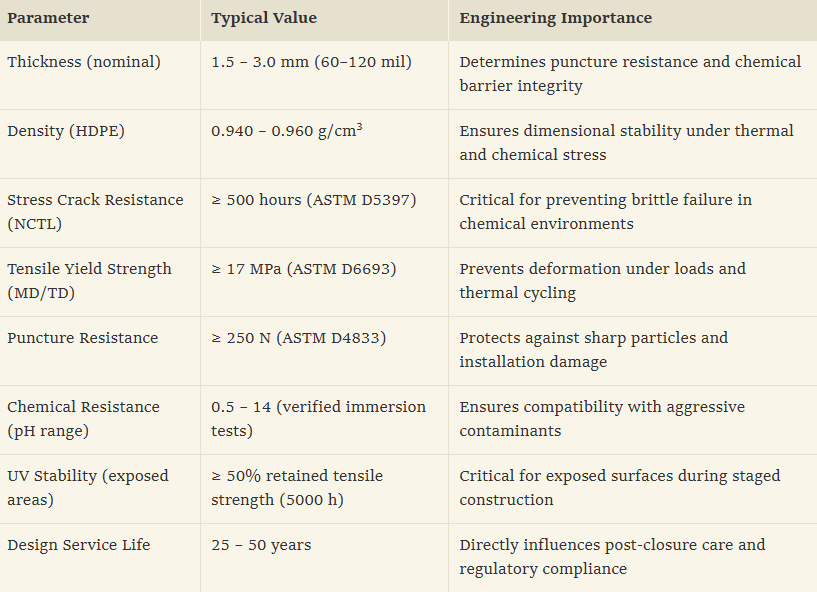
Products produced by certified environmentally friendly liner manufacturers must meet a stringent set of performance standards. The following table details common parameters in environmental protection application scenarios and their corresponding engineering significance.
All values are verified through in-house and third-party testing per ASTM, ISO, and GRI standards. A reliable environmental protection liner manufacturer provides lot-specific test reports and chemical immersion data.
Material Structure and Composition
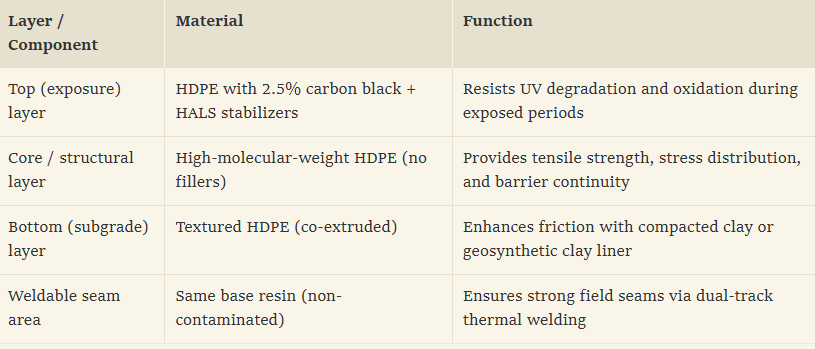
The multi-layer structural design of the high-performance impermeable membrane produced by an eco-friendly geosynthetic liner manufacturer is specifically tailored to deliver outstanding chemical corrosion resistance, puncture damage prevention performance, and long-term stress crack resistance. The table presented below details the standard material composition and structural configuration of this product.
![]()
Layer / Component Material Function
Top (exposure) layer HDPE with 2.5% carbon black + HALS stabilizers Resists UV degradation and oxidation during exposed periods
Core / structural layer High-molecular-weight HDPE (no fillers) Provides tensile strength, stress distribution, and barrier continuity
Bottom (subgrade) layer Textured HDPE (co-extruded) Enhances friction with compacted clay or geosynthetic clay liner
Weldable seam area Same base resin (non-contaminated) Ensures strong field seams via dual-track thermal welding
The co-extrusion process fuses the layers into a seamless single piece. The use of high-quality high molecular weight resin significantly improves stress crack resistance and meets the requirements of long-term resistance to chemical corrosion and thermal loads. The specially-made textured bottom layer enhances the interface shear strength and reduces the risk of slope slippage.
Manufacturing Process of Environmental Protection Liner Manufacturer
The industrial production process of a leading high-quality eco-friendly liner manufacturing enterprise follows a six-step standardized workflow paired with multi-node rigorous quality management mechanisms, with key inspection priorities specifically concentrated on the product's stress crack resistance performance and the consistency of thickness across every part of the liner.
Raw material preparation – Virgin HDPE resin (high molecular weight), carbon black masterbatch, and antioxidant packages are precision-weighed and blended in forced-air dryers to reduce moisture below 0.02%, preventing bubble formation during extrusion.
Extrusion and forming – The blend is melted in a twin-screw extruder (230–250°C) and forced through a flat-sheet die. Calender rollers set the precise thickness (typically 1.5–2.5 mm for environmental applications).
Surface texturing – Textured geomembrane liners use specially designed embossing rollers to create evenly distributed friction textures (e.g. sharp raised spikes or concave dimples) across the surface, effectively boosting slip resistance on slopes and greatly enhancing project slope stability.
Precision finishing – The film passes through the cooling tank and trimming station in sequence. Its width can be up to eight meters, thus reducing the number of joints on site by nearly 40%.
Quality inspection – In-line and off-line tests include ultrasonic thickness mapping, tensile (ASTM D6693), puncture (D4833), stress-crack (NCTL per D5397), and high-voltage pinhole detection. Any coil with deviations is quarantined.
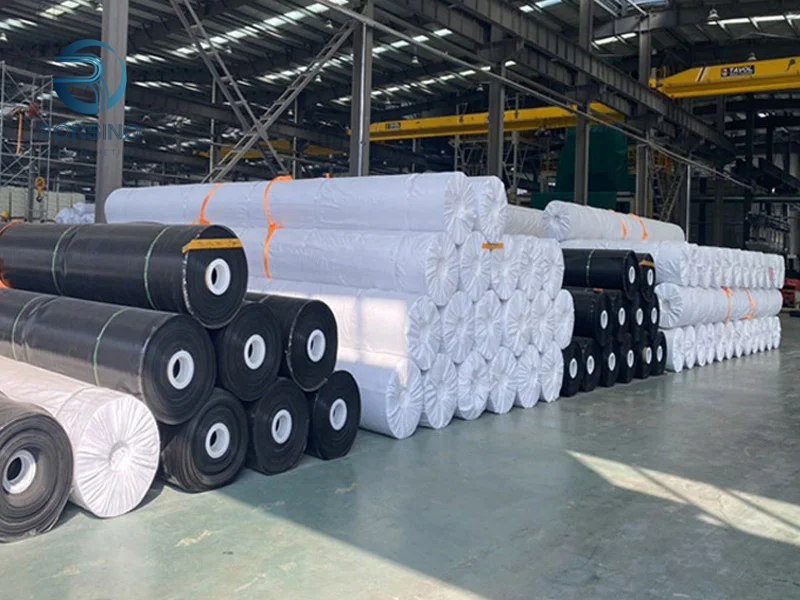
Packaging and labeling – Rolls are wrapped in opaque, UV-blocking film, labeled with batch number, thickness, and certification marks, then palletized for shipment.
Each stage is engineered to prevent defects: Improper drying of the resin can easily cause pinholes in the lining, and irregular stress cracking resistance testing may cause premature product damage. Professional environmentally friendly lining companies will establish a full-process traceability system to achieve full-chain information traceability from raw materials to finished products.
Performance Comparison with Alternative Materials
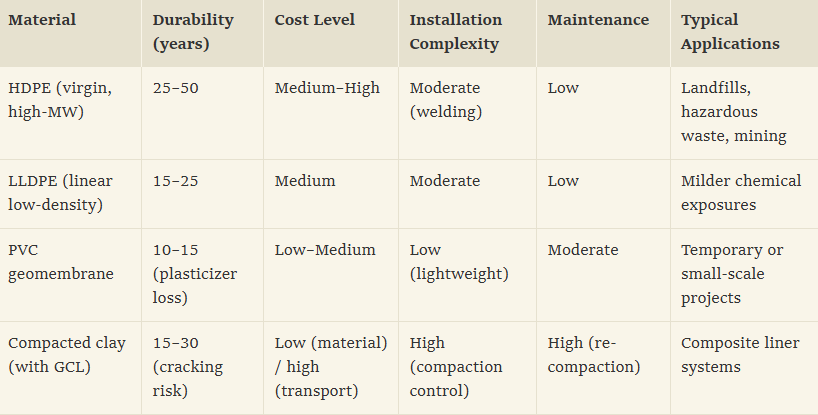
When evaluating environmentally friendly lining manufacturers' products and alternatives, engineers consider factors such as durability, chemical resistance and cost-effectiveness. The following table provides a detailed reference for multi-attribute comparative analysis.
Material Durability (years) Cost Level Installation Complexity Maintenance Typical Applications
Environmentally certified HDPE lining provides an ideal comprehensive solution for environmental protection projects with its excellent chemical resistance, stress cracking resistance and ultra-long life.
![]()
Industrial Applications of Environmental Protection Liner Manufacturer
Goods produced by a manufacturer specializing in ecological containment solutions find application across a wide array of environmental conservation initiatives:
Municipal solid waste (MSW) landfills: Base and side slope liners for new cells and expansions.
Hazardous waste containment: Liners for hazardous waste landfills and storage facilities.
Mining operations: Heap leach pads, tailings storage, acid rock drainage basins.
Industrial wastewater treatment: Liners for equalization basins, sludge lagoons, and chemical treatment ponds.
Groundwater remediation: Liners for containment of contaminated groundwater and pump-and-treat systems.
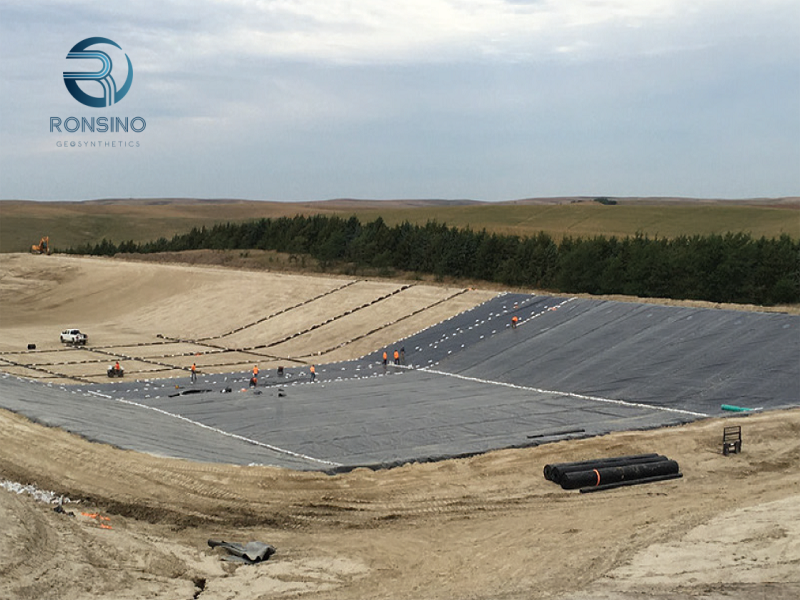
A major project in the United States used 2.0 mm HDPE liners from a leading environmental protection liner manufacturer for a 20 ha hazardous waste landfill cell, achieving 30+ years of containment with zero groundwater contamination detected.
Common Industry Problems and Engineering Solutions
Premium protective barriers are not immune to complications when planning or execution proves inadequate. The following section outlines four persistent challenges and their technical solutions for safeguarding ecological containment liners.
Problem 1: Stress cracking near leachate collection pipes
Root cause: Differential settlement and chemical attack at stress points.
Solution: Use prefabricated boots with expansion loops; specify NCTL ≥500 h; conduct post-installation leak detection surveys.
Problem 2: Puncture from sharp waste particles
Root cause: Inadequate protective layer or insufficient liner thickness.
Solution: Install 500 g/m² nonwoven geotextile as cushion; specify thickness ≥2.0 mm for high-load areas.
Problem 3: Seam failure due to improper welding
Root cause: Contamination or incorrect weld temperature under field conditions.
Solution: Prior to commencing each work period, it is imperative to conduct peel and shear examinations on sample specimens; employ dual-lane extrusion welding apparatus equipped with automated thermal regulation.
Problem 4: UV degradation on exposed side slopes
Root cause: Insufficient carbon black content or lack of protective cover.
Solution: Specify ≥2.5% carbon black and apply a spray-on UV coating for exposed areas.
Risk Factors and Prevention Strategies
Environmental risk mitigation initiatives for endeavors collaborating with sustainable barrier fabric producers encompass five fundamental domains:
Improper liner selection: Choosing inadequate thickness or resin type. Prevention: conduct chemical compatibility testing with site-specific contaminants.
Material mismatch: Employing incompatible geomembranes across various sections should be avoided. Mitigation: confirm that all lining components originate from an identical manufacturing batch and exhibit chemical congruence.
Environmental exposure: Long-term exposure to high-intensity UV rays and repeated thermal changes. Countermeasures: Increase carbon black concentration and cover weak surfaces in time.
Subgrade issues: Sharp rocks or differential settlement. Prevention: perform subgrade proof-rolling; install geotextile cushion layers.
Quality control gaps: Insufficient seam testing. Prevention: implement 100% seam testing (vacuum/air pressure) and independent third-party CQA.
Procurement Guide: How to Choose the Right Environmental Protection Liner Manufacturer
Buyers should follow this step‑by‑step checklist when engaging an environmental protection liner manufacturer:
Traffic load evaluation – Assess waste loading and equipment traffic to specify puncture resistance and thickness.
Specification verification – Confirm thickness, stress-crack resistance (NCTL), and chemical resistance data against project design criteria.
Certifications – Require ISO 9001, GRI-GM13, and ASTM compliance; request chemical immersion test reports for site-specific contaminants.
Manufacturer capability – Audit factory capacity, lead times, and track record on similar environmental projects.
Quality control – Review in-house testing frequency, NCTL measurements, and third-party lab reports.
Sample testing – Request 1 m² samples for independent chemical immersion, puncture, and tensile tests.
Warranty evaluation – Examine warranty covering material defects, seam integrity, and stress-crack performance (≥10 years).
Engineering Case Study
Project: 20 ha hazardous waste landfill cell
Location: Midwestern USA
Size: 400 m × 500 m cell, 15 m waste height, 2.5H:1V side slopes
Product specification: Environmentally friendly certified 2.0mm high-density polyethylene liner with durable surface texture and tensile strength ≥ 600 hours. Contains 2.5% carbon black to enhance UV resistance and durability, and passes pH 2-13 chemical stability test. A 500g/m² geotextile support is laid underneath, and the seams are double welded and 100% air pressure tested to ensure no leakage.
Results & benefits: The hydrostatic pressure system was installed without leaks in 55 days. After seven years, no hazardous substances were detected in groundwater. It exceeded EPA Subtitle C standards, saving $5 million in potential remediation costs.
FAQ Section
1. What thickness of liner is recommended for environmental protection?
Typically 1.5–3.0 mm, with 2.0 mm being the most common for hazardous waste and landfill applications.
2. What is NCTL and why is it important?
Notched Constant Tensile Load (ASTM D5397) measures stress-crack resistance; ≥500 hours is critical for chemical environments.
3. Can HDPE liners withstand aggressive chemicals?
Yes — but chemical immersion testing (ASTM D5322) should be performed for site-specific contaminant mixtures.
4. What is the typical service life of an environmental protection liner?
25–50 years with proper material selection and installation.
5. Is textured or smooth liner better for side slopes?
Textured liner provides higher friction (interface angle >25°) and is preferred for slopes steeper than 3H:1V.
6. What certifications should a liner manufacturer have?
ISO 9001, GRI-GM13, and ASTM compliance; additionally, chemical resistance data for site-specific contaminants.
7. How are seams tested in the field?
Using vacuum box (ASTM D6392) or air pressure testing (ASTM D7406) for 100% seam coverage.
8. Can exposed liners be used for environmental protection?
Yes — but they require enhanced UV stabilizers (≥2.5% carbon black) and regular inspections.
9. What is the difference between HDPE and LLDPE for environmental protection?
HDPE offers higher stress-crack resistance and chemical stability; LLDPE is more flexible but less chemically resistant.
10. Does the manufacturer provide installation support?
Most reputable manufacturers offer CQA (Construction Quality Assurance) guidance and weld training.
Request Technical Support or Quotation
For project-specific engineering assistance, product samples, or detailed technical datasheets from a qualified environmental protection liner manufacturer, our technical advisory team is available. We provide:
Customized liner selection based on contaminant chemistry, pH, and site conditions
Free 1 m² sample panels for independent chemical and mechanical testing
Full technical specifications and installation CQA guidelines
Direct consultation with polymer and environmental engineers
Submit your project parameters through the contact form on our website to receive a detailed engineering proposal within 48 hours.
About the Author
This manual is written by experts with more than 15 years of global industry experience, specializing in geomembrane production, environmental protection infrastructure and waste management. We have led hazardous waste landfill, mine containment and industrial wastewater treatment EPC projects, and provided technical due diligence, factory assessment and post-installation performance evaluation. Independent of any brand or commercial entity, our guidance is based on engineering fundamentals and field failure analysis.
What is Environmental Protection Liner Manufacturer
Our company is a professional environmentally friendly anti-seepage liner manufacturer, mainly engaged in HDPE and reinforced geomembranes, which can block the penetration of hazardous liquids, leachates, and polluted water. It is suitable for landfills, hazardous waste storage areas, mining areas, and industrial wastewater treatment facilities. We provide technical information, chemical resistance certification, and construction support.Project selection gives priority to 8-meter width, thickness uniformity, stress cracking resistance (NCTL ≥ 500 hours), and extreme chemical environment resistance to pH 0.5-14.The purchaser will focus on quality management system qualifications such as ISO9001 and GRI-GM13, product traceability, and project testing plans including long-term immersion tests in simulated contaminated liquids.This liner is mostly a component of a composite anti-seepage system, and works together with geosynthetic clay liner, drainage layer, etc. to improve the protective effect.
Technical Specifications of Environmental Protection Liner Manufacturer
Products produced by certified environmentally friendly liner manufacturers must meet a stringent set of performance standards. The following table details common parameters in environmental protection application scenarios and their corresponding engineering significance.
All values are verified through in-house and third-party testing per ASTM, ISO, and GRI standards. A reliable environmental protection liner manufacturer provides lot-specific test reports and chemical immersion data.
Material Structure and Composition
The multi-layer structural design of the high-performance impermeable membrane produced by an eco-friendly geosynthetic liner manufacturer is specifically tailored to deliver outstanding chemical corrosion resistance, puncture damage prevention performance, and long-term stress crack resistance. The table presented below details the standard material composition and structural configuration of this product.
Layer / Component Material Function
Top (exposure) layer HDPE with 2.5% carbon black + HALS stabilizers Resists UV degradation and oxidation during exposed periods
Core / structural layer High-molecular-weight HDPE (no fillers) Provides tensile strength, stress distribution, and barrier continuity
Bottom (subgrade) layer Textured HDPE (co-extruded) Enhances friction with compacted clay or geosynthetic clay liner
Weldable seam area Same base resin (non-contaminated) Ensures strong field seams via dual-track thermal welding
The co-extrusion process fuses the layers into a seamless single piece. The use of high-quality high molecular weight resin significantly improves stress crack resistance and meets the requirements of long-term resistance to chemical corrosion and thermal loads. The specially-made textured bottom layer enhances the interface shear strength and reduces the risk of slope slippage.
Manufacturing Process of Environmental Protection Liner Manufacturer
The industrial production process of a leading high-quality eco-friendly liner manufacturing enterprise follows a six-step standardized workflow paired with multi-node rigorous quality management mechanisms, with key inspection priorities specifically concentrated on the product's stress crack resistance performance and the consistency of thickness across every part of the liner.
Raw material preparation – Virgin HDPE resin (high molecular weight), carbon black masterbatch, and antioxidant packages are precision-weighed and blended in forced-air dryers to reduce moisture below 0.02%, preventing bubble formation during extrusion.
Extrusion and forming – The blend is melted in a twin-screw extruder (230–250°C) and forced through a flat-sheet die. Calender rollers set the precise thickness (typically 1.5–2.5 mm for environmental applications).
Surface texturing – Textured geomembrane liners use specially designed embossing rollers to create evenly distributed friction textures (e.g. sharp raised spikes or concave dimples) across the surface, effectively boosting slip resistance on slopes and greatly enhancing project slope stability.
Precision finishing – The film passes through the cooling tank and trimming station in sequence. Its width can be up to eight meters, thus reducing the number of joints on site by nearly 40%.
Quality inspection – In-line and off-line tests include ultrasonic thickness mapping, tensile (ASTM D6693), puncture (D4833), stress-crack (NCTL per D5397), and high-voltage pinhole detection. Any coil with deviations is quarantined.
Packaging and labeling – Rolls are wrapped in opaque, UV-blocking film, labeled with batch number, thickness, and certification marks, then palletized for shipment.
Each stage is engineered to prevent defects: Improper drying of the resin can easily cause pinholes in the lining, and irregular stress cracking resistance testing may cause premature product damage. Professional environmentally friendly lining companies will establish a full-process traceability system to achieve full-chain information traceability from raw materials to finished products.
Performance Comparison with Alternative Materials
When evaluating environmentally friendly lining manufacturers' products and alternatives, engineers consider factors such as durability, chemical resistance and cost-effectiveness. The following table provides a detailed reference for multi-attribute comparative analysis.
Material Durability (years) Cost Level Installation Complexity Maintenance Typical Applications
Environmentally certified HDPE lining provides an ideal comprehensive solution for environmental protection projects with its excellent chemical resistance, stress cracking resistance and ultra-long life.
Industrial Applications of Environmental Protection Liner Manufacturer
Goods produced by a manufacturer specializing in ecological containment solutions find application across a wide array of environmental conservation initiatives:
Municipal solid waste (MSW) landfills: Base and side slope liners for new cells and expansions.
Hazardous waste containment: Liners for hazardous waste landfills and storage facilities.
Mining operations: Heap leach pads, tailings storage, acid rock drainage basins.
Industrial wastewater treatment: Liners for equalization basins, sludge lagoons, and chemical treatment ponds.
Groundwater remediation: Liners for containment of contaminated groundwater and pump-and-treat systems.
A major project in the United States used 2.0 mm HDPE liners from a leading environmental protection liner manufacturer for a 20 ha hazardous waste landfill cell, achieving 30+ years of containment with zero groundwater contamination detected.
Common Industry Problems and Engineering Solutions
Premium protective barriers are not immune to complications when planning or execution proves inadequate. The following section outlines four persistent challenges and their technical solutions for safeguarding ecological containment liners.
Problem 1: Stress cracking near leachate collection pipes
Root cause: Differential settlement and chemical attack at stress points.
Solution: Use prefabricated boots with expansion loops; specify NCTL ≥500 h; conduct post-installation leak detection surveys.
Problem 2: Puncture from sharp waste particles
Root cause: Inadequate protective layer or insufficient liner thickness.
Solution: Install 500 g/m² nonwoven geotextile as cushion; specify thickness ≥2.0 mm for high-load areas.
Problem 3: Seam failure due to improper welding
Root cause: Contamination or incorrect weld temperature under field conditions.
Solution: Prior to commencing each work period, it is imperative to conduct peel and shear examinations on sample specimens; employ dual-lane extrusion welding apparatus equipped with automated thermal regulation.
Problem 4: UV degradation on exposed side slopes
Root cause: Insufficient carbon black content or lack of protective cover.
Solution: Specify ≥2.5% carbon black and apply a spray-on UV coating for exposed areas.
Risk Factors and Prevention Strategies
Environmental risk mitigation initiatives for endeavors collaborating with sustainable barrier fabric producers encompass five fundamental domains:
Improper liner selection: Choosing inadequate thickness or resin type. Prevention: conduct chemical compatibility testing with site-specific contaminants.
Material mismatch: Employing incompatible geomembranes across various sections should be avoided. Mitigation: confirm that all lining components originate from an identical manufacturing batch and exhibit chemical congruence.
Environmental exposure: Long-term exposure to high-intensity UV rays and repeated thermal changes. Countermeasures: Increase carbon black concentration and cover weak surfaces in time.
Subgrade issues: Sharp rocks or differential settlement. Prevention: perform subgrade proof-rolling; install geotextile cushion layers.
Quality control gaps: Insufficient seam testing. Prevention: implement 100% seam testing (vacuum/air pressure) and independent third-party CQA.
Procurement Guide: How to Choose the Right Environmental Protection Liner Manufacturer
Buyers should follow this step‑by‑step checklist when engaging an environmental protection liner manufacturer:
Traffic load evaluation – Assess waste loading and equipment traffic to specify puncture resistance and thickness.
Specification verification – Confirm thickness, stress-crack resistance (NCTL), and chemical resistance data against project design criteria.
Certifications – Require ISO 9001, GRI-GM13, and ASTM compliance; request chemical immersion test reports for site-specific contaminants.
Manufacturer capability – Audit factory capacity, lead times, and track record on similar environmental projects.
Quality control – Review in-house testing frequency, NCTL measurements, and third-party lab reports.
Sample testing – Request 1 m² samples for independent chemical immersion, puncture, and tensile tests.
Warranty evaluation – Examine warranty covering material defects, seam integrity, and stress-crack performance (≥10 years).
Engineering Case Study
Project: 20 ha hazardous waste landfill cell
Location: Midwestern USA
Size: 400 m × 500 m cell, 15 m waste height, 2.5H:1V side slopes
Product specification: Environmentally friendly certified 2.0mm high-density polyethylene liner with durable surface texture and tensile strength ≥ 600 hours. Contains 2.5% carbon black to enhance UV resistance and durability, and passes pH 2-13 chemical stability test. A 500g/m² geotextile support is laid underneath, and the seams are double welded and 100% air pressure tested to ensure no leakage.
Results & benefits: The hydrostatic pressure system was installed without leaks in 55 days. After seven years, no hazardous substances were detected in groundwater. It exceeded EPA Subtitle C standards, saving $5 million in potential remediation costs.
FAQ Section
1. What thickness of liner is recommended for environmental protection?
Typically 1.5–3.0 mm, with 2.0 mm being the most common for hazardous waste and landfill applications.
2. What is NCTL and why is it important?
Notched Constant Tensile Load (ASTM D5397) measures stress-crack resistance; ≥500 hours is critical for chemical environments.
3. Can HDPE liners withstand aggressive chemicals?
Yes — but chemical immersion testing (ASTM D5322) should be performed for site-specific contaminant mixtures.
4. What is the typical service life of an environmental protection liner?
25–50 years with proper material selection and installation.
5. Is textured or smooth liner better for side slopes?
Textured liner provides higher friction (interface angle >25°) and is preferred for slopes steeper than 3H:1V.
6. What certifications should a liner manufacturer have?
ISO 9001, GRI-GM13, and ASTM compliance; additionally, chemical resistance data for site-specific contaminants.
7. How are seams tested in the field?
Using vacuum box (ASTM D6392) or air pressure testing (ASTM D7406) for 100% seam coverage.
8. Can exposed liners be used for environmental protection?
Yes — but they require enhanced UV stabilizers (≥2.5% carbon black) and regular inspections.
9. What is the difference between HDPE and LLDPE for environmental protection?
HDPE offers higher stress-crack resistance and chemical stability; LLDPE is more flexible but less chemically resistant.
10. Does the manufacturer provide installation support?
Most reputable manufacturers offer CQA (Construction Quality Assurance) guidance and weld training.
Request Technical Support or Quotation
For project-specific engineering assistance, product samples, or detailed technical datasheets from a qualified environmental protection liner manufacturer, our technical advisory team is available. We provide:
Customized liner selection based on contaminant chemistry, pH, and site conditions
Free 1 m² sample panels for independent chemical and mechanical testing
Full technical specifications and installation CQA guidelines
Direct consultation with polymer and environmental engineers
Submit your project parameters through the contact form on our website to receive a detailed engineering proposal within 48 hours.
About the Author
This manual is written by experts with more than 15 years of global industry experience, specializing in geomembrane production, environmental protection infrastructure and waste management. We have led hazardous waste landfill, mine containment and industrial wastewater treatment EPC projects, and provided technical due diligence, factory assessment and post-installation performance evaluation. Independent of any brand or commercial entity, our guidance is based on engineering fundamentals and field failure analysis.


