How to Prepare Subgrade Before Geomembrane Installation
Blog · 2026-09-01 · 0 views
What is How to Prepare Subgrade Before Geomembrane Installation
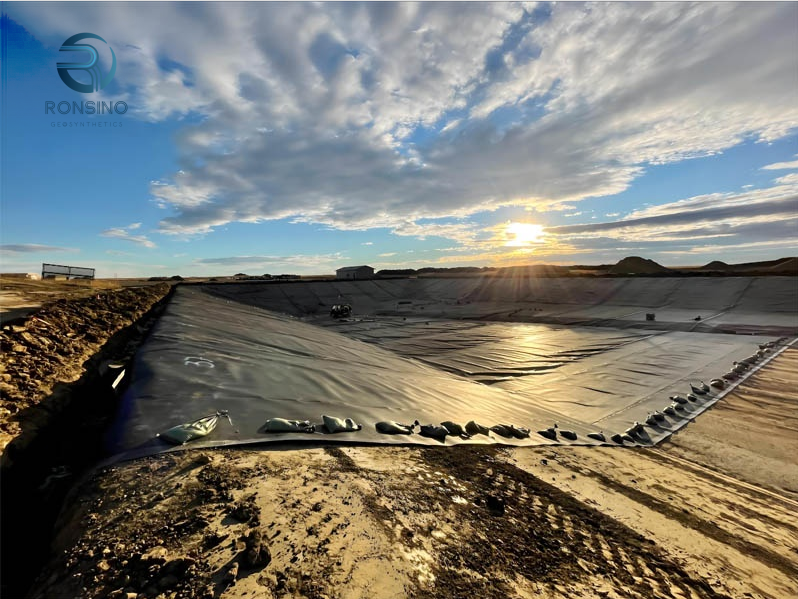
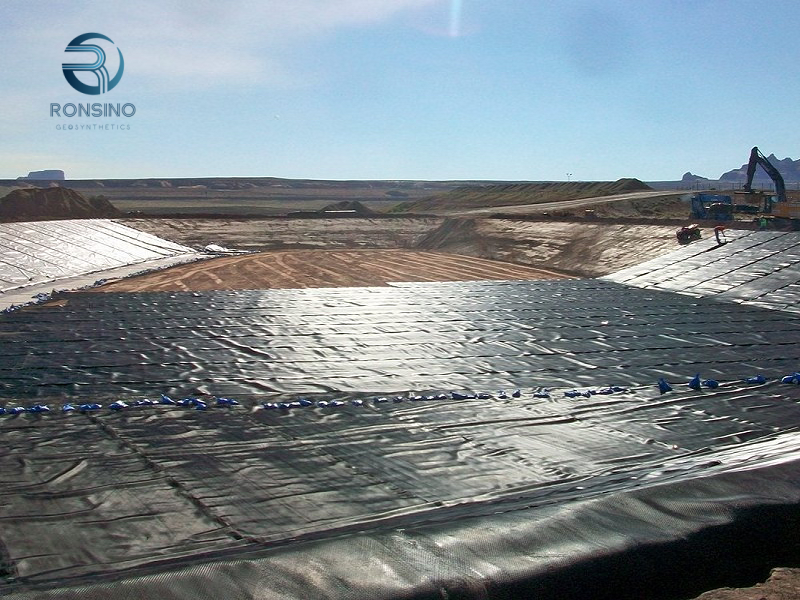
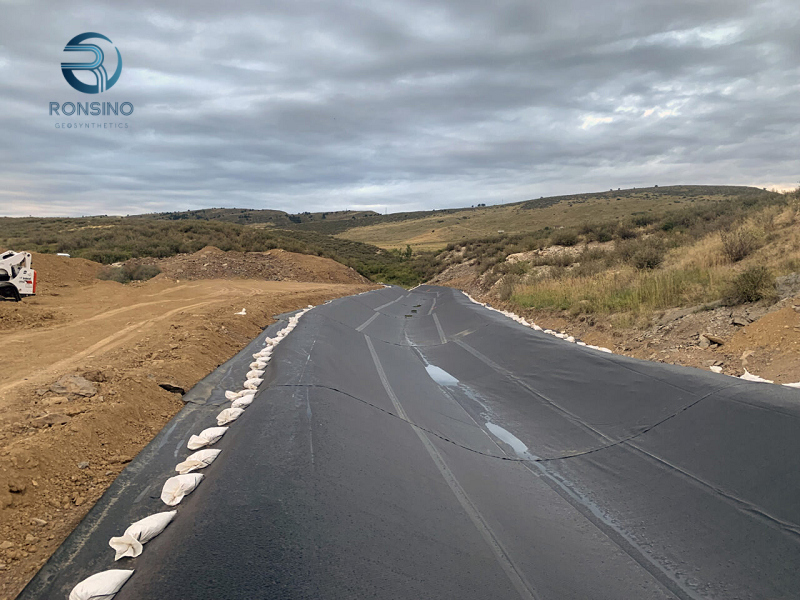
Geomembrane pre-installation subgrade preparation is a systematic workflow covering site grading, layered compaction, precision leveling and targeted foundation soil protection, aiming to form a stable, uniform, puncture-resistant base to support the geomembrane liner and ensure the long-term effective operation of the containment system within its designed service life.
It is critical for engineers, contractors, and procurement managers to know how to properly prepare the foundation before laying the geomembrane, because the quality of the foundation preparation will directly determine the actual performance of the impermeable layer. Industry statistics indicate that approximately 35% of cases of barrier failure can be attributed to inadequate foundation preparation. This guide provides a systematic operating framework for foundation treatment before geomembrane installation.
Technical Specifications: Subgrade Preparation Parameters
The Following Table Defines the Key Technical Parameters for Subgrade Preparation.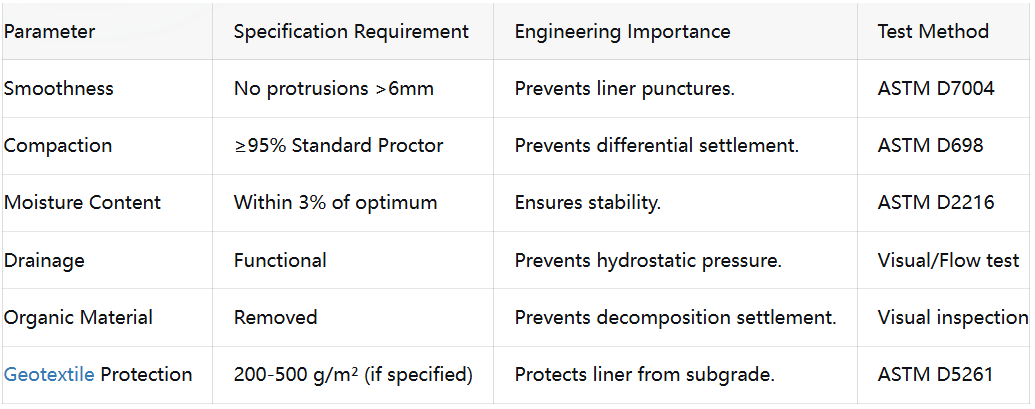
Subgrade Preparation Process
Step 1: Site Clearing
All vegetation, construction waste and organic residues need to be removed from the construction site. Reason: The decomposition of organic matter will cause uneven settlement of the foundation and destroy the stability and durability of subsequent structures.
Step 2: Rough Grading
Grade the subgrade to the required elevation and slope. Why this matters: Establishes the base profile.
Step 3: Remove Problematic Materials
Remove rocks, roots, and debris >6mm. Why this matters: Prevents liner punctures.
Step 4: Fine Grading
Fine-grade to achieve smooth surface. Why this matters: Provides uniform support for the liner.
Step 5: Compaction
Compact subgrade to ≥95% Standard Proctor. Why this matters: Prevents differential settlement.
Step 6: Moisture Control
Control moisture content within 3% of optimum. Why this matters: Ensures compaction quality.
Step 7: Drainage Installation
Install subgrade drainage if required. Why this matters: Prevents hydrostatic pressure.
Step 8: Geotextile Protection (if specified)
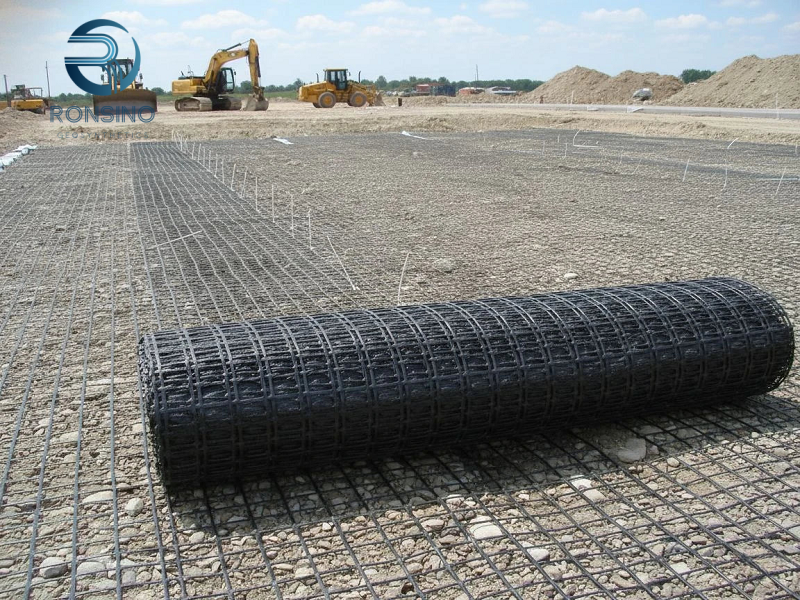
Place geotextile protection layer. Why this matters: Protects liner from subgrade.
Step 9: Final Inspection
Inspect subgrade before liner deployment. Why this matters: Verifies preparation quality.
Subgrade Preparation Equipment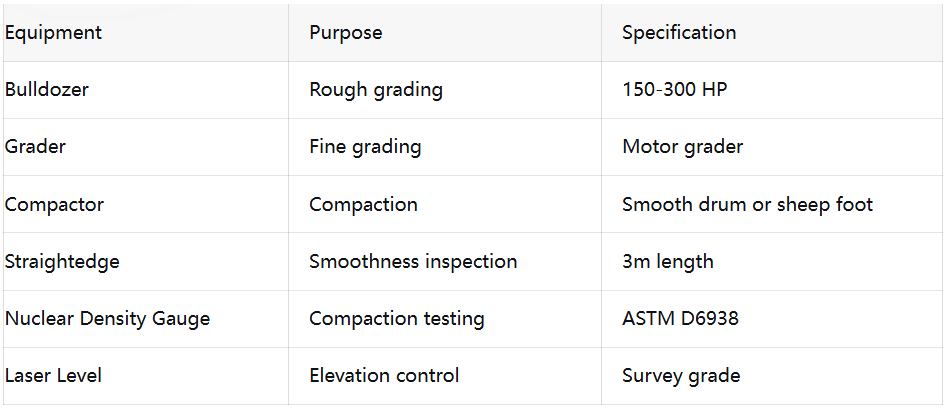
Subgrade Preparation Checklist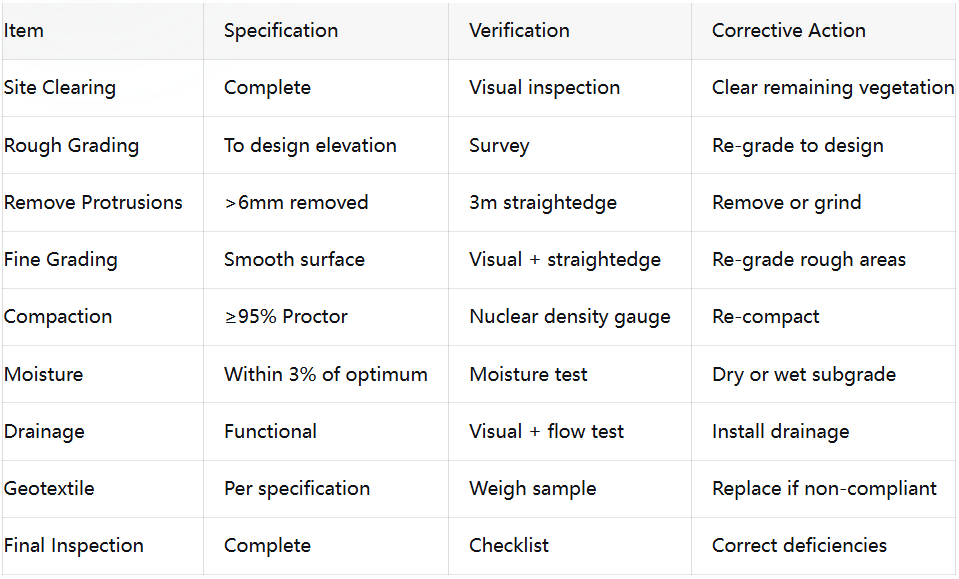
Common Subgrade Problems and Solutions
Problem 1: Protrusions >6mm
Root cause: Rocks or debris not removed. Solution: Remove protrusions. Grind or cover with sand.
Problem 2: Poor Compaction
Root cause: Inadequate compaction effort. Solution: Re-compact to ≥95% Proctor.
Problem 3: High Moisture
Root cause: Excess water in subgrade. Solution: Dry subgrade. Add drying agent.
Problem 4: Organic Material
Root cause: Vegetation or organic soil. Solution: Remove organic material. Replace with suitable fill.
Risk Factors and Prevention Strategies
Puncture Risk
Risk: Subgrade protrusions puncture liner. Prevention: Remove protrusions >6mm. Geotextile protection.
Settlement Risk
Risk: Differential settlement stresses liner. Prevention: Compact to ≥95% Proctor.
Hydrostatic Pressure Risk
Risk: Water pressure lifts liner. Prevention: Subgrade drainage.
Procurement Guide: How to Prepare Subgrade Before Geomembrane Installation
Step 1: Define Subgrade Requirements
Define: smoothness, compaction, moisture, drainage, protection.
Step 2: Prepare Subgrade
Prepare: clear, grade, remove protrusions, compact, control moisture.
Step 3: Install Protection
Install: geotextile protection (if specified).
Step 4: Inspect and Verify
Inspect: smoothness, compaction, moisture, drainage.
Step 5: Document
Document: inspection records, test results, photographs.
Engineering Case Study: Subgrade Failure
Project type: Heap leach pad, 150,000m².
Location: South America.
Preparation error: Rocks >25mm not removed.
Failure: Liner punctured by rocks.
Corrective action: Remove rocks. Geotextile protection.
Cost impact: $1.5M remediation.
FAQ Section
Q1: How to prepare subgrade before geomembrane installation?
A: Clear site, grade, remove protrusions >6mm, compact to ≥95% Proctor, control moisture, install drainage, inspect.
Q2: What is the maximum allowed subgrade protrusion?
A: 6mm per ASTM D7004. Protrusions >6mm must be removed.
Q3: What is the minimum subgrade compaction?
A: 95% Standard Proctor (ASTM D698).
Q4: How do I check subgrade smoothness?
A: Use a 3m straightedge. No gaps >6mm.
Q5: Why is subgrade drainage important?
A: Prevents hydrostatic pressure that can lift the liner.
Q6: What is a geotextile protection layer?
A: A nonwoven geotextile that protects the liner from subgrade materials.
Q7: What is the most common subgrade preparation mistake?
A: Not removing protrusions >6mm.
Q8: How do I test subgrade compaction?
A: Nuclear density gauge per ASTM D6938.
Q9: What documentation is required for subgrade preparation?
A: Inspection records, test results, and photographs.
Q10: Who is responsible for subgrade preparation?
A: The contractor. CQA inspector verifies quality.
Request Technical Support or Quotation
For engineering consultation on how to prepare subgrade before geomembrane installation for your specific project:
Request quotation: Submit project requirements for subgrade preparation.
Request samples: Obtain preparation checklists and inspection forms.
Download technical specifications: Comprehensive package including subgrade preparation guide.
Contact technical team: Our subgrade specialists provide independent review.