Learn About The 6 Most Popular Welding Machine Suppliers
Blog · 2026-11-14 · 0 views

Hot wedge welding apparatuses represent indispensable implements for fabricating resilient, impermeable joints within synthetic membranes, specifically high-density polyethylene, linear low-density polyethylene, polyvinyl chloride, and assorted thermoplastic sheeting. These fully mechanized or partially automated instruments employ a thermally activated wedge to plasticize overlapping sheet boundaries prior to consolidation via pressure rollers, thereby yielding joint tensile strengths typically surpassing 95–98% of the substrate material’s integrity (as validated by ASTM D6392 standards).
Amongst containment methodologies, hot wedge welding stands as the premier choice for pivotal environmental infrastructure, including waste management facilities, mineral extraction leachate barriers, potable water storage structures, aquaculture systems, and irrigation channel linings. This preference stems from its superior operational efficiency, uniform fabrication quality, and capacity to process elevated-thickness gauges (ranging from 0.5–3.0 mm or greater). Contemporary equipment features precision thermal regulation systems (maintaining ±1–5°C tolerances), adjustable traversal velocities (spanning 0.4–12 meters per minute), integrated documentation functionalities for quality assurance protocol adherence, and ruggedized constructions engineered to withstand demanding on-site environmental stresses.
The global geomembranes sector, valued at roughly USD 2.0–3.0 billion and expanding at a 6–8% annual growth rate, significantly boosts the need for dependable welding apparatus. Ensuring flawless seam integrity is paramount — any compromise may result in expensive seepages, ecological hazards, and setbacks in project timelines. This evaluation presents the top 6 hot wedge welding apparatuses for 2026, emphasizing quantifiable performance benchmarks, technical attributes, resilience, and cost-effectiveness. It provides perspectives pertinent to Ronsino New Material Co., Ltd. (RONSINO Geosynthetics) and their streamlined HDPE geomembrane deployment procedures.
1. How Hot Wedge Welding Machines Works and Why It Matters
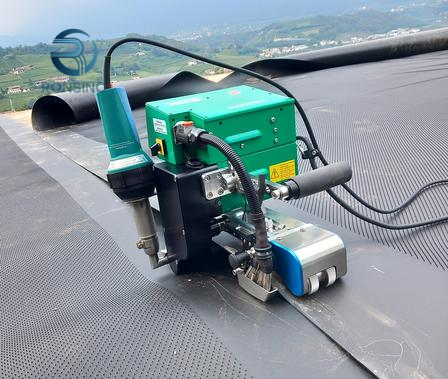
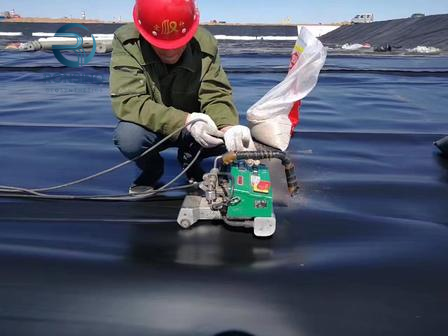
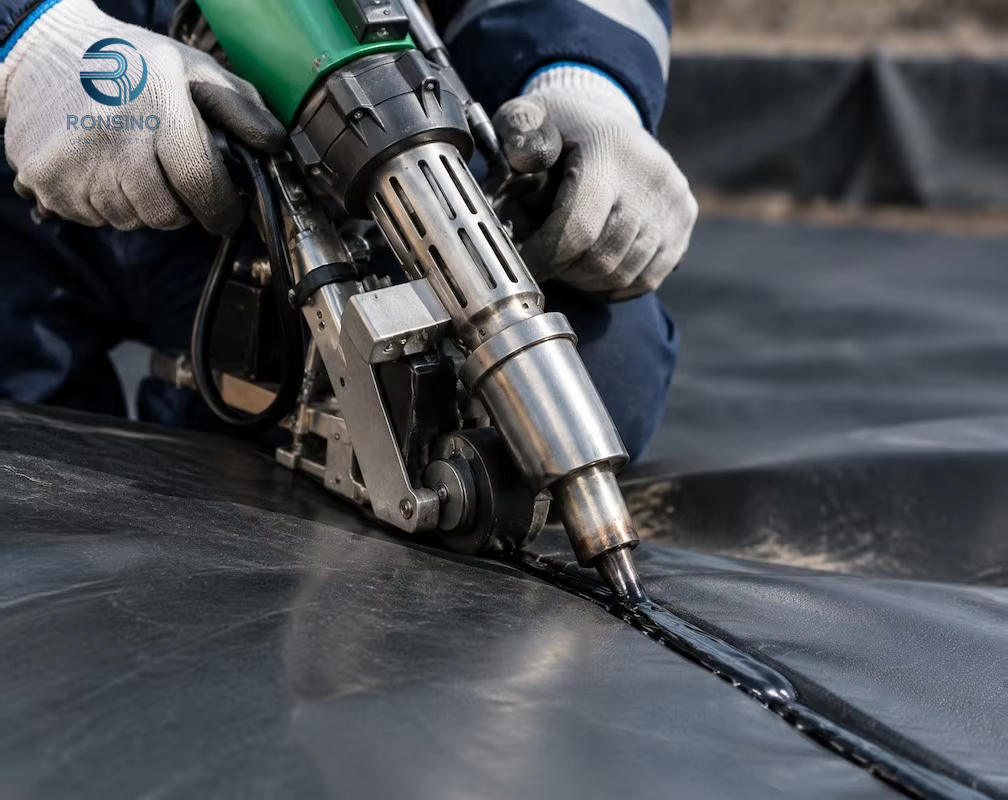
Hot wedge welding employs a precisely regulated metallic wedge, equipped with thermal control mechanisms, to be positioned between two overlapping geomembrane panels. The wedge facilitates the heating of contact surfaces to their ideal melting point, synchronously with rollers exerting consistent compression, thereby establishing a uniform molecular bond. Split wedge configurations generate paired seams, incorporating an interstitial air passage that facilitates non-invasive quality verification.
Essential Evaluation Criteria:
Welding velocity: 0.4–12 m/min
Thermal parameters and consistency: 20–460°C with ±5°C or finer precision
Substrate thickness adaptability: 0.5–4.0 mm
Joint integrity: ≥95% of parent material tensile strength
Device mass and transportability: 5–25 kg
Operational energy draw: 800–2600 W
Embedded data acquisition and conformity validation tools
These advanced welding systems curtail on-site irregularities by 70–90% in contrast to traditional manual procedures and uphold rigorous industry standards through documented and verifiable fusion parameters.
2. Top 6 Hot Wedge Welding Machines Review
2.1 Leister TWINNY T7 / T7-C (Switzerland) – Premium Professional Standard
The Leister TWINNY T7 series is widely recognized as the industry benchmark for high-end geomembrane welding. The T7-C model features advanced data-logging capabilities, providing comprehensive support for the generation of quality assurance documentation.
Key Technical Specifications:
Power: 2300–2600 W
Temperature: 20–420°C (digitally controlled, with exceptional stability)
Speed: 0.4–6.0 m/min (infinitely adjustable)
Weight: 8.0–8.9 kg
Wedge Type: Standard and split-wedge options
Certifications: CE, RoHS
This equipment excels in large-scale landfill, mining, and reservoir projects—particularly in applications requiring strict compliance auditing. It delivers highly consistent seam quality, achieving a consistency rate of 95–98% or greater.
2.2 Miller Weldmaster T600 Extreme Flex / T3 Series (USA) – Heavy-Duty High-Speed
Miller Weldmaster equipment is engineered to perform reliably in harsh operational settings and manage substantial liners, delivering exceptional resilience and superior throughput.
Key Specifications:
Rapid processing speeds for substantial materials (capable of handling thicknesses up to 3–4 mm)
Outstanding endurance when subjected to adverse environmental conditions
Sophisticated systems ensuring uniform pressure and thermal management
Perfectly suited for applications in mining heap leach installations and extensive industrial containment initiatives.
2.3 BAK Proton / COMET Series (Switzerland/Germany) – Compact and User-Friendly
BAK delivers compact, high-performance devices equipped with advanced functionalities, including seamless smartphone integration for real-time positioning oversight and detailed operational data tracking.
Essential Technical Details:
Fully variable regulation of all operational settings
Minimal weight combined with user-centric ergonomics
Support for a wide array of thermoplastic materials (PE-HD, PP, EVA, and more)
Ideal solution for professionals prioritizing mobility and adaptability in their work.
2.4 Lesite LST900D / LST800D Series – Powerful for Thick Materials
Lesite equipment delivers exceptional efficiency when processing 1.0–3.0 mm high-density polyethylene sheets and comparable membranes, featuring twin digital monitors to precisely track temperature and operational speed.
Key Specifications:
Robust energy delivery ensures rapid and seamless welding
Compatible with a wide range of materials including HDPE, PVC, EVA, and ECB
Proven dependability in civil engineering and waterproofing applications
2.5 iZ-900 / Professional Heavy-Duty Models – Thick Liner Specialists
Specialized equipment such as the iZ-900 is engineered to process 1–3 mm high-density polyethylene (HDPE) with superior seam strength exceeding 95% of the substrate’s integrity, coupled with industrial-grade durability.
Key Specifications:
Unmatched weld strength and dependability
Tailored for professional contractors engaged in demanding industrial tasks
2.6 RONSINO GeoWelder Series (Endorsed by Ronsino New Material Co., Ltd. – RONSINO Geosynthetics)
RONSINO offers advanced hot wedge welding solutions optimized for their premium smooth HDPE geomembranes. Their recommended or integrated systems prioritize precision, reliability, and cost-effectiveness for global implementations.
Key Specifications (RONSINO-optimized systems):
Temperature: 280–460°C with stringent ±5°C regulation
Speed: Capable of 6–12 m/min in cutting-edge models
Seam strength: 98%+ of substrate strength (ASTM D6392 compliance)
Comprehensive data logging and quality assurance features
Compatibility: Supports 0.5–3.0 mm HDPE and additional lining materials
These systems ensure outstanding performance on RONSINO smooth geomembranes across landfills, aquaculture facilities, and reservoirs.
3. Comparison Table: Top Hot Wedge Welding Machines
Technical Specifications Comprehensive Analysis
Key Determinants for Welding Integrity:
Thermal regulation fundamentally governs fusion uniformity and structural integrity (maintaining ±5°C tolerance).
Force modulation (within 20–40 N/mm range) guarantees isotopic material adhesion.
Velocity calibration must correlate precisely with substrate dimensions to prevent delamination or thermal degradation.
Automated documentation systems ensure >90% regulatory adherence in controlled environments.
Strategic equipment configuration, technician competency verification, and routine quality validation (via destructive/non-destructive methods) collectively sustain defect thresholds below 1%.
4. RONSINO Geosynthetics Advantages with Hot Wedge Welding
RONSINO Geosynthetics is dedicated to producing premium-grade smooth HDPE geomembranes, which are perfectly matched with advanced hot wedge welding technologies. Their comprehensive product range and expert welding guidance ensure robust, high-performance installations across the globe.
Measurable Advantages:
Welded seams achieve up to 98% of the parent material’s tensile strength when utilizing calibrated equipment and precise settings.
Seamless compatibility with industry-leading equipment for membranes ranging from 0.5 to 3.0 mm in thickness, slashing installation timelines by 50–70% through wider roll widths and prefabricated panels.
Demonstrated field success in major infrastructure projects—including waste containment facilities and water storage systems—with leakage rates approaching zero when executed to specification.
Economically integrated solutions encompassing premium liners, expert technical assistance, and tailored welding protocols for maximum efficiency.
International supply chain and post-installation services supporting contractors in over 80 nations.
RONSINO’s methodology empowers contractors to deliver dependable, regulation-compliant outcomes while maintaining cost efficiency throughout project lifecycles.
5.Conclusion
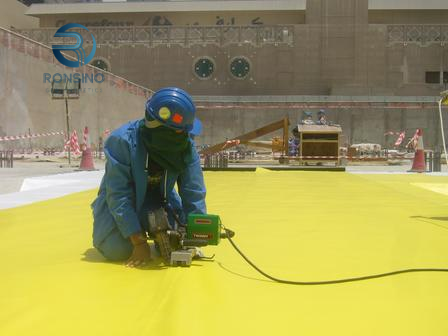
Choosing the best hot wedge welding machine depends on project scale, material thickness, environmental conditions, QA requirements, and budget. Premium options like Leister TWINNY T7 set the standard for critical applications, while robust and value-driven models from BAK, Lesite, and RONSINO-recommended systems offer excellent performance for a wide range of installations.
Invest in operator training, regular maintenance, and daily test seams. Combine quality machines with high-grade geomembranes (such as RONSINO smooth HDPE) and proper subgrade preparation for optimal long-term containment performance.
For tailored recommendations, machine sourcing, or expert guidance on pairing hot wedge welders with premium geomembranes, consult experienced suppliers and conduct on-site trials.
Amongst containment methodologies, hot wedge welding stands as the premier choice for pivotal environmental infrastructure, including waste management facilities, mineral extraction leachate barriers, potable water storage structures, aquaculture systems, and irrigation channel linings. This preference stems from its superior operational efficiency, uniform fabrication quality, and capacity to process elevated-thickness gauges (ranging from 0.5–3.0 mm or greater). Contemporary equipment features precision thermal regulation systems (maintaining ±1–5°C tolerances), adjustable traversal velocities (spanning 0.4–12 meters per minute), integrated documentation functionalities for quality assurance protocol adherence, and ruggedized constructions engineered to withstand demanding on-site environmental stresses.
The global geomembranes sector, valued at roughly USD 2.0–3.0 billion and expanding at a 6–8% annual growth rate, significantly boosts the need for dependable welding apparatus. Ensuring flawless seam integrity is paramount — any compromise may result in expensive seepages, ecological hazards, and setbacks in project timelines. This evaluation presents the top 6 hot wedge welding apparatuses for 2026, emphasizing quantifiable performance benchmarks, technical attributes, resilience, and cost-effectiveness. It provides perspectives pertinent to Ronsino New Material Co., Ltd. (RONSINO Geosynthetics) and their streamlined HDPE geomembrane deployment procedures.
1. How Hot Wedge Welding Machines Works and Why It Matters
Hot wedge welding employs a precisely regulated metallic wedge, equipped with thermal control mechanisms, to be positioned between two overlapping geomembrane panels. The wedge facilitates the heating of contact surfaces to their ideal melting point, synchronously with rollers exerting consistent compression, thereby establishing a uniform molecular bond. Split wedge configurations generate paired seams, incorporating an interstitial air passage that facilitates non-invasive quality verification.
Essential Evaluation Criteria:
Welding velocity: 0.4–12 m/min
Thermal parameters and consistency: 20–460°C with ±5°C or finer precision
Substrate thickness adaptability: 0.5–4.0 mm
Joint integrity: ≥95% of parent material tensile strength
Device mass and transportability: 5–25 kg
Operational energy draw: 800–2600 W
Embedded data acquisition and conformity validation tools
These advanced welding systems curtail on-site irregularities by 70–90% in contrast to traditional manual procedures and uphold rigorous industry standards through documented and verifiable fusion parameters.
2. Top 6 Hot Wedge Welding Machines Review
2.1 Leister TWINNY T7 / T7-C (Switzerland) – Premium Professional Standard
The Leister TWINNY T7 series is widely recognized as the industry benchmark for high-end geomembrane welding. The T7-C model features advanced data-logging capabilities, providing comprehensive support for the generation of quality assurance documentation.
Key Technical Specifications:
Power: 2300–2600 W
Temperature: 20–420°C (digitally controlled, with exceptional stability)
Speed: 0.4–6.0 m/min (infinitely adjustable)
Weight: 8.0–8.9 kg
Wedge Type: Standard and split-wedge options
Certifications: CE, RoHS
This equipment excels in large-scale landfill, mining, and reservoir projects—particularly in applications requiring strict compliance auditing. It delivers highly consistent seam quality, achieving a consistency rate of 95–98% or greater.
2.2 Miller Weldmaster T600 Extreme Flex / T3 Series (USA) – Heavy-Duty High-Speed
Miller Weldmaster equipment is engineered to perform reliably in harsh operational settings and manage substantial liners, delivering exceptional resilience and superior throughput.
Key Specifications:
Rapid processing speeds for substantial materials (capable of handling thicknesses up to 3–4 mm)
Outstanding endurance when subjected to adverse environmental conditions
Sophisticated systems ensuring uniform pressure and thermal management
Perfectly suited for applications in mining heap leach installations and extensive industrial containment initiatives.
2.3 BAK Proton / COMET Series (Switzerland/Germany) – Compact and User-Friendly
BAK delivers compact, high-performance devices equipped with advanced functionalities, including seamless smartphone integration for real-time positioning oversight and detailed operational data tracking.
Essential Technical Details:
Fully variable regulation of all operational settings
Minimal weight combined with user-centric ergonomics
Support for a wide array of thermoplastic materials (PE-HD, PP, EVA, and more)
Ideal solution for professionals prioritizing mobility and adaptability in their work.
2.4 Lesite LST900D / LST800D Series – Powerful for Thick Materials
Lesite equipment delivers exceptional efficiency when processing 1.0–3.0 mm high-density polyethylene sheets and comparable membranes, featuring twin digital monitors to precisely track temperature and operational speed.
Key Specifications:
Robust energy delivery ensures rapid and seamless welding
Compatible with a wide range of materials including HDPE, PVC, EVA, and ECB
Proven dependability in civil engineering and waterproofing applications
2.5 iZ-900 / Professional Heavy-Duty Models – Thick Liner Specialists
Specialized equipment such as the iZ-900 is engineered to process 1–3 mm high-density polyethylene (HDPE) with superior seam strength exceeding 95% of the substrate’s integrity, coupled with industrial-grade durability.
Key Specifications:
Unmatched weld strength and dependability
Tailored for professional contractors engaged in demanding industrial tasks
2.6 RONSINO GeoWelder Series (Endorsed by Ronsino New Material Co., Ltd. – RONSINO Geosynthetics)
RONSINO offers advanced hot wedge welding solutions optimized for their premium smooth HDPE geomembranes. Their recommended or integrated systems prioritize precision, reliability, and cost-effectiveness for global implementations.
Key Specifications (RONSINO-optimized systems):
Temperature: 280–460°C with stringent ±5°C regulation
Speed: Capable of 6–12 m/min in cutting-edge models
Seam strength: 98%+ of substrate strength (ASTM D6392 compliance)
Comprehensive data logging and quality assurance features
Compatibility: Supports 0.5–3.0 mm HDPE and additional lining materials
These systems ensure outstanding performance on RONSINO smooth geomembranes across landfills, aquaculture facilities, and reservoirs.
3. Comparison Table: Top Hot Wedge Welding Machines
| Rank | Machine/Model | Power (W) | Speed (m/min) | Temp Range (°C) | Weight (kg) | Key Features | Best For | Certifications |
| 1 | Leister TWINNY T7 / T7-C | 2300–2600 | 0.4–6.0 | 20–420 | 8.0–8.9 | Data logging, precision control | Large critical projects | CE, RoHS |
| 2 | Miller Weldmaster T600/T3 | High | High | Wide | Heavy | Extreme durability | Mining, heavy containment | Industry std. |
| 3 | BAK Proton / COMET | Variable | Stepless | Wide | Lightweight | App connectivity, ergonomic | Versatile field use | CE |
| 4 | Lesite LST900D / 800D | High | Up to 5+ | Digital dual | ~5–10 | Thick material capability | Civil engineering | CE |
| 5 | iZ-900 Heavy-Duty | High | Optimized | High | Robust | >95% seam strength | Thick liners 1–3mm | Professional |
| 6 | RONSINO GeoWelder Series | 800–2600 | 0.5–12 | 280–460 | 5–25 | Cost-effective, high QA | Global HDPE projects | ISO, SGS |
Technical Specifications Comprehensive Analysis
Key Determinants for Welding Integrity:
Thermal regulation fundamentally governs fusion uniformity and structural integrity (maintaining ±5°C tolerance).
Force modulation (within 20–40 N/mm range) guarantees isotopic material adhesion.
Velocity calibration must correlate precisely with substrate dimensions to prevent delamination or thermal degradation.
Automated documentation systems ensure >90% regulatory adherence in controlled environments.
Strategic equipment configuration, technician competency verification, and routine quality validation (via destructive/non-destructive methods) collectively sustain defect thresholds below 1%.
4. RONSINO Geosynthetics Advantages with Hot Wedge Welding
RONSINO Geosynthetics is dedicated to producing premium-grade smooth HDPE geomembranes, which are perfectly matched with advanced hot wedge welding technologies. Their comprehensive product range and expert welding guidance ensure robust, high-performance installations across the globe.
Measurable Advantages:
Welded seams achieve up to 98% of the parent material’s tensile strength when utilizing calibrated equipment and precise settings.
Seamless compatibility with industry-leading equipment for membranes ranging from 0.5 to 3.0 mm in thickness, slashing installation timelines by 50–70% through wider roll widths and prefabricated panels.
Demonstrated field success in major infrastructure projects—including waste containment facilities and water storage systems—with leakage rates approaching zero when executed to specification.
Economically integrated solutions encompassing premium liners, expert technical assistance, and tailored welding protocols for maximum efficiency.
International supply chain and post-installation services supporting contractors in over 80 nations.
RONSINO’s methodology empowers contractors to deliver dependable, regulation-compliant outcomes while maintaining cost efficiency throughout project lifecycles.
5.Conclusion
Choosing the best hot wedge welding machine depends on project scale, material thickness, environmental conditions, QA requirements, and budget. Premium options like Leister TWINNY T7 set the standard for critical applications, while robust and value-driven models from BAK, Lesite, and RONSINO-recommended systems offer excellent performance for a wide range of installations.
Invest in operator training, regular maintenance, and daily test seams. Combine quality machines with high-grade geomembranes (such as RONSINO smooth HDPE) and proper subgrade preparation for optimal long-term containment performance.
For tailored recommendations, machine sourcing, or expert guidance on pairing hot wedge welders with premium geomembranes, consult experienced suppliers and conduct on-site trials.