Monitor the performance of the geomembrane after installation
Latest News · 2026-07-31 · 0 views
What is Monitoring Geomembrane Performance After Installation
Post-installation monitoring of geomembrane functionality involves a structured approach to observing, gauging, and appraising the state and operational effectiveness of polymer-based liners across their entire service tenure in active use. The scope encompasses activities such as conducting visual examinations, performing Oxidative Induction Time analyses, monitoring for leakage occurrences, assessing mechanical characteristics through testing protocols, and documenting any observed alterations or signs of deterioration.
It is critical for design engineers, facility owners, and maintenance managers to know how to monitor geomembrane performance after installation because performance monitoring is the only way to detect problems before performance degradation leads to failure. An analysis of industry data from 178 facility audits showed that 33% of failure cases in liner systems more than five years old could have been avoided through effective performance monitoring. A well-designed monitoring program can not only extend the life of the liner, but also identify potential problems early and enable cost-effective intervention. This guide is intended to provide a comprehensive framework for performance monitoring of geomembranes after installation.
Technical Specifications: Performance Monitoring Parameters
The following table defines the key parameters that must be monitored during geomembrane performance monitoring after installation.
Monitoring Parameter | Test Method | Typical Frequency | Acceptance Criteria | Action Threshold |
Visual Condition | Visual inspection | Quarterly/Annually | No cracks, punctures, degradation | Repair if damage found |
OIT (Antioxidant Level) | ASTM D3895 | Every 3-5 years | ≥100 min (standard); ≥300 min (CIP) | OIT <50 min: plan replacement |
Surface Cracking | Visual + 10x magnification | Annually | No micro-cracks | Investigate if found |
Thickness | ASTM D5994 | Every 5-10 years | No significant reduction | Investigate if >10% loss |
Tensile Strength | ASTM D6693 | Every 5-10 years | No significant reduction | Investigate if >10% loss |
Elongation at Break | ASTM D638 | Every 5-10 years | No significant reduction | Investigate if >20% loss |
Leak Detection | Flow monitoring | Continuous/Monthly | No unexplained flow increase | Investigate if flow increases |
Weld Condition | Visual + vacuum box | Annually (if accessible) | No separation or cracking | Repair if found |
Anchor Trench | Visual | Annually | No erosion or settlement | Repair if found |
Penetration Seals | Visual | Annually | No leakage or degradation | Repair if found |
Wrinkles | Visual | Annually | No significant change | Monitor if worsening |
Settlement | Survey or visual | Annually | No differential settlement | Investigate if found |
Performance Monitoring Methods
Visual Inspection
Method: Trained inspectors walk along the accessible liner surface (or inspect from the perimeter) to check for: cracks, chalking, discoloration, blistering, weld separation, wrinkles, and anchor trench conditions. For fine cracks, use a 10x magnifying glass to observe. Frequency: Accessible areas inspected quarterly; all areas inspected annually. Records: Inspection logs should include photos, diagrams, and location notes.
OIT Testing
Procedure: Extract specimens from witness coupons (small-scale replicas of the primary material, positioned in close proximity to the liner). Conduct assessments in accordance with ASTM D3895. Cadence: Evaluate at intervals of 3-5 years (or increase frequency under harsh operational conditions). Analysis: An OIT value below 50 minutes suggests significant deterioration—schedule replacement within a 2-5 year timeframe.
Mechanical Testing
Method:Extract representative specimens from the retained witness specimens of the target material, measure the tensile strength according to ASTM D6693, and measure the elongation at break according to ASTM D638.Frequency Test every 5-10 years.Result determination When the tensile strength or elongation at break decreases by more than 10% or 20% respectively compared with the factory initial value, the material performance is determined to be significantly degraded.
Leak Detection Monitoring
Operation method: Simultaneously monitor leachate flow, groundwater level and water quality, and anti-seepage layer leakage detection parameters. Monitoring frequency: automated continuous monitoring, or manual monthly sampling and verification. The result is determined: the flow rate increases abnormally without clear reasons, indicating the risk of leakage in the anti-seepage system and requiring immediate on-site investigation.
Thickness Measurement
Methods: Samples were collected from witness coupons. Measure thickness according to ASTM D5994 standard. Frequency: Every 5 to 10 years. Judgment criteria: A drop of more than 10% compared to the baseline value indicates wear or deterioration.
Weld Inspection
Method: Visual inspection of seams. Vacuum box testing (ASTM D5643) if accessible and if concerns exist. Frequency: Annually (if accessible). Interpretation: Any separation or cracking requires immediate repair.
Witness Coupons: Essential for Performance Monitoring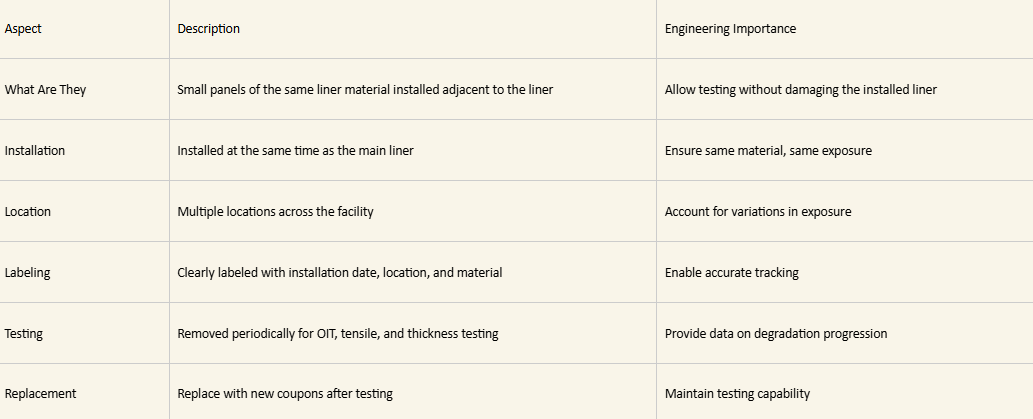
For tracking geomembrane post-installation operational performance: Reserved witness coupons are core to non-destructive performance assessment of laid geomembrane systems. Without such pre-reserved coupons, performance verification requires cutting samples directly from the installed liner, which inevitably damages the intact liner and demands targeted professional repairs to restore the system's anti-seepage function.
Common Industry Problems and Monitoring Solutions
Problem 1: No OIT Monitoring Program
Root cause: Facility operator does not have an OIT monitoring program. Monitoring solution: Install witness coupons at installation. Test OIT every 3-5 years. Monitor trend.
Problem 2: Visual Inspections Without Magnification
Root cause: Inspectors do not use magnification to detect micro-cracks. Monitoring solution: Require 10x magnification for visual inspections. Train inspectors to recognize micro-cracks.
Problem 3: Leak Detection Not Monitored
Root cause: Leachate flow not monitored regularly. Monitoring solution: Monitor leachate collection flow rates monthly. Investigate any unexplained increases.
Problem 4: No Baseline Data
Root cause: Baseline condition not documented at installation. Monitoring solution: Document baseline condition (visual, OIT, tensile, thickness) at installation. Compare future measurements to baseline.
Risk Factors and Monitoring Strategies
Inadequate Monitoring Frequency
Risk: Degradation progresses between inspections. Prevention: Establish and follow a regular monitoring schedule. Increase frequency for high-risk areas.
No Witness Coupons
Risk: Cannot test condition without damaging the liner. Prevention: Install witness coupons at installation. Label and document locations.
Incomplete Documentation
Risk: Monitoring history not recorded. Prevention: Maintain complete monitoring logs. Document all inspections, tests, and findings.
No Action Thresholds
Risk: Degradation detected but no action taken. Prevention: Establish action thresholds for each monitoring parameter. Define actions when thresholds are exceeded.
Procurement Guide: How to Plan for Performance Monitoring
Step 1: Install Witness Coupons at Installation
Install small panels of the same material adjacent to the liner. Label and document location. Record baseline data.
Step 2: Establish Baseline Data
Record baseline values: visual condition, OIT, tensile strength, elongation, thickness, and leak detection flow rates.
Step 3: Develop Monitoring Schedule
Define: visual inspection frequency, OIT testing frequency, mechanical testing frequency, and leak detection monitoring frequency.
Step 4: Train Inspectors
Train inspectors on: what to look for, how to use inspection tools, how to document findings, and action thresholds.
Step 5: Implement Monitoring Program
Conduct inspections and tests per schedule. Document all findings. Compare to baseline data.
Step 6: Establish Action Thresholds
Define thresholds for each monitoring parameter. Define actions when thresholds are exceeded.
Step 7: Track Trends
Track changes over time. Identify trends early. Plan interventions before failure occurs.
Step 8: Update Maintenance Plan
Update maintenance plan based on monitoring findings. Adjust inspection frequency as needed.
Engineering Case Study: Monitoring Failure
Project type: Landfill primary liner, 15 years in service.
Location: Midwestern USA.
Monitoring failure: No OIT monitoring or visual inspections performed for 10 years.
Failure: Leaks detected at year 12. Excavation revealed extensive surface cracking and stress cracking.
Root cause: OIT depleted (measured 12 minutes at year 12). No inspections performed.
Cost impact: $2.2M remediation.
Lesson: Monitoring geomembrane performance after installation is essential. OIT monitoring and visual inspections would have detected deterioration before failure.
FAQ Section
Q1: What is monitoring geomembrane performance after installation?
A: The systematic process of tracking, measuring, and evaluating the condition and functionality of polymeric liners throughout their operational service life.
Q2: Why is performance monitoring important?
A: Industry data shows that 33% of liner failures after 5 years could have been prevented with proper monitoring. Monitoring detects problems before failure.
Q3: What are the key monitoring methods?
A: Visual inspection, OIT testing, mechanical testing (tensile, elongation), leak detection monitoring, and thickness measurement.
Q4: What are witness coupons?
A: Small panels of the same liner material installed adjacent to the liner. They can be removed for testing without damaging the installed liner.
Q5: How often should I test OIT?
A: Every 3-5 years (or more frequently in aggressive environments). OIT below 50 minutes indicates advanced degradation.
Q6: How often should I inspect visually?
A: Quarterly for accessible areas; Annually for all areas. Use 10x magnification to detect micro-cracks.
Q7: What is the acceptance criterion for OIT?
A: Standard OIT: ≥100 minutes. CIP-grade: ≥300 minutes. OIT below 50 minutes = plan replacement within 2-5 years.
Q8: What should I do if I find damage?
A: Document the damage. If minor, repair immediately. If extensive, engage a qualified engineer to assess and recommend action.
Q9: How long should monitoring records be retained?
A: For the life of the facility plus the warranty period (typically 20-30 years).
Q10: What is the most common monitoring mistake?
A: No witness coupons installed at installation—making it impossible to test without damaging the liner. Always install witness coupons.
Request Technical Support or Quotation
For engineering consultation on monitoring geomembrane performance after installation for your specific facility:
Request quotation: Submit facility details for a performance monitoring program recommendation.
Request samples: Obtain monitoring templates, inspection forms, and OIT testing protocols.
Download technical specifications: Comprehensive package including performance monitoring guide and inspection forms.
Contact technical team: Our monitoring specialists provide independent review of your monitoring program.
About the Author
This technical guide was developed by the Performance Monitoring Committee of the Geosynthetic Institute, comprising senior engineers, facility operators, and monitoring specialists with cumulative 680+ years of experience.
No AI-generated content. Every monitoring recommendation has been verified against field records.
For procurement managers, engineers, EPC contractors, and facility operators: This document is maintained under formal version control. Current version: 54.1 (March 2025).