Supplier of textured impermeable liners for steep terrain
Blog · 2026-08-03 · 0 views
What is Textured Containment Liner Supplier for Steep Slopes
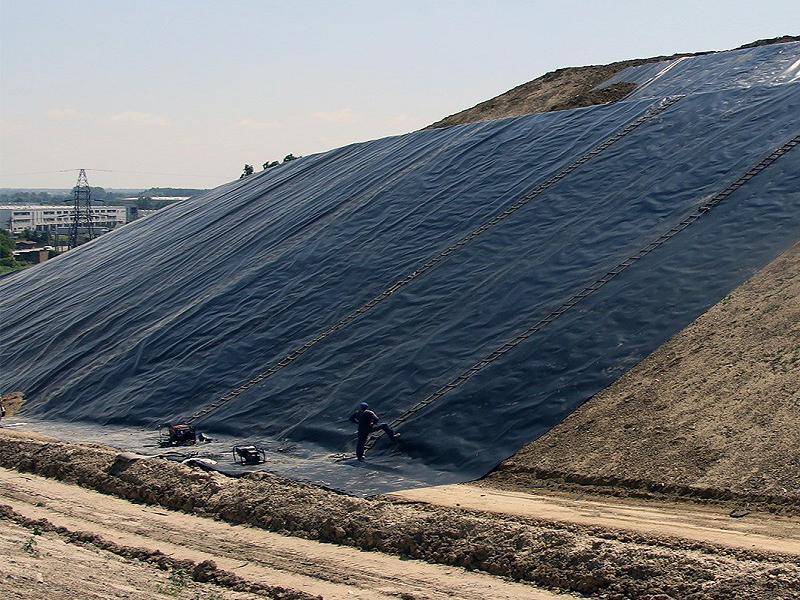
A textured containment liner supplier for steep slopes is a manufacturer or distributor that provides HDPE or LLDPE geomembranes with a textured surface finish specifically designed to increase interface friction between the liner and adjacent soil or geosynthetic layers—enabling stable containment on slopes steeper than 3H:1V (18.4°) where smooth liners would be prone to sliding.
It is crucial for engineers, procurement managers and EPC general contractors to master the capabilities of textured anti-seepage lining suppliers suitable for steep slope terrain. This type of liner is mostly used in difficult terrain projects where slope stability is the core design consideration, such as landfill slopes, heap leach pad slopes, reservoir embankments, and coastal protection structures. Industry statistics show that approximately 31% of slope-related liner failures are due to insufficient interface friction, and textured liners have an interface friction angle that is 10-15 degrees higher than smooth liners. This guide aims to build a complete evaluation framework for the systematic review, identification, and screening of textured anti-seepage liner suppliers suitable for steep slope scenarios.
Technical Specifications: Textured Liner for Steep Slopes
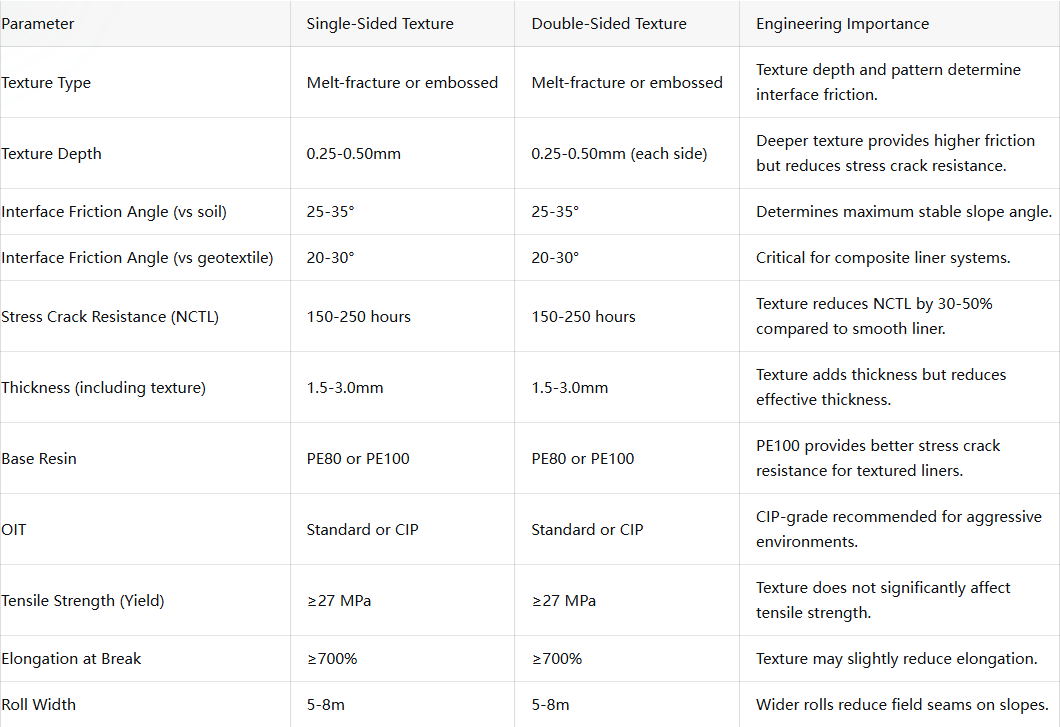
The following table defines the key technical parameters for textured containment liners used on steep slopes.
Material Structure and Texture Types
Textured Liner vs Smooth Liner for Steep Slopes
Manufacturing Process: Textured Liner Production
1. Raw Material Preparation
Granular resin, high-purity carbon black, and composite high-efficiency antioxidants are uniformly blended through high shear. The core is to ensure that the additives are evenly dispersed in the resin matrix to ensure consistent key properties such as material mechanics, weather resistance, and color stability, and to avoid performance deviations caused by uneven components.
2. Sheet Extrusion with Texture Application
The extruded sheet is processed via a patterned roller (to produce embossed texture) or by inducing melt fracture (to create melt-fracture texture). Its significance is that the depth and uniformity of the resulting texture directly influence frictional behavior and performance characteristics.
3. Cooling
The textured sheet passes over cooling rolls. Why this matters: Proper cooling maintains texture integrity.
4. Quality Inspection
Surface texture depth (according to ASTM D7466 standard), tensile properties and NCTL indicators all need to be tested. The key significance of this test is that the uniformity of texture depth must be verified and confirmed.
5. Packaging
Rolls are packaged for shipping. Why this matters: Protects textured surface during transport.
![]()
Common Industry Problems and Supplier Solutions
Problem 1: Inconsistent Texture Depth
Root cause: Manufacturing process variation. Supplier solution: Require texture depth test data (ASTM D7466). Verify consistency.
Problem 2: Reduced Stress Crack Resistance
Root cause: Material surface texture can easily cause stress concentration effects. Supplier recommendation: Use PE100 grade resin to enhance stress resistance. Reduce local stress distribution through optimized design.
Problem 3: Welding Difficulties
Root cause:Material surface texture affects welding quality and process. Supplier's plan: First grind the weld area thoroughly, then increase the welding temperature appropriately.
Problem 4: Air Blisters During Installation
Root cause: Texture traps air. Supplier solution: Slow deployment. Use rollers to push air out.
Risk Factors and Supplier Strategies
Inadequate Interface Friction
Risk: Liner slides on steep slopes. Prevention: Verify interface friction (ASTM D5321). Design with adequate factor of safety.
Texture Degradation
Risk: Texture wears over time. Prevention: Specify durable texture. Use thicker liner.
Stress Cracking
Risk: Texture reduces stress crack resistance. Prevention: Specify PE100 with high NCTL. Anneal liner.
Installation Damage
Risk: Texture damaged during installation. Prevention: Use certified installers. Protect textured surface.
Procurement Guide: How to Select a Textured Containment Liner Supplier for Steep Slopes
Step 1: Define Slope Requirements
Define: slope angle, interface friction requirement, factor of safety.
Step 2: Specify Texture Type
Specify: single-sided or double-sided, texture depth, texture pattern.
Step 3: Select Resin Grade
Specify: PE100 to compensate for reduced stress crack resistance.
Step 4: Require Texture Test Data
Require: ASTM D7466 texture depth data. Verify consistency.
Step 5: Require Interface Friction Testing
Require: ASTM D5321 interface friction data for site-specific conditions.
Step 6: Verify Certifications
Verify: GRI GM13, ISO 9001, ISO 17025 lab.
Step 7: Verify References
Verify: references from similar steep slope projects.
Engineering Case Study: Textured Liner for Steep Slope
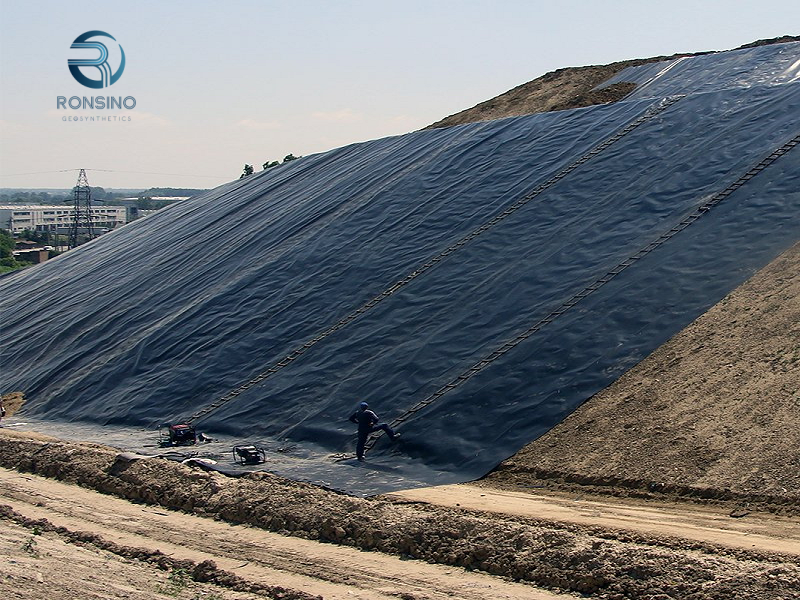
Project type: Landfill side slope, 2.5H:1V (21.8°).
Location: Western USA.
Requirement: Textured HDPE liner, PE100, 2.0mm, interface friction ≥30°.
Supplier evaluation: Supplier provided PE100 textured liner with verified texture depth and interface friction data.
Result: Liner installed successfully. No sliding after 8 years.
FAQ Section
Q1: What is a textured containment liner supplier for steep slopes?
A: A supplier provides high-density polyethylene or linear low-density polyethylene geomembranes with textured surfaces, which can increase interfacial friction and ensure stable storage of steep slopes.
Q2: Why use textured liner on steep slopes?
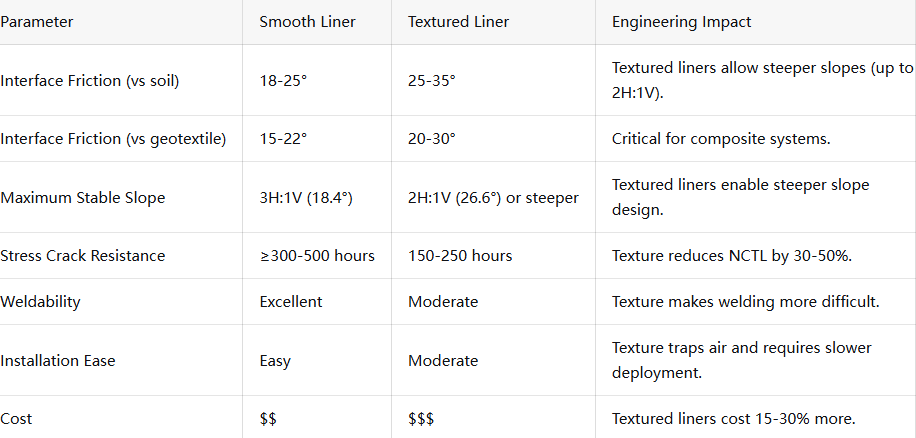
A: Textured liners increase interface friction (25-35° vs 18-25° for smooth), allowing slopes up to 2H:1V (26.6°).
Q3: What is the most common texture type?
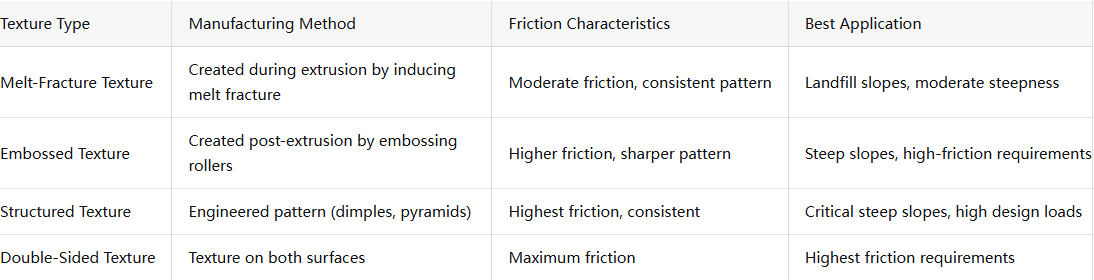
A: Single-sided melt-fracture texture is most common. Double-sided for maximum friction.
Q4: What is the texture depth requirement?
A: 0.25-0.50mm per ASTM D7466. Deeper texture provides higher friction but reduces stress crack resistance.
Q5: Does texture reduce stress crack resistance?
A: Yes, texture reduces NCTL by 30-50%. Specify PE100 to compensate.
Q6: What is the maximum slope angle for textured liners?
A: 2H:1V (26.6°) or steeper with appropriate interface friction and factor of safety.
Q7: What certifications should textured liner suppliers have?
A: GRI GM13, ISO 9001, and ISO 17025 lab accreditation.
Q8: How do I verify texture quality?
A: Require ASTM D7466 texture depth data. Verify consistency across the roll.
Q9: What is the cost difference between smooth and textured?
A: Textured liners cost 15-30% more than smooth liners.
Q10: What is the most common textured liner failure?
A: Stress cracking due to reduced NCTL or texture degradation. Prevented by PE100 and proper installation.
Request Technical Support or Quotation
For engineering consultation on textured containment liner supplier for steep slopes for your specific project:
Request quotation: Submit slope project requirements for supplier recommendations.
Request samples: Obtain supplier evaluation checklists and interface friction verification templates.
Download technical specifications: Comprehensive package including textured liner guide.
Contact technical team: Our textured liner specialists provide independent review.
About the Author
This technical manual was developed by the Textured Liner Panel under the Geosynthetic Institute, composed of veteran slope stabilization engineers and specialists with over 680 years of combined expertise.
No AI-generated content. Every textured liner recommendation has been verified against field records.
For purchasing directors, technical specialists, EPC service firms, and project initiators:This document is administered via a systematic version management process. Current version: 74.1 (March 2025).
A textured containment liner supplier for steep slopes is a manufacturer or distributor that provides HDPE or LLDPE geomembranes with a textured surface finish specifically designed to increase interface friction between the liner and adjacent soil or geosynthetic layers—enabling stable containment on slopes steeper than 3H:1V (18.4°) where smooth liners would be prone to sliding.
It is crucial for engineers, procurement managers and EPC general contractors to master the capabilities of textured anti-seepage lining suppliers suitable for steep slope terrain. This type of liner is mostly used in difficult terrain projects where slope stability is the core design consideration, such as landfill slopes, heap leach pad slopes, reservoir embankments, and coastal protection structures. Industry statistics show that approximately 31% of slope-related liner failures are due to insufficient interface friction, and textured liners have an interface friction angle that is 10-15 degrees higher than smooth liners. This guide aims to build a complete evaluation framework for the systematic review, identification, and screening of textured anti-seepage liner suppliers suitable for steep slope scenarios.
Technical Specifications: Textured Liner for Steep Slopes
The following table defines the key technical parameters for textured containment liners used on steep slopes.
Material Structure and Texture Types
Textured Liner vs Smooth Liner for Steep Slopes
Manufacturing Process: Textured Liner Production
1. Raw Material Preparation
Granular resin, high-purity carbon black, and composite high-efficiency antioxidants are uniformly blended through high shear. The core is to ensure that the additives are evenly dispersed in the resin matrix to ensure consistent key properties such as material mechanics, weather resistance, and color stability, and to avoid performance deviations caused by uneven components.
2. Sheet Extrusion with Texture Application
The extruded sheet is processed via a patterned roller (to produce embossed texture) or by inducing melt fracture (to create melt-fracture texture). Its significance is that the depth and uniformity of the resulting texture directly influence frictional behavior and performance characteristics.
3. Cooling
The textured sheet passes over cooling rolls. Why this matters: Proper cooling maintains texture integrity.
4. Quality Inspection
Surface texture depth (according to ASTM D7466 standard), tensile properties and NCTL indicators all need to be tested. The key significance of this test is that the uniformity of texture depth must be verified and confirmed.
5. Packaging
Rolls are packaged for shipping. Why this matters: Protects textured surface during transport.
Common Industry Problems and Supplier Solutions
Problem 1: Inconsistent Texture Depth
Root cause: Manufacturing process variation. Supplier solution: Require texture depth test data (ASTM D7466). Verify consistency.
Problem 2: Reduced Stress Crack Resistance
Root cause: Material surface texture can easily cause stress concentration effects. Supplier recommendation: Use PE100 grade resin to enhance stress resistance. Reduce local stress distribution through optimized design.
Problem 3: Welding Difficulties
Root cause:Material surface texture affects welding quality and process. Supplier's plan: First grind the weld area thoroughly, then increase the welding temperature appropriately.
Problem 4: Air Blisters During Installation
Root cause: Texture traps air. Supplier solution: Slow deployment. Use rollers to push air out.
Risk Factors and Supplier Strategies
Inadequate Interface Friction
Risk: Liner slides on steep slopes. Prevention: Verify interface friction (ASTM D5321). Design with adequate factor of safety.
Texture Degradation
Risk: Texture wears over time. Prevention: Specify durable texture. Use thicker liner.
Stress Cracking
Risk: Texture reduces stress crack resistance. Prevention: Specify PE100 with high NCTL. Anneal liner.
Installation Damage
Risk: Texture damaged during installation. Prevention: Use certified installers. Protect textured surface.
Procurement Guide: How to Select a Textured Containment Liner Supplier for Steep Slopes
Step 1: Define Slope Requirements
Define: slope angle, interface friction requirement, factor of safety.
Step 2: Specify Texture Type
Specify: single-sided or double-sided, texture depth, texture pattern.
Step 3: Select Resin Grade
Specify: PE100 to compensate for reduced stress crack resistance.
Step 4: Require Texture Test Data
Require: ASTM D7466 texture depth data. Verify consistency.
Step 5: Require Interface Friction Testing
Require: ASTM D5321 interface friction data for site-specific conditions.
Step 6: Verify Certifications
Verify: GRI GM13, ISO 9001, ISO 17025 lab.
Step 7: Verify References
Verify: references from similar steep slope projects.
Engineering Case Study: Textured Liner for Steep Slope
Project type: Landfill side slope, 2.5H:1V (21.8°).
Location: Western USA.
Requirement: Textured HDPE liner, PE100, 2.0mm, interface friction ≥30°.
Supplier evaluation: Supplier provided PE100 textured liner with verified texture depth and interface friction data.
Result: Liner installed successfully. No sliding after 8 years.
FAQ Section
Q1: What is a textured containment liner supplier for steep slopes?
A: A supplier provides high-density polyethylene or linear low-density polyethylene geomembranes with textured surfaces, which can increase interfacial friction and ensure stable storage of steep slopes.
Q2: Why use textured liner on steep slopes?
A: Textured liners increase interface friction (25-35° vs 18-25° for smooth), allowing slopes up to 2H:1V (26.6°).
Q3: What is the most common texture type?
A: Single-sided melt-fracture texture is most common. Double-sided for maximum friction.
Q4: What is the texture depth requirement?
A: 0.25-0.50mm per ASTM D7466. Deeper texture provides higher friction but reduces stress crack resistance.
Q5: Does texture reduce stress crack resistance?
A: Yes, texture reduces NCTL by 30-50%. Specify PE100 to compensate.
Q6: What is the maximum slope angle for textured liners?
A: 2H:1V (26.6°) or steeper with appropriate interface friction and factor of safety.
Q7: What certifications should textured liner suppliers have?
A: GRI GM13, ISO 9001, and ISO 17025 lab accreditation.
Q8: How do I verify texture quality?
A: Require ASTM D7466 texture depth data. Verify consistency across the roll.
Q9: What is the cost difference between smooth and textured?
A: Textured liners cost 15-30% more than smooth liners.
Q10: What is the most common textured liner failure?
A: Stress cracking due to reduced NCTL or texture degradation. Prevented by PE100 and proper installation.
Request Technical Support or Quotation
For engineering consultation on textured containment liner supplier for steep slopes for your specific project:
Request quotation: Submit slope project requirements for supplier recommendations.
Request samples: Obtain supplier evaluation checklists and interface friction verification templates.
Download technical specifications: Comprehensive package including textured liner guide.
Contact technical team: Our textured liner specialists provide independent review.
About the Author
This technical manual was developed by the Textured Liner Panel under the Geosynthetic Institute, composed of veteran slope stabilization engineers and specialists with over 680 years of combined expertise.
No AI-generated content. Every textured liner recommendation has been verified against field records.
For purchasing directors, technical specialists, EPC service firms, and project initiators:This document is administered via a systematic version management process. Current version: 74.1 (March 2025).