
Textured HDPE Geomembrane for Tailing Project in Chile
CASE · 2025-12-08 · 0 views
CASE STUDY
Location : Chile
Product(s) : Textured HDPE Geomembrane
Application : Tailing Project
Benefits
Textured HDPE Geomembrane is specially designed for landfill and mining projects and has excellent stability, high friction coefficient and strong adaptability. As one of our geomembrane solutions, it is widely used in landfill liners, steep slope reinforcement, leachate cushions, anti-seepage facility bases, as well as water conservancy projects (such as dams, reservoirs, sewage treatment tanks, swimming pools) and commercial construction, underground engineering, waste treatment and mineral mining.Its simple installation process, excellent durability, high cost performance and diverse performance make it an ideal choice for stabilizing the ground surface under complex geological conditions (especially fractured or exposed slopes) and providing reliable protection in harsh environments.
Features of HDPE Textured Geomembrane Liner
Single-side or double-side texturing is available upon request.
High friction coefficient suits steep slope applications.
Excellent UV and chemical resistance.
Superior resistance to UV-induced degradation and environmental stress cracking.
High tensile strength, low elongation rate.
Synergizes with geotextiles to enhance friction, tensile performance and structural reinforcement.
Exceptional water tightness, corrosion resistance and aging resistance.
Advanced stabilization performance.
Functions: impermeable, anti-fouling, skid-proof.
Lightweight design allows easy installation and ensures good overall continuity.
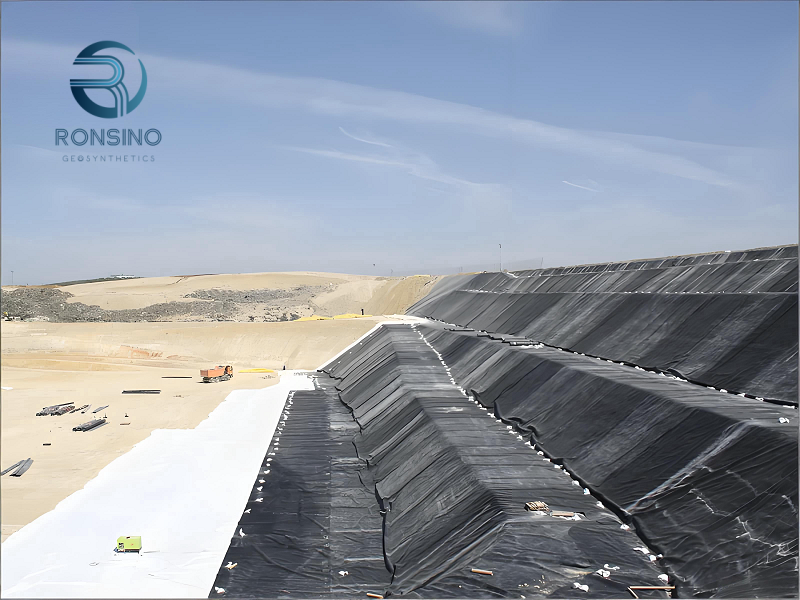
Construction method of Textured HDPE Geomembrane
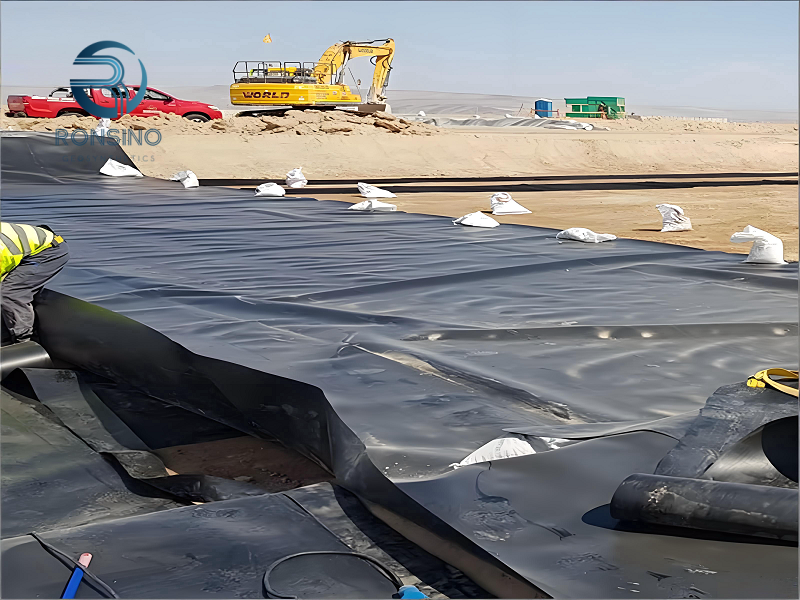
Prior to the installation of impermeable geomembrane, the slope surface must be smoothed to eliminate sharp protrusions, after which the impermeable HDPE geomembrane shall be laid over loose soil areas.
The geomembrane should be unrolled from the slope bottom to the top, without being stretched overly tight. A 1.50% allowance must be reserved to accommodate local settlement and stretching. However, in consideration of on-site project conditions, slope laying may be implemented in a top-to-bottom sequence instead.
Adjacent longitudinal seams are prohibited from being aligned horizontally; a staggering distance of over 1 meter between such seams is required.
Longitudinal joints should be positioned at a distance of more than 1.50 meters from dam toes and bending points, and must be arranged on flat plane areas only.
The construction sequence shall follow the principle of slope first, then base.
When laying the geomembrane on slopes, the unrolling direction should be kept roughly parallel to the maximum slope line.
Slope Laying ProcedureBefore placing the impermeable geomembrane on slopes, the target laying area shall be inspected and measured. Based on the measured dimensions, appropriately sized impermeable geomembrane rolls shall be transported to the anchorage trench platform of Phase I. In light of actual site circumstances, the geomembrane is to be unrolled using a top-to-bottom "push-laying" method for operational convenience. For sector-shaped areas, reasonable cutting is necessary to ensure the upper and lower ends can be securely anchored.
Base Laying ProcedurePrior to installation, the base laying area must undergo inspection and measurement. Geomembrane rolls with matching dimensions shall be transported to the designated location according to the measured data. During the laying process, manual pushing shall be adopted to unroll the geomembrane in a predetermined direction.
Alignment and Lap-Joint ArrangementWhether laid on slopes or the base, RONSINO HDPE textured geomembrane must be positioned smoothly and neatly, with no wrinkles or ripples allowed, to ensure proper alignment between adjacent geomembrane sheets. In accordance with design specifications, the lap width is generally set at approximately 10 centimeters.
Securing with Weighting MaterialsOnce aligned properly, RONSINO HDPE textured geomembrane shall be weighted down with sandbags promptly to prevent displacement caused by wind forces.
Laying at Anchorage TrenchesAt the top section of anchorage trenches, a specified length of impermeable geomembrane shall be reserved as per design requirements, to account for potential local settlement and stretching.
Longitudinal Joint RequirementsFor longitudinal joints, the uphill geomembrane sheet shall overlap the downhill sheet on top, with a minimum lap length of 15 centimeters guaranteed. After the geomembrane area passes acceptance inspection, bentonite pads shall be laid in the same zone using a manual push-laying method in a set direction.
Issue
Mine tailings are the fine residual particles produced from ore extraction operations, with their grain size varying according to ore properties and milling techniques. Usually in the form of wet slurry, tailings are commonly stored above ground behind earthen dams—a practice that has turned into a high-pollution link in related engineering projects. As a result, tailings storage and handling have become a critical environmental concern.
Many tailings are toxic and need to be permanently isolated from the environment. Both the raw tailings and processed tailings-related products are hazardous goods that can cause significant environmental damage. Without proper protection, toxic pollutant leakage will contaminate groundwater and gravely endanger environmental safety.
Following tailings excavation, Chilean clients decided to lay a protective geomembrane for seepage prevention. Yet the complicated terrain at the construction site has increased the difficulty of construction work. It is worth noting that tailings containment facilities are among the world’s biggest man-made constructions.
Solution
For tailings storage lagoons and treatment ponds in mining operations, HDPE textured geomembranes serve as a cost-efficient and optimal solution for slope protection and dam reinforcement. The technical principle behind its application on complex, fractured open-air slopes is outlined below.
The impervious HDPE textured geomembrane liner can block rainwater from infiltrating the soil, thus avoiding the adverse impact of rain-induced soil loosening on the underlying stratum. Its single-side textured surface offers enhanced frictional strength and structural stability, which prevents the reduction of mechanical parameters on potential sliding planes or the loss of slope stability and subsequent overall slippage caused by increased self-weight.
By implementing HDPE impermeable geomembrane technology for slope protection and reinforcement on complex, fractured open-pit slopes, the risk of slope slippage can be effectively mitigated—even when the slope develops extensive through-cracks under prolonged rainfall exposure.
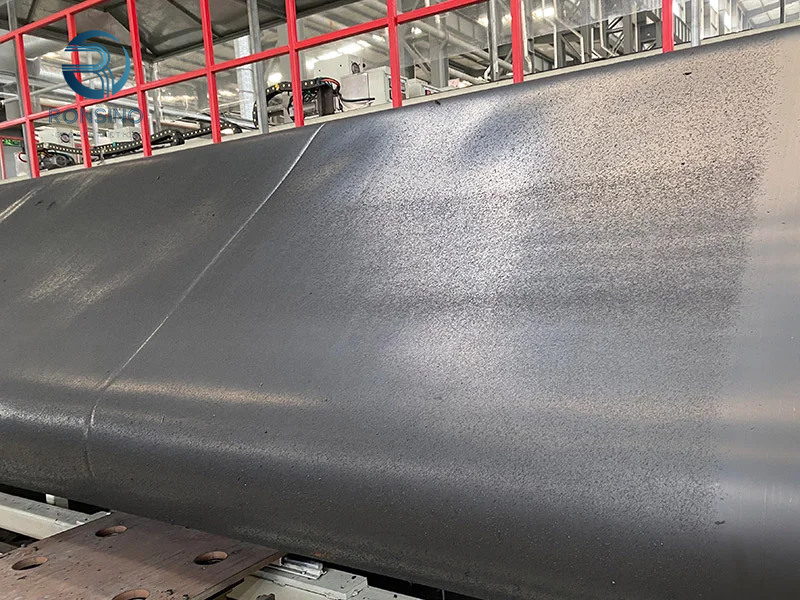
Specifications of Textured HDPE Geomembrane for Tailing Project in Chile
Total HDPE Textured Geomembrane quantity – 160,000 squares meters
Thickness – 2.0mm
Each roll size – 7m*50m
Summary
RONSINO geomembranes are engineered using premium virgin polyethylene resin as the core raw material, blended with a proprietary formula incorporating carbon black, anti-aging agents, UV stabilizers and other functional additives. Manufactured via state-of-the-art fully automated production lines, these materials are formed through either three-layer co-extrusion blow molding or calendering processes, resulting in a high-performance waterproof barrier engineered for demanding civil engineering applications.
We have supplied a comprehensive range of cutting-edge geomembranes and complementary geosynthetic products to clients across more than 120 countries worldwide. Our customer base spans diverse regions, with major partners located in Chile, France, Sweden, the UK, Hong Kong, Hungary, New Zealand, Poland, Mexico, Ecuador, Brazil, Pakistan, Bangladesh, Thailand, Vietnam, Malaysia, Indonesia, Singapore, the Philippines, Sri Lanka, India, the UAE, Saudi Arabia, Qatar, Kenya, Ghana, Ethiopia, Somalia, Nigeria, South Africa, Eswatini and Mongolia.
In recent years, RONSINO has allocated over 2 million US dollars to upgrade its modern manufacturing facility. The investment has been directed towards enhancing core production infrastructure, upgrading manufacturing equipment, optimizing workplace conditions, improving employee compensation and benefits, as well as funding technical and team collaboration training programs.
Our advanced production base is outfitted with a full suite of sophisticated machinery, including blow film geomembrane production lines, extrusion geomembrane production lines, PET geogrid production lines and geotextile production lines, among other specialized equipment. This robust setup enables us to maintain stringent product quality standards, shorten lead times and offer cost-competitive solutions to fulfill the requirements of our global clientele. The majority of our geomembranes and geosynthetics are on par with international leading counterparts, with several product lines—particularly our smooth HDPE geomembrane liners and composite geomembrane liners—holding market-leading positions.
We warmly welcome you to visit our geomembrane manufacturing facility in person.
About RONSINO
As the the professional geomembrane manufacturer and supplier, RONSINO has been dedicated to supplying one stop geomembranes and services to worldwide customers since its foundation in 2010. Our main innovaTextured HDPE Geomembrane for Tailing Project in Chile


