Unxial Plastic Geogrid for Road Construction in Sweden
CASE · 2025-11-11 · 0 views
Case Study
Location : Sweden
Product(s) : Unxial Plastic Geogrid 150kN
Application : Road Construction
Key Points of Construction
Site PreparationThe construction area intended for uniaxial plastic geogrid installation must be compacted, leveled, and kept horizontal, with all sharp protrusions eliminated beforehand.
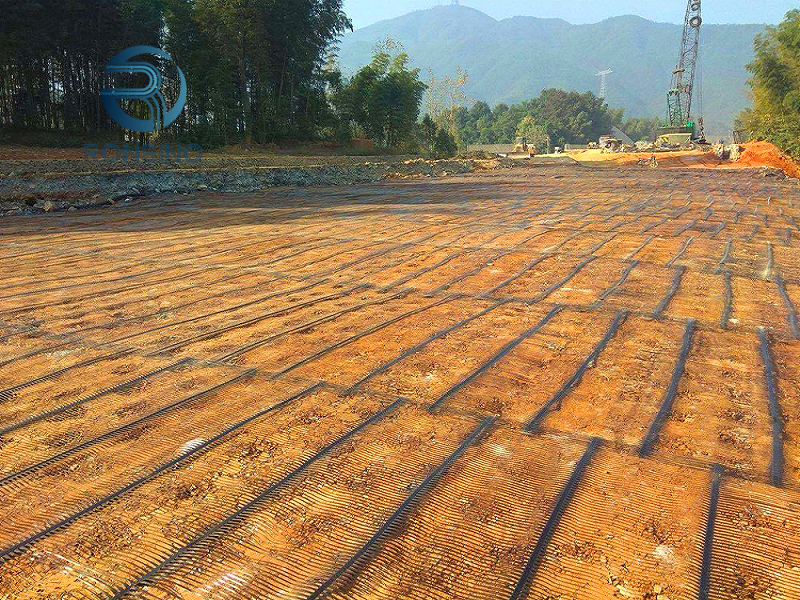
Geogrid Laying ProceduresOn the pre-compacted, flat site, the geogrid shall be placed such that its primary stress orientation (longitudinal direction) runs perpendicular to the embankment axis. The laying must be smooth, wrinkle-free, and stretched as tightly as feasible. Securing can be achieved via anchoring pegs and the weight of earth or rock fill. Notably, the geogrid should remain joint-free along its entire length in the main stress direction. Adjacent sheets may be joined manually through lashing and overlapping, with the lap width being no less than 10 centimeters. For multi-layer installations, the seams of adjacent layers need to be offset from one another. Once large-area laying is finished, overall flatness shall be adjusted accordingly. After placing a layer of fill soil, re-compaction is required prior to rolling operations.
The geogrid shall be tensioned either manually or by machinery, with uniform force applied to ensure it stays in a straight, stressed condition within the soil.
Filler Material SelectionFill materials shall be chosen in accordance with design specifications. Practical experience demonstrates that most soil types are suitable, excluding frozen soil, bog soil, domestic refuse, chalky soil, and diatomaceous earth. Gravelly soil and sandy soil are particularly recommended as preferred options, owing to their stable mechanical properties and minimal susceptibility to moisture content fluctuations. The maximum particle size of fill materials shall not exceed 15 centimeters, and proper gradation control is essential to guarantee compaction quality.
Fill Paving and CompactionUpon completion of geogrid placement and positioning, fill covering shall be carried out promptly, with the maximum allowable exposure time of the geogrid not exceeding 48 hours. An alternative construction method involves the sequential laying and backfilling process: first, place fill at both ends to fix the geogrid in position, then proceed with backfilling toward the center. Rolling operations shall follow the sequence of moving from both sides to the middle. During rolling, rollers must not make direct contact with the geogrid reinforcement. Generally, vehicles are prohibited from driving on unreinforced or uncompacted geogrid areas to prevent reinforcement displacement. Layered compaction shall be conducted with each layer thickness ranging from 20 to 30 centimeters. Achieving the design-specified compaction degree is critical, as it constitutes a key factor for the success of the reinforced soil structure.
Waterproofing and Drainage MeasuresFor reinforced soil projects, thorough drainage treatment must be implemented both inside and outside the retaining structure. In addition, adequate toe protection works should be carried out to prevent erosion damage. Filter and drainage systems need to be embedded within the soil, and geotextiles plus permeable pipes (or blind ditches) should be installed when necessary. A drainage principle of "diverting rather than blocking" must be adopted; otherwise, potential safety hazards may arise.
Post-Laying Compaction Requirements After geogrid installation, the upper layer of fill shall be spread manually, followed by immediate rolling to avoid prolonged exposure to sunlight. Subsequent processes, including material transportation, leveling, and rolling, can be performed mechanically. Mechanical paving and rolling operations shall proceed from the two sides to the center, with compaction degree maintained to meet specification standards. All construction vehicles and machinery are forbidden from driving or parking on the laid geogrid. Geogrid quality must be inspected continuously during construction. Any detected damage, such as breakage, punctures, or tears, shall be repaired or replaced based on the severity of the issue.
Issue
A client from Sweden, RONSINO, indicated that the Cuban highway project demands uniaxial plastic geogrid to enhance the strength and stability of the road subgrade. Given that the subgrade must withstand the crushing pressure exerted by heavy-duty vehicles during road operation, it is essential to select a geogrid reinforcement and stabilization geosynthetic material featuring high strength, long service life, corrosion resistance, and consistent strength performance for subgrade construction.
Solution
Following deliberations, the RONSINO team put forward uniaxial plastic geogrid and biaxial geogrid as recommendations to the client. Subsequently, the client forwarded the technical specifications of the required products. Based on the performance parameters specified by the client, we proposed a comparable product: the 150kN uniaxial plastic geogrid.
The rationale behind this recommendation lies in the manufacturing process of uniaxial geogrid. Produced from high-molecular polymers (PP or HDPE), the material is first extruded into thin sheets, then perforated to create a regular hole pattern, and finally subjected to longitudinal stretching. During production, the polymer is also blended with specific UV-resistant and anti-aging additives. The unidirectional stretching process rearranges the originally disordered polymer chains into a linear alignment, forming a fully integrated network structure of evenly distributed, high-strength elongated elliptical nodes.
This unique structure endows the geogrid with exceptional tensile strength and tensile modulus, with tensile strength ranging from 100 to 200 MPa—on par with low-carbon steel and far superior to conventional or existing reinforcement materials. Notably, the product boasts high early-stage tensile strength and modulus that exceed international standards, with an elongation rate of just 2%–5%. It delivers an ideal force-bearing and diffusion chain system for soil layers, making it a versatile reinforcement material suitable for a wide range of soil types. Its core advantages include high tensile strength, favorable creep resistance, ease of construction, and cost-effectiveness.
After rounds of communication and negotiations, the client finally verified the quality of our uniaxial plastic geogrid products and signed a trial order contract with our company.
Main purpose
Foundation Reinforcement
Uniaxial plastic geogrid serves as a core material for reinforcing weak soil foundations. Featuring high-density polyethylene (HDPE) composition, this geogrid rapidly elevates foundation bearing capacity, restrains settlement progression, and efficiently distributes surface loads across a broader subbase layer. Such mechanical advantages enable reductions in base course thickness, project expenditures, and construction timelines, while simultaneously extending the overall service life of the foundation structure.
Asphalt & Cement Pavement Reinforcement
When applied to asphalt or cement pavement reinforcement, HDPE uniaxial geogrid is installed beneath the pavement base. This placement effectively mitigates rutting depth, extends the pavement’s fatigue resistance lifespan, and allows for thinner pavement layer designs, ultimately cutting down on material and construction costs without compromising structural performance.
Embankment Slope & Retaining Wall Reinforcement
Traditional embankment construction—particularly high-fill embankments—commonly requires over-excavation and faces challenges with inadequate compaction at shoulder edges, leading to rainwater infiltration, slope collapse, and structural instability over time. Conventional designs also demand gentle slope ratios that occupy excessive land area, a drawback shared by standard retaining walls. By integrating uniaxial plastic geogrid for slope and retaining wall reinforcement, land occupation can be cut by half, service life extended, and total project costs reduced by 20% to 50%.
River & Seawall Protection
Uniaxial HDPE geogrid is widely adopted for river and seawall reinforcement projects. It can be fabricated into gabion structures and used in tandem with geocomposite grids to resist dam failure caused by seawater and flood scouring. The permeable nature of geogrid-reinforced gabions buffers wave impact forces, enhances dam durability, reduces labor and material consumption, and accelerates overall construction progress.
Waste Landfill Remediation
In waste landfill management, uniaxial plastic geogrid is combined with other geosynthetic materials to address critical engineering issues. This composite system effectively resolves uneven foundation settlement and biogas emission problems, while maximizing the waste storage capacity of landfill sites to optimize operational efficiency.
Specialized Low-Temperature Performance
Uniaxial HDPE geogrid boasts exceptional low-temperature resistance, a standout specialized property. It has successfully passed rigorous testing involving 200 repeated freeze-thaw cycles between -45℃ and -50℃, with all performance indicators fully complying with regulatory standards. Additionally, it has been validated for use in the Qinghai-Tibet Railway project, making it highly suitable for harsh northern geological conditions, including low-ice permafrost, ice-rich permafrost, and high ice-content permafrost zones.
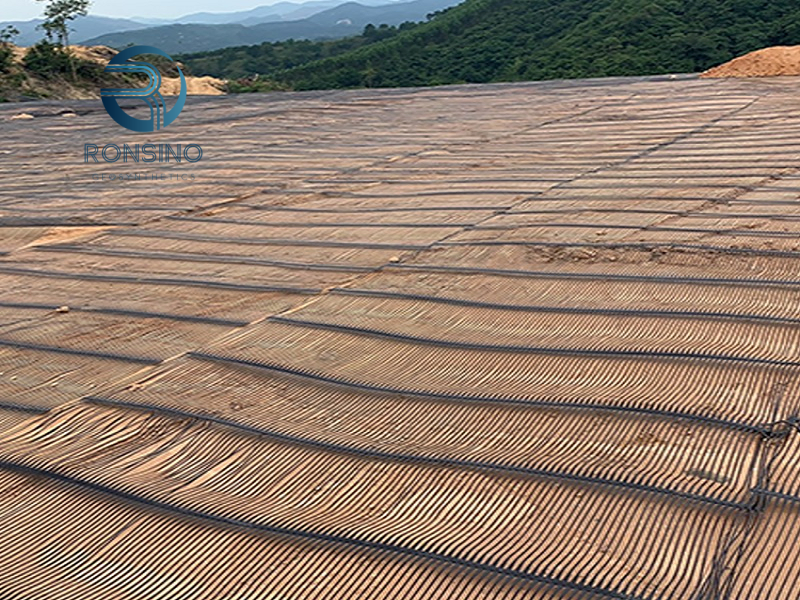
Specifications of HDPE Uniaxial Geogrid for Road Construction in Sweden
Properties – 150kN
Specification – 1.2m×50m
Total quantity – 15,000 square meters
Delivery time – 15 days
About RONSINO
RONSINO manufactures and supplies many types of effective and state of the art geogrid, geomembrane, geotextile, and geosynthetics to over 36 countries. Our main innovative, high quality geogrid products include plastic biaxial geogrid, fiberglass geogrid, plastic uniaxial geogrid, warp knitting polyester geogrid, and steel plastic georgic mesh, etc. RONSINO brand brand high quality geosynthetic products had been certificated by the ISO9001, ISO14001,OHSAS18001 Soncap, SASO and BV, SGS and Intertek, etc.
If you have any questions or inquiries, please fill in and submit the form to contact us.