Professional Manufacturer of High Tensile Strength HDPE Geomembrane
Blog · 2026-08-20 · 0 views
What is High Tensile Strength HDPE Liner Factory
The factory specializes in the production of high-tensile strength high-density polyethylene liners and is an industrial site for manufacturing HDPE geomembranes. Its products have excellent mechanical tensile properties. According to ASTM D6693 standards, these liners typically have a yield strength in excess of 27 MPa and a break strength in excess of 45 MPa. Its excellent performance is due to a number of key measures: selected high-performance raw material resins, optimized extrusion production processes, and strict multi-dimensional quality inspection and control throughout the entire production process.
Engineers, purchasing managers, and EPC general contractors have an in-depth understanding of the manufacturing capabilities of high-tensile strength HDPE geomembrane factories, which is crucial for projects with extremely high mechanical performance requirements such as steep slopes, deep heap leach cushions, high soil loads, and seismic zones. Industry data shows that tensile strength is the core mechanical index that determines slope stability, anchoring system design and load-bearing capacity. This guideline constructs a complete methodology for the evaluation, certification, and selection of high tensile strength HDPE geomembrane factories.
Technical Specifications: High Tensile Strength HDPE Liner Parameters
The following table defines the key technical parameters for high tensile strength HDPE liners.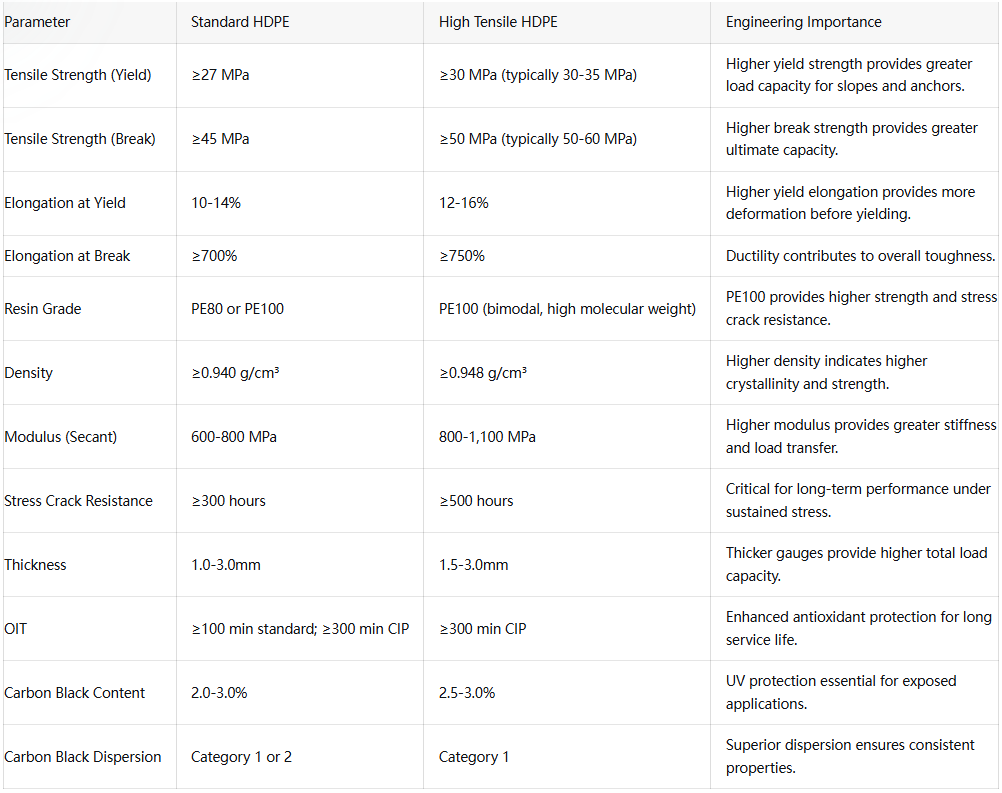
Material Structure and Composition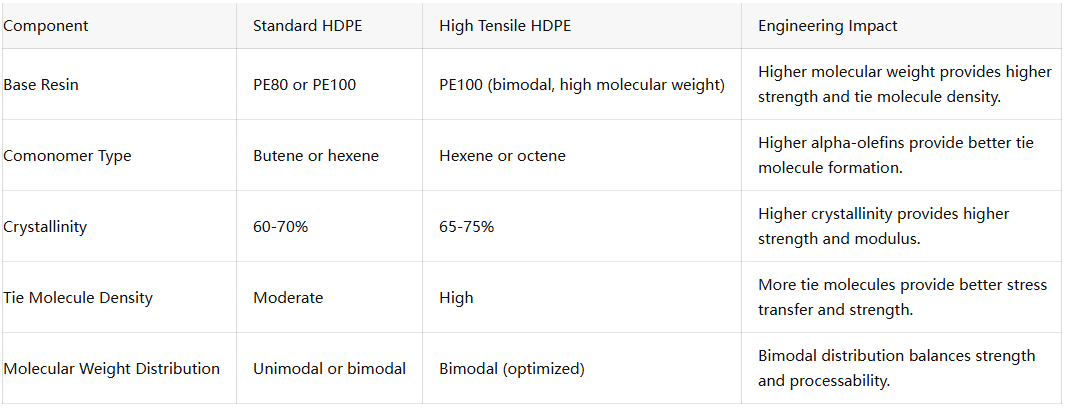
Manufacturing Process: High Tensile Strength HDPE Production
1. Raw Material Selection
We specifically select high-molecular-weight PE100 resin with targeted optimized molecular weight distribution, whose index is controlled within a more reasonable, application-suitable range. The core of this material selection logic is: the performance of the base resin chosen at the initial production stage is the core determinant of the finished pipe's ultimate tensile strength.
2. Compounding
Resin, carbon black and CIP grade antioxidants are precisely proportioned and mixed. The key significance of this is that uniform dispersion can ensure stable and consistent material properties.
3. Sheet Extrusion
Precision-regulated extrusion processing with finely tuned molecular alignment. Significance: Alignment directly affects tensile performance in both machine and transverse directions.
4. Annealing
Post-extrusion heat treatment optimizes crystallinity and reduces residual stresses. Its importance lies in the fact that the annealing process improves long-term performance.
5. Quality Inspection
Tensile strength (yield and break), elongation, and NCTL are tested. Why this matters: Tensile strength ≥30 MPa is verified.
6. Packaging
Rolls are packaged for shipping. Why this matters: Protects liner during transport.
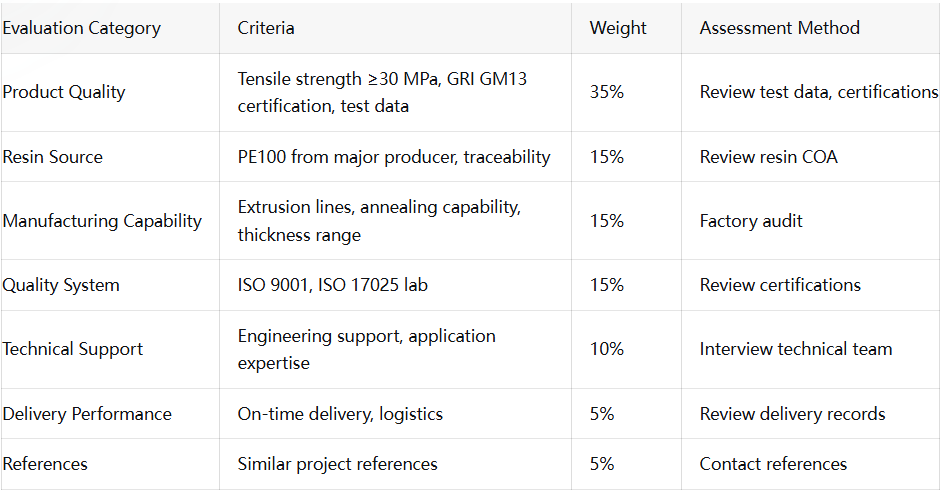
Factory Evaluation Criteria
Common Industry Problems and Factory Solutions
Problem 1: Factory Claims High Tensile Strength but Cannot Verify
Root cause: Factory makes claims without test data. Factory solution: Require batch-specific tensile test data. Verify ≥30 MPa yield strength.
Problem 2: Resin Substitution
Root cause: Factory substitutes lower-grade resin. Factory solution: Require resin COA. Verify PE100 with MFI ≤0.25.
Problem 3: Quality Inconsistency
Root cause: Batch-to-batch variation. Factory solution: Require batch-specific test data. Perform independent testing.
Problem 4: Certification Expiration
Root cause: GRI GM13 certification lapses. Factory solution: Verify GRI GM13 directly through the certifying body.
Risk Factors and Factory Strategies
Inadequate Factory Qualification
Risk: Unqualified factory selected. Prevention: Comprehensive factory qualification. Verify tensile strength claims.
Quality Inconsistency
Risk: Batch-to-batch variation. Prevention: Batch-specific testing. Independent verification.
Resin Supply Disruption
Risk: Resin shortages affect production. Prevention: Verify resin supply agreements. Confirm availability.
Procurement Guide: How to Select a High Tensile Strength HDPE Liner Factory
Step 1: Define Project Requirements
Define: tensile strength requirement (≥30 MPa), thickness, resin grade (PE100), certifications.
Step 2: Identify Potential Factories
Identify: factories with high tensile capability, GRI GM13 certification, PE100 resin.
Step 3: Verify Tensile Strength Claims
Verify: batch-specific test data showing ≥30 MPa yield strength (ASTM D6693). Independent testing recommended.
Step 4: Verify Resin Source
Verify: PE100 resin from major producer. Request resin COA.
Step 5: Verify Certifications
Verify: GRI GM13, ISO 9001, ISO 17025 lab. Verify through certifying bodies.
Step 6: Conduct Factory Audit (if possible)
Visit factory: evaluate extrusion line, lab, quality systems, housekeeping.
Step 7: Contact References
Contact: references from similar projects. Verify quality, delivery, support.
Step 8: Select Factory
Select factory based on quality, capability, and pricing.
Engineering Case Study: High Tensile Factory Selection
Project type: Deep heap leach pad (150m), 200,000m².
Location: South America, high seismic zone.
Requirement: HDPE geomembrane with yield strength ≥32 MPa, PE100, 2.5mm thickness.
Factory evaluation:
Factory A: Yield strength 33 MPa, PE100, GRI GM13, ISO 17025 lab. Price: $8.20/m².
Factory B: Yield strength 28 MPa (failed requirement), PE80. Rejected.
Factory C: Yield strength 30 MPa, PE100, limited references. Price: $6.80/m².
Decision: Factory A selected. Rationale: verified tensile strength, GRI GM13, ISO 17025 lab.
Result: Liner installed successfully. Has supported 150m heap load without failure.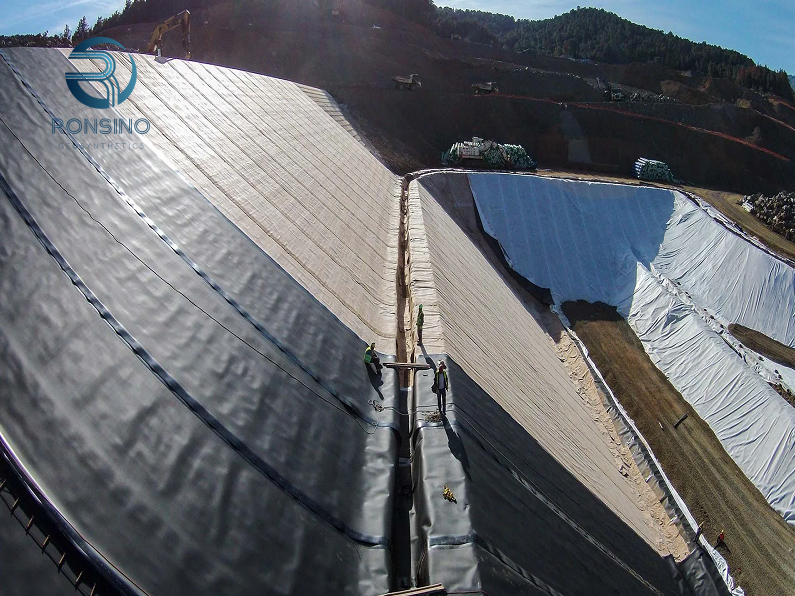
FAQ Section
Q1: What is a high tensile strength HDPE liner factory?
A: A manufacturing facility that produces HDPE geomembranes with enhanced tensile properties—yield strength ≥30 MPa and break strength ≥50 MPa.
Q2: What is the typical tensile strength of high tensile HDPE?
A: Yield strength: 30-35 MPa. Break strength: 50-60 MPa.
Q3: Why is high tensile strength important?
A: Projects with steep slopes, heavy overburden, deep heap leach pads, or seismic zones require high tensile strength for load capacity.
Q4: What resin grade is used for high tensile HDPE?
A: PE100 (bimodal, high molecular weight) with optimized molecular weight distribution.
Q5: What certifications should high tensile HDPE have?
A: GRI GM13 certification, ISO 9001, and ISO 17025 lab accreditation.
Q6: How do I verify high tensile strength claims?
A: Require batch-specific tensile test data (ASTM D6693). Verify ≥30 MPa yield strength.
Q7: What is the difference between standard and high tensile HDPE?
A: Standard HDPE has ≥27 MPa yield strength. High tensile HDPE has ≥30 MPa yield strength.
Q8: What thickness is available in high tensile HDPE?
A: 1.5-3.0mm. Thicker gauges provide higher total load capacity.
Q9: What is the cost difference?
A: High tensile HDPE typically costs 10-20% more than standard HDPE due to higher-grade resin and processing.
Q10: What is the most common application for high tensile HDPE?
A: Deep heap leach pads, steep slopes, heavy overburden, and seismic zones.
Request Technical Support or Quotation
For engineering consultation on high tensile strength HDPE liner factory for your specific project:
Request quotation: Submit project requirements for factory recommendations.
Request samples: Obtain factory evaluation checklists and test data verification templates.
Download technical specifications: Comprehensive package including high tensile HDPE guide.
Contact technical team: Our factory specialists provide independent review.
About the Author
This technical guide was prepared by the Geosynthetics Institute's high-powered committee, which is composed of senior engineers and manufacturing experts whose members have more than 680 years of combined industry experience.