Understanding Geocell Driveway Systems
Blog · 2026-05-08 · 0 views
A driveway is a key element in defining a property's beauty, practicality and ecological impact, not just a driving path. For a long time, owners' choices were largely limited to two traditional materials: the ubiquitous black asphalt or the uniform gray concrete. While both are durable under certain conditions, both have significant drawbacks such as visible cracks, susceptibility to damage from freeze-thaw cycles, insufficient drainage leading to runoff, high recurring repair costs, and significant environmental costs. Other materials, such as gravel or interlocking blocks, have advantages such as permeability or modular design, but they also have problems with shifting, weed growth and unequal settlement.
A transformative solution is emerging from the fields of large-scale civil engineering, military logistics and ecological restoration - geocell driveway technology. Geocells are not only a new material, but also represent a fundamental change in philosophy: from traditional rigid or non-constrained pavement structures to mechanically stabilized, flexible and intelligently responsive systems. By applying the simple yet far-reaching principle of cellular confinement, geocell technology provides a robust, reliable, cost-effective and environmentally friendly solution to the many limitations faced by traditional driveways, thereby redefining the boundaries of possibility for durable, stable and sustainable surface structures.
1. Deconstructing the Technology – What Exactly is a Geocell?
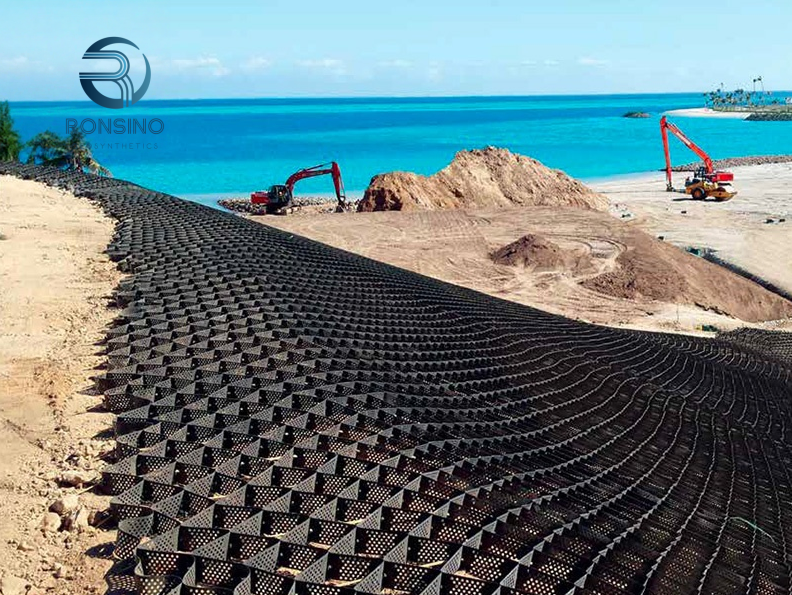
To gain a comprehensive understanding of the advantages offered by a geocell driveway system, it is essential to begin with an examination of its foundational technology. The geocell itself is characterized by its three-dimensional cellular configuration, which closely resembles a honeycomb matrix. This structure is commonly fabricated from robust materials such as high-density polyethylene (HDPE Geocell) or innovative polymer blends designed for exceptional tensile strength and longevity. These specialized polymers are formulated to resist chemical agents, biological decay, and significant fluctuations in temperature while also providing protection against ultraviolet degradation. Such engineering ensures that the system maintains structural integrity over an extended operational lifespan.
Geogrid arrives at the construction site in tightly stacked, interconnected strips. After being unfolded and laid on a treated foundation, it will expand into a flexible structure with a uniform grid while maintaining excellent rigidity. These honeycomb grids are the core of its technology, and their design principle is to achieve a three-dimensional wrapping effect. Each unit acts like a miniature retaining wall, effectively limiting the lateral movement of the fill material – whether soil, sand, gravel or recycled aggregate – when subjected to external pressure.
Confinement serves as the very mechanism that converts loose, unstable materials into a robust, integrated composite structure. Picture a collection of marbles spread loosely across a flat surface; when pressure is applied, they roll away in every direction without resistance. But if those same marbles are placed within an array of rigid, separate cells—forming an interlocking grid—they can no longer shift laterally under load. Instead, force is transmitted vertically and dissipated horizontally through the interconnected framework. This core mechanical principle forms the basis of geocell driveway systems. The result is a reinforced earth mat that functions much like a solid slab, yet retains both the flexibility and drainage capacity characteristic of unbound granular materials.
Geocell driveway installation constitutes a meticulously structured procedure; strict adherence to its steps ensures the system's acclaimed long-term durability. While significantly simpler than the processes involved in pouring concrete or applying asphalt, it nonetheless demands careful execution and precise attention to technical details at every stage.
2.1 Geocell Driveway – Site Excavation and Subgrade Preparation
The first step in construction is to excavate the site to a sufficient depth—usually 8 to 12 inches (approximately 20 to 30 centimeters)—to accommodate the base material and the geocell itself. The original foundation soil (i.e. subgrade soil) is then processed, and its quality is crucial. The roadbed must be accurately leveled to ensure an effective drainage slope (it is generally recommended that the slope be away from the building, with a slope of not less than 2%) and fully compacted. A stable and dense roadbed is an indispensable basic condition for the subsequent construction of all structural layers.
2.2 Geocell Driveway – Geotextile Fabric Placement
Before laying geocells, non-woven geotextiles need to be spread on the compacted roadbed. This material plays the role of isolation and filtration: it can not only prevent the lower fine-grained soil from influxing into the upper layer of aggregate, but also prevent the aggregate from sinking into the soft foundation, thereby eliminating pollution and instability caused by mixing of materials. Its good water permeability ensures smooth drainage and maintains the independence and integrity of each structural layer.
2.3 Geocell Driveway – Geocell Deployment and Anchoring
Subsequently, the geocell panels in the folded state are fully unfolded and laid on the flat base surface. Use J-shaped or U-shaped anchors to firmly fix the cell system to the ground; these anchors effectively prevent the system from shifting during the filling process and ensure that it remains fully extended when subjected to external loads.
2.4 Geocell Driveway – The Infill Process
The Heart of the System:This phase finalizes the driveway's form, establishing its definitive aesthetic and function. The selected material is meticulously applied to the prepared base, locking in the final appearance. A key advantage is the stage's remarkable adaptability to diverse design and practical needs.
For a Granular Driveway:Crushed stone, gravel, or even recycled crushed concrete are excellent choices. The angular nature of crushed materials interlocks well, providing even greater stability.
For a Green” or Grass Driveway: The cellular compartments may be filled with fertile soil and planted with resilient turf or robust ground-covering vegetation. This results in a vibrant, verdant surface that possesses remarkable load-bearing strength—able to withstand the weight of emergency vehicles such as fire trucks without suffering deformation—while harmoniously integrating into the surrounding environment.
Fill should be laid in layers, with each layer moderately compacted to achieve optimal density and eliminate void areas. It is usually possible to slightly overfill the lattice units to account for initial settlement.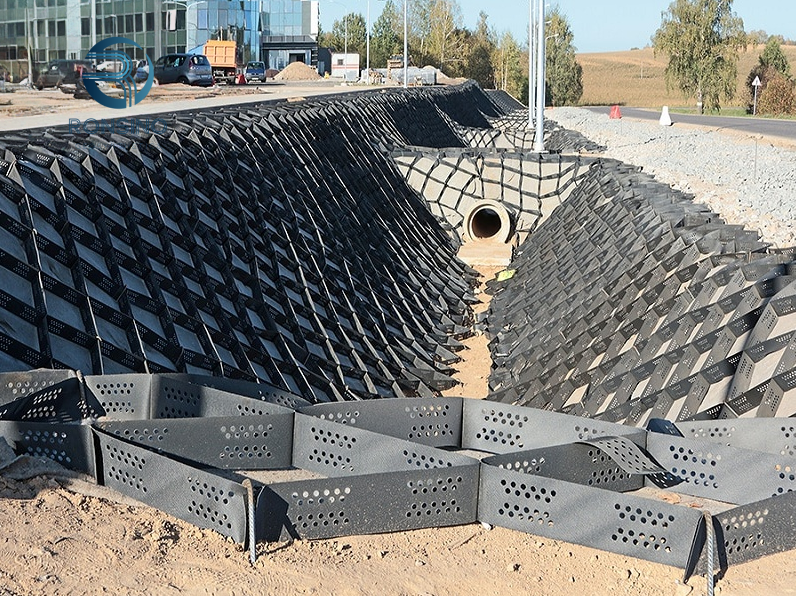
3. Why Choose a Geocell Driveway?
The advantages of implementing a geocell system are comprehensive, offering solutions that span practical application, economic efficiency, and ecological sustainability.
3.1 Geocell Driveway – Superior Durability and Load-Bearing Capacity
Its main advantage is excellent stability. Cellular restraint systems can distribute vertical loads over a wider area than traditional flexible pavements. When a vehicle's tires apply pressure, the force is dissipated laterally through the interconnected honeycomb structure, significantly reducing rutting, deformation and potholes. The system also has excellent resistance to freeze-thaw cycles, and its flexibility can adapt to small movements on the ground without cracking, making it especially suitable for driveways carrying RVs, boats and heavy trucks.
3.2 Geocell Driveway – Exceptional Permeability and Erosion Control
Currently, sustainable management of water resources has attracted much attention, and the grass-planted grid driveway system has received attention due to its significant advantages. Unlike traditional hard paving, which can easily lead to rainwater runoff and surface erosion, the grass grid system has excellent water permeability, allowing rainwater to seep quickly and recharge groundwater. This not only relieves the pressure on the urban rainwater pipe network, but also reduces the risk of soil loss. It also reduces the probability of surface water accumulation and winter freezing, and improves the safety and comfort of driving and walking.
3.3 Geocell Driveway – Significant Cost and Maintenance Efficiency
Cellular restraint systems offer economic advantages both in terms of initial investment and long-term maintenance. Its honeycomb structure can effectively restrain filling materials, reduce the amount of graded aggregate, and reduce material and transportation costs. Construction requires less machinery and labor, further saving initial investment. Long-term maintenance is simple, requiring only regular raking of the surface and a small amount of aggregate added over several years. In comparison, asphalt requires sealing, concrete repairs are expensive, and unreinforced gravel requires frequent leveling. The cellular system is outstanding in terms of economy and convenience.
3.4 Geocell Driveway – Environmental Sustainability
Geocell permeable driveway is a sustainable landscaping solution. Its permeable structure promotes rainwater infiltration, recharges groundwater, reduces the demand for high-carbon-consuming building materials, and reduces embodied carbon. The use of locally recycled aggregate infill can further enhance environmental benefits. When used as a surface reinforcement with grass, it can turn hardened areas into green spaces, with the functions of sequestering carbon and releasing oxygen, alleviating the heat island effect and promoting biodiversity.
3.5 Geocell Driveway – Unmatched Versatility and Aesthetics
Geocells empower homeowners to transcend the conventional aesthetic boundaries of paving materials. The selection of infill enables complete customization of the driveway, allowing it to harmonize with any architectural theme or garden design. For instance, crushed granite delivers a crisp, modern appearance; river rock imparts a gentler, organic aesthetic; while grass infill transforms the surface into an attractive, permeable green channel that actively contributes to the property's ecological health.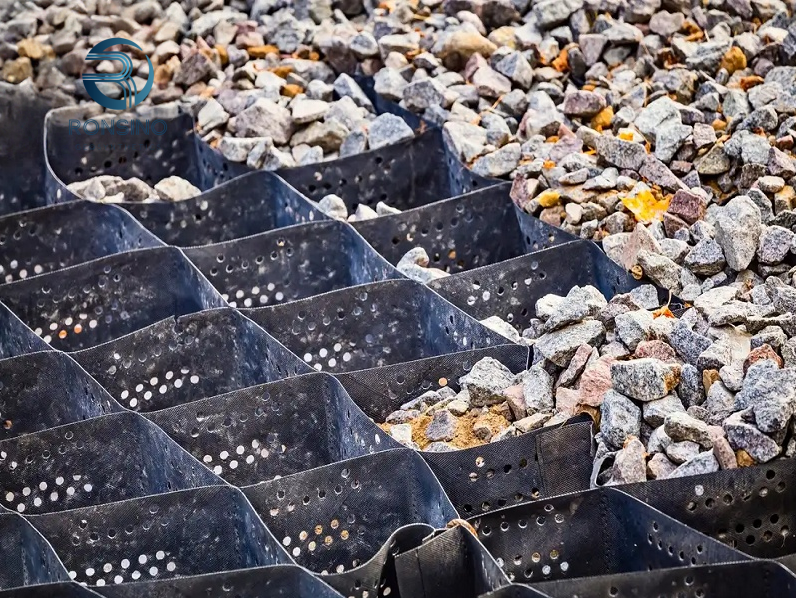
4. Considerations and Long-Term Outlook
Although the advantages are significant, the following factors need to be considered: First, there is insufficient awareness. Many owners and contractors prefer traditional methods because they are unfamiliar with them, so they need to choose professional installers. Second, although the gravel-filled geocell driveway is stable in load-bearing, it does not feel as good as concrete pavement during activities such as basketball and cycling. Its charm lies in the practical characteristics of natural texture.
In the coming years, the geocell driveway system is anticipated to emerge as a widely adopted alternative. With the escalating need for eco-conscious, durable, and budget-friendly paving methods, this innovation presents a well-documented and sophisticated resolution. It embodies an optimal integration of advanced engineering principles and sustainable ecological practices.
5. Conclusion: A Paradigm Shift in Pavement
Geocell paving technology breaks through the limitations of traditional materials and is both strong and flexible, environmentally friendly and highly functional. It abandons the binary choice of asphalt-concrete and achieves structural integrity and sustainable water management through soil reinforcement and permeable design. This technology is the best solution for modern owners to pursue durability, economy, beauty and environmental protection, and represents the development direction of intelligent and adaptable cellular systems for residential pavements in the future. Consult RONSINO for details.