What is the Best Underlayment for a Gravel Driveway?
Blog · 2026-05-29 · 0 views
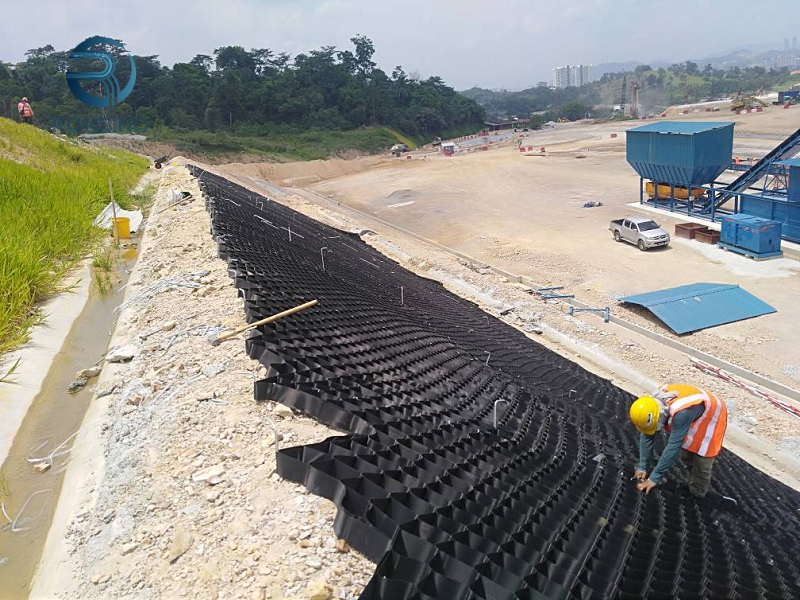
In contemporary transportation networks driveways serve as a foundational element within broader roadway systems Regardless whether traversing remote country paths gated communities industrial zones or temporary construction sites robustness under pressure defines both operational security driving comfort With rising expectations regarding subgrade integrity alongside environmentally responsible building practices conventional pavement designs increasingly fall short Consequently geocell reinforcement tailored specifically for driveways has surfaced providing highperformance sustainable stabilization winning approval among architectural planners builders alike
Confronted marketplace overflowing diverse geosynthetic offerings purchasing agents technical personnel must identify optimal solutions fitting specific project requirements This piece delivers exhaustive multifaceted insights enabling stakeholders execute sound selections while preventing expensive miscalculations
1. What Is Geocell and Why Is It Suitable for Driveways?
A three-dimensional geosynthetic product known as the geocell features an architecture that closely resembles the intricate pattern found in natural beehives; these systems are predominantly fabricated using durable strips welded together from robust polymers such as high-density polyethylene. Upon deployment at the construction site this flexible material undergoes significant expansion stretching out into an interconnected matrix or grid which subsequently gets compactly infilled with various earthen aggregates including concrete sand loose dirt crushed stone and other particulate matter; this specific filling methodology serves crucial engineering functions by significantly boosting load distribution improving structural integrity providing superior vertical reinforcement restricting unwanted horizontal movement and offering robust protection against surface scouring and erosive forces.
Why is Geocell suitable for driveway?
Increased Load-Bearing Capacity: Through its unique three-dimensional configuration, this system effectively confines the aggregate material within it to prevent any sideways displacement; by doing so, it ensures that traffic forces are spread uniformly across a wider area, which significantly enhances the overall load-bearing capacity and stability of the underlying ground.
Minimized Rutting and Settlement: Unlike traditional gravel pavements, Geocell helps reduce uneven settlement and rutting caused by water or heavy traffic.
Adaptability to Various Soil Conditions: Effective on soft soils, sandy ground, mountainous terrains, and more.
Quick Installation & Reusability: Ideal for temporary access roads; can be dismantled and reused.
Eco-Friendly: Manufactured from recyclable polymer materials, enabling green and compliant construction.
High Performance Geocell for Driveway
Custom Size HDPE Geocell for Civil Construction
2.1 Geocell for Driveway – Subgrade Soil Conditions
Unstable foundations require heavy-duty cellular confinement systems to prevent failure, while stable bases suffice with standard-grade solutions.
Recommendation: For soft soils, choose HDPE Geocells with a thickness ≥1.5mm and weld peel strength ≥14N.
2.2 Geocell for Driveway – Load Class and Traffic Type
Light-Duty Driveways: Used by pedestrians, bicycles, or small vehicles. Low strength requirements.
Medium-Duty Driveways: Residential areas or industrial transport lanes. Require moderate to high strength.
Heavy-Duty Driveways: Construction sites, mining roads, military routes. Require thick Geocells and gravel infill.
Driveway Type Recommended Cell Height Recommended Thickness Weld Strength
Light 50mm 1.0mm ≥10N
Medium 75mm 1.2mm ≥12N
Heavy 100–150mm 1.5–1.8mm ≥14N
2.3 Geocell for Driveway – Availability of Fill Materials
Geocells are compatible with various infill materials:
Compacted soil
Crushed stone
Sand/gravel
Recycled aggregates
In establishing proper dimensional requirements for geosynthetic units engineers must carefully analyze specific properties of available filling media including gradation curves; notably angular cobble typically performs best within structures possessing minimum depths approaching or exceeding one hundred millimeters ensuring sufficient interlock while delivering requisite bearing capacity integrity
2.4 Geocell for Driveway – Slope and Drainage Conditions
For sloped driveways or rainy regions, choose Geocells with enhanced erosion resistance, supplemented with nonwoven fabric and proper drainage layers.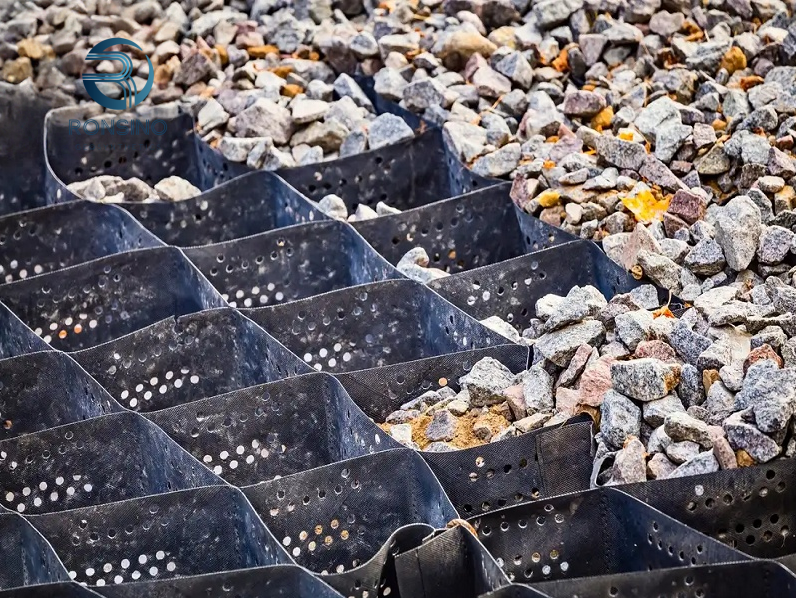
3.Key Selection Criteria for Geocell for Driveway
3.1 Geocell for Driveway – Material Type
The Geocell material determines its durability and application scope. Common options:
HDPE (High-Density Polyethylene): UV-resistant and corrosion-proof. Ideal for outdoor, long-term applications.
PP (Polypropylene): Excellent flexibility. Suitable for regions with large temperature variations.
PET (Polyester): High tensile strength. Suitable for heavy-load environments.
Recommendation: Use HDPE for residential driveways; opt for PET or reinforced HDPE for industrial/heavy-duty use.
3.2 Geocell for Driveway – Cell Height and Size
Height: Typically ranges from 50mm to 300mm. Taller cells provide better load distribution but increase cost.
Cell Dimensions: Smaller cells (e.g., 200mm x 200mm) suit fine aggregates; larger cells (e.g., 400mm x 400mm) for coarse materials.
Recommendation:
Use 100–150mm height for light-duty driveways.
Use 200mm+ for heavy-duty applications.
Smaller cells offer better confinement and are ideal for heavy traffic.
3.3 Geocell for Driveway – Weld Peel Strength
A measure of connection stability. For high-traffic or construction scenarios, use Geocells with weld peel strength ≥14N.
3.4 Geocell for Driveway – Environmental Compatibility
Consider local climate conditions:
Cold Regions: Use low-temperature-resistant materials (e.g., PP).
Hot Regions: Use UV-resistant HDPE.
High-Humidity or Chemically Aggressive Areas: Use coated or anti-corrosive Geocell types.
3.5 Geocell for Driveway – Infill Compatibility
Geocells must match the chosen fill type:
Crushed Stone: Offers excellent drainage; widely applicable.
Concrete: Used for high-strength demands; more expensive.
4.Installation Steps for Geocell Driveways
4.1 Site Preparation
Clear debris and remove weak soil.
Compact the base and ensure level grading.
4.2 Geocell Deployment
Expand and anchor cells using stakes.
Connect adjacent cells with specialized clips.
4.3 Infill Placement
Fill in layers and compact each to the design level.
Avoid over-compaction that may deform the cells.
4.4 Surface Finishing
Apply asphalt or concrete if needed.
For temporary roads, compacted gravel is sufficient.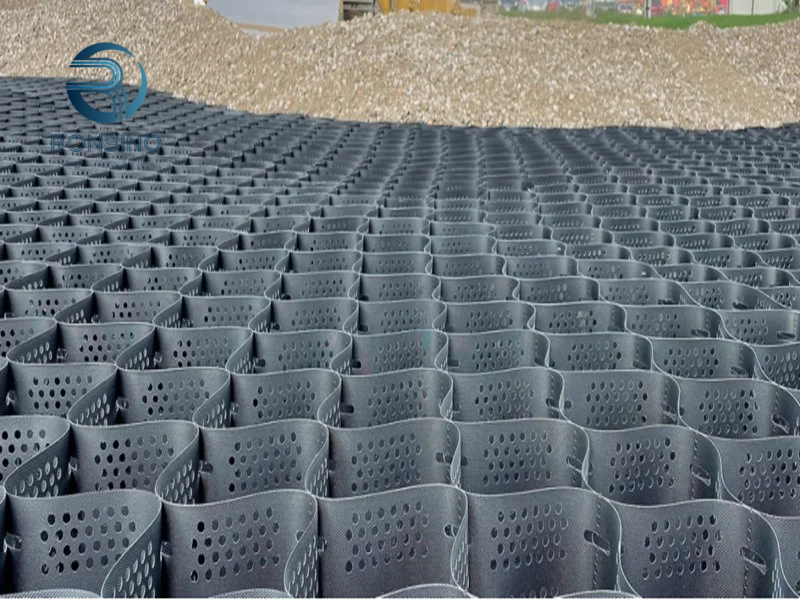
5.Common Issues and Solutions
When improperly installed or mismatched with the application, Geocells may cause performance problems. Below are typical issues and practical remedies.
5.1 Cell Deformation or Displacement
Symptoms: Misaligned boundaries, bulging or shifting.
Causes:
Poor layer-wise compaction.
Insufficient anchor points or depth.
No physical restraint during installation.
Solutions:
Increase anchor density; compact each layer before adding the next.
Use staggered layout and pre-tensioning.
Add perimeter reinforcement or curbs.
5.2 Infill Material Loss
Symptoms: Fine materials wash away, causing voids or loose structure.
Causes:
Cell size too large for fine particles.
Permeable subgrade without a geotextile layer.
No drainage system, leading to water erosion.
Solutions:
Match cell size to fill particle size (e.g., 330mm for fine aggregates).
Use nonwoven geotextile as a separation layer.
Install drainage ditches or French drains.
5.3 Long-Term Settlement
Symptoms: Mid-lane or edge depressions, rutting.
Causes:Inadequate base compaction.Improper fill moisture content.Poor load dispersion by cell structure.
Solutions:Conduct geotechnical tests pre-construction.Use gravel base + Geocell reinforcement on soft ground.Choose high-strength HDPE Geocells (weld strength ≥14N).Monitor and refill if settlement is detected early.
5.4 Cell Tearing or Rupture
Symptoms: Cell failure under extreme conditions.
Causes:Use of recycled materials with poor properties.Weak weld seams.Thin walls with low pressure resistance.
Solutions:Use virgin HDPE with CE/ISO certification.For heavy loads, use ≥1.5mm thick cells, weld strength ≥14N.For hot climates, choose UV-stabilized products.Control equipment load during compaction.